

A finer creatine powder can look more refined, disperse more readily in some applications and reduce the gritty sensation consumers often associate with standard creatine.
Unfortunately, the consumer is not the first person who has to handle it.
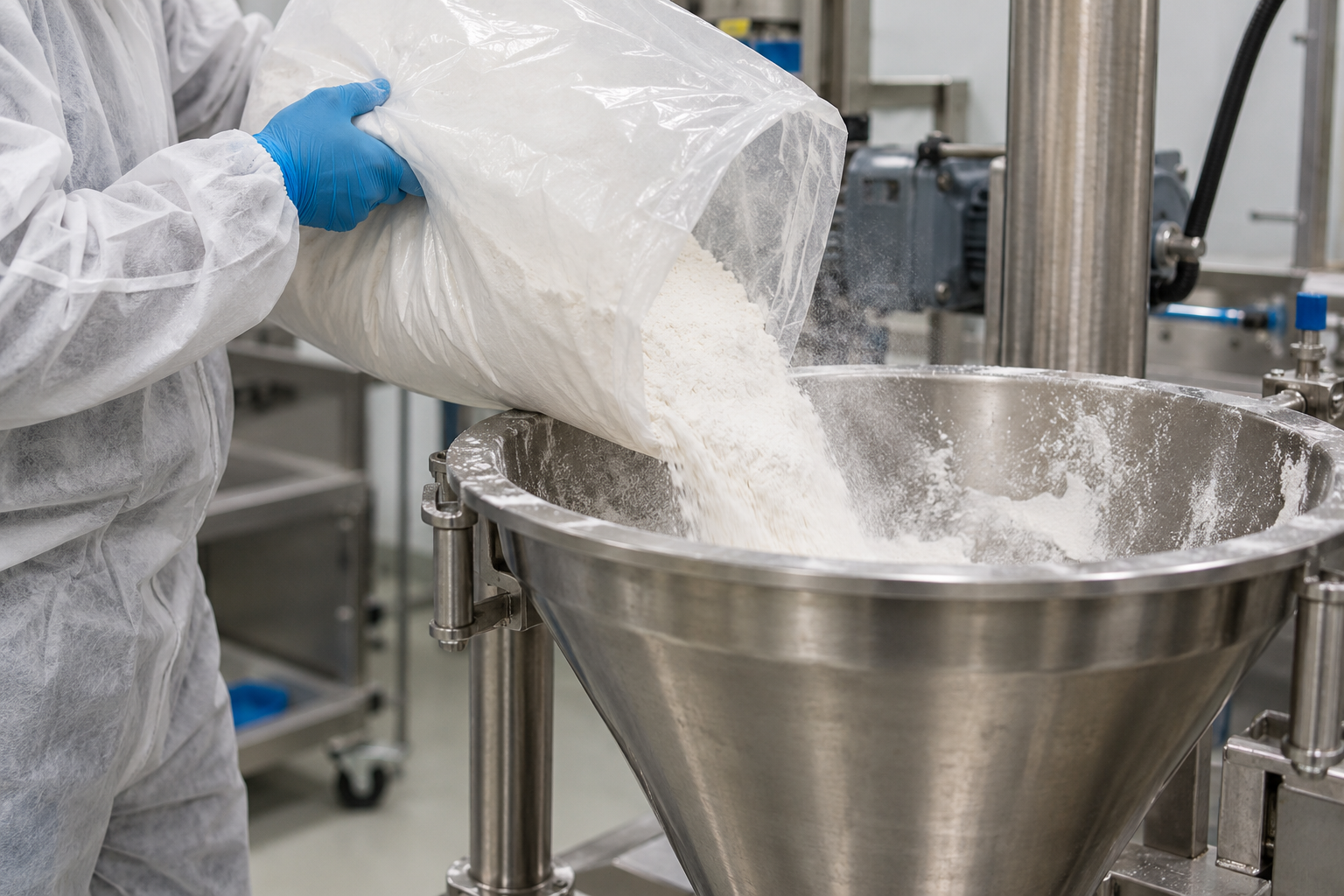
Before 500-mesh creatine reaches a shaker, stick pack or pouch, it must leave its liner, enter a hopper, move through equipment and reach the finished package. At each transfer point, very fine powder may become airborne, adhere to surfaces or remain trapped in the packaging.
The relevant question is not whether 500 mesh is “better.” It is whether its consumer-facing advantages survive the production line without creating avoidable loss.
Why Fine Powder Can Behave Differently
Reducing particle size increases surface area relative to particle mass. As particles become finer, surface forces can become more influential than gravity, increasing cohesion between particles and adhesion to equipment surfaces.
This can affect:
- [•] discharge from the original liner;
- [•] flow into a hopper;
- [•] powder remaining on transfer surfaces;
- [•] dust released during open handling;
- [•] filling consistency and cleanup time.
Research across powder-processing applications shows that greater cohesion can reduce flow consistency. However, behaviour cannot be predicted from particle size alone. Shape, moisture, electrostatic conditions, particle-size distribution and equipment design also matter. sciencedirect.com
A “500-mesh” label is therefore only a screening description. It does not establish one universal Dv(10), Dv(50), Dv(90), dustiness or flow profile.
The Cost Is Not Only Powder on the Floor
Visible spillage is easy to notice. Less visible losses may be commercially more important.
Fine powder can remain inside liners, coat hopper walls, collect around seals or be removed by dust-extraction systems. Additional material may be lost during equipment startup, sampling and cleaning.
Individually, these quantities may appear small. Across repeated production runs, they can affect:
The powder captured by an extraction system has not necessarily disappeared, but it may no longer be suitable for returning to the product. Recovery decisions must follow the manufacturer’s approved hygiene and quality procedures.
Does 500 Mesh Automatically Create More Dust?
No. A finer grade may have greater dust potential, but actual airborne release depends heavily on how the material is handled.
NIOSH notes that powder dustiness is influenced by the material, handling energy and test conditions. Pouring from height, rapid bag emptying or using open transfer points may produce a different result from controlled or enclosed transfer.
The same creatine grade can therefore behave differently on two production lines.
A comparison should document:
- transfer height and speed
- bag-opening method
- hopper geometry
- local extraction
- room humidity
- batch size
- time allowed for powder to settle
- visible residue and collected dust
“Low dust” should not be claimed solely because the powder flowed acceptably during a small laboratory test.
Use a Mass Balance, Not an Impression
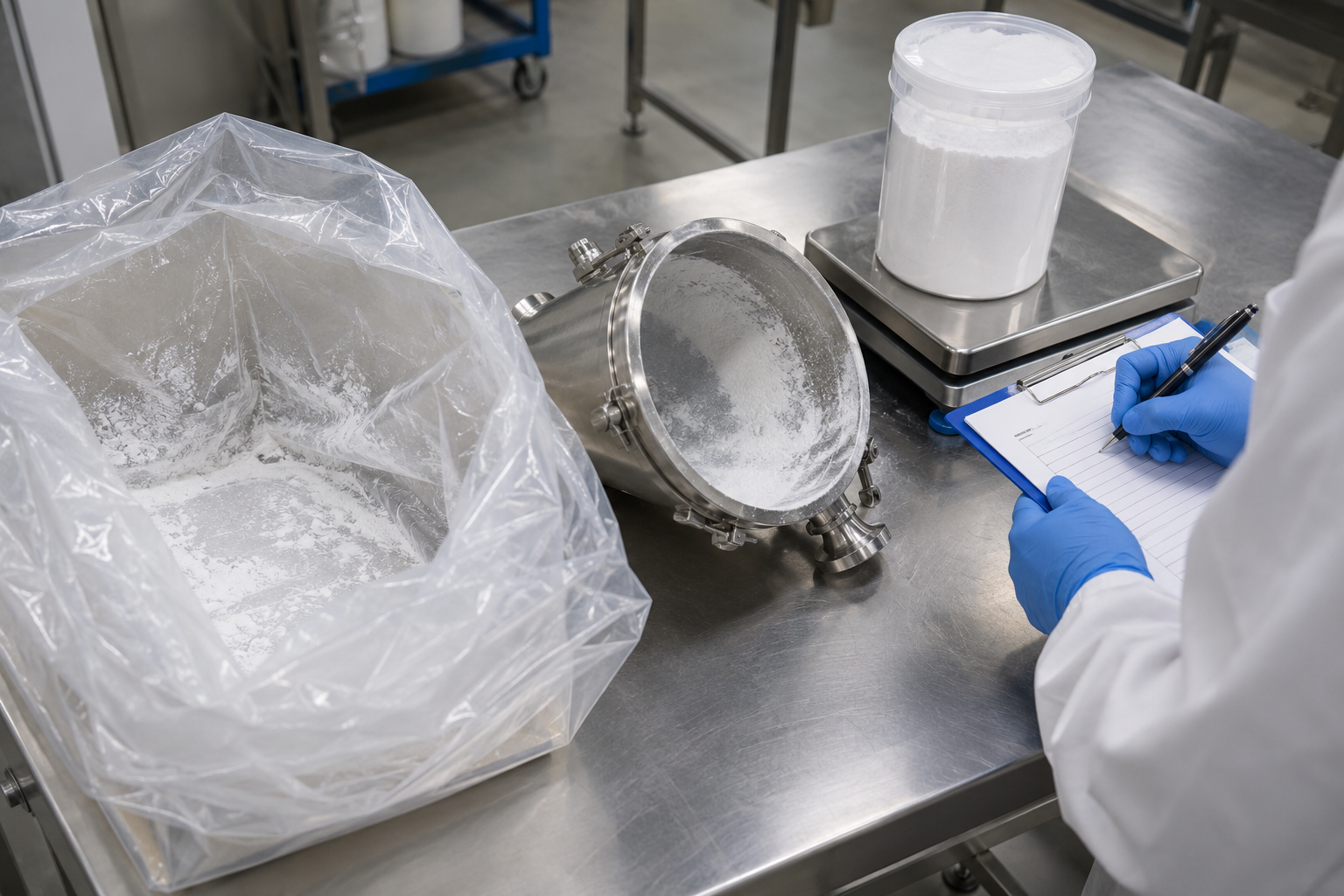
A pilot run should record the starting quantity and account for finished product, retained samples, rejected units, recoverable material and identifiable process residue.
Process recovery (%) = accounted usable output ÷ material introduced × 100
The purpose is not to force every gram into the finished product. It is to identify where material is being lost and whether the loss is acceptable for the proposed process.
Run the trial with the intended commercial grade, packaging, batch size and filling equipment. Comparing 200-mesh and 500-mesh creatine under equivalent conditions can reveal whether the finer grade materially changes transfer time, residue, dust collection or filling performance.
Dust Control Is Also a Facility Question
Powder handling affects more than yield. Airborne material can increase housekeeping requirements and create cross-contamination or occupational-hygiene concerns.
FDA food CGMP guidance calls for suitable ventilation or control equipment where dust could contaminate food, food-contact surfaces or packaging. NIOSH likewise identifies partial enclosures, ventilated booths and closed transfer as possible engineering controls in powder-handling operations. fda.gov
These sources establish general control principles. They do not prove that a particular creatine batch presents a defined inhalation or combustible-dust hazard. Facility-specific assessment remains necessary.
When Does 500-Mesh Creatine Still Make Sense?
The finer grade may remain commercially attractive for products competing on powder appearance, mouthfeel or preparation experience.
The objective is not to eliminate every processing difference. It is to determine whether the differences can be managed through:
- shorter or enclosed transfer;
- controlled feeding speed;
- suitable hopper and filling settings;
- appropriate extraction;
- realistic yield allowances;
- validated cleaning procedures.
A premium sensory experience is valuable only when the factory can reproduce it economically.
Evaluate 500-Mesh Creatine With SRS
SRS Nutrition Express can provide representative 500-mesh creatine monohydrate samples, grade specifications, lot COAs and available particle-size and density information for comparative production trials.
Share your dosage format, batch size, transfer method, filling equipment and current creatine grade.
Evidence Boundaries
- A 500-mesh designation does not define one universal PSD, dustiness or flow profile.
- Fine powder does not automatically produce unacceptable manufacturing loss.
- Powder-processing research supports general principles but does not establish a guaranteed loss rate for creatine.
- Mesh size alone cannot determine occupational or combustible-dust risk.
- Commercial suitability must be confirmed using the intended grade, formulation, equipment and process.
Recommended Reading
- Creatine Mesh Size vs Particle Size Distribution
- Can a Finer Creatine Powder Make a Premium Product Look Less Premium?
- Your 500-Mesh Creatine Sample Passed
References
- Shah DS, et al. Heliyon. 2023;9(6):e16498.
- Jones-Salkey O, et al. Pharmaceutics. 2023;15(6):1637.
- NIOSH. Quantification of Airborne Dusts From Powders.
- U.S. FDA. Current Good Manufacturing Practice (CGMP).
- NIOSH. Best Practices: Engineering Controls.
Post time: Oct-30-2026


