

H1: Creatine for Endurance Athletes: Where Power Meets Stamina
Creatine monohydrate is widely associated with strength, muscle and resistance training. Research is now expanding its relevance into endurance and mixed-sport nutrition.
A 2026 scoping review examined 38 randomized controlled trials involving cycling, swimming, running, rowing, kayaking and intermittent team sports. The strongest performance signals appeared in activities combining aerobic endurance with repeated accelerations, high-power intervals, short recovery periods or sprint finishes.
This reflects the demands of real competition. Cyclists attack and climb. Runners respond to changes in pace. Swimmers repeat intense intervals. Team-sport athletes sprint, recover and accelerate again.
H2: Why Creatine Matters Beyond Strength Training
During brief, intense movement, muscles require ATP faster than aerobic metabolism alone can provide it. The phosphocreatine system helps regenerate ATP rapidly, supporting power during sprints, accelerations and repeated high-intensity efforts.
Creatine supplementation can increase intramuscular creatine and phosphocreatine availability. This gives creatine a practical role in sports where endurance provides the foundation but high-power actions can influence positioning, tactical response and the final result.
Rather than viewing creatine only as a gym ingredient, brands can position it around the high-intensity components found within endurance and mixed sports.
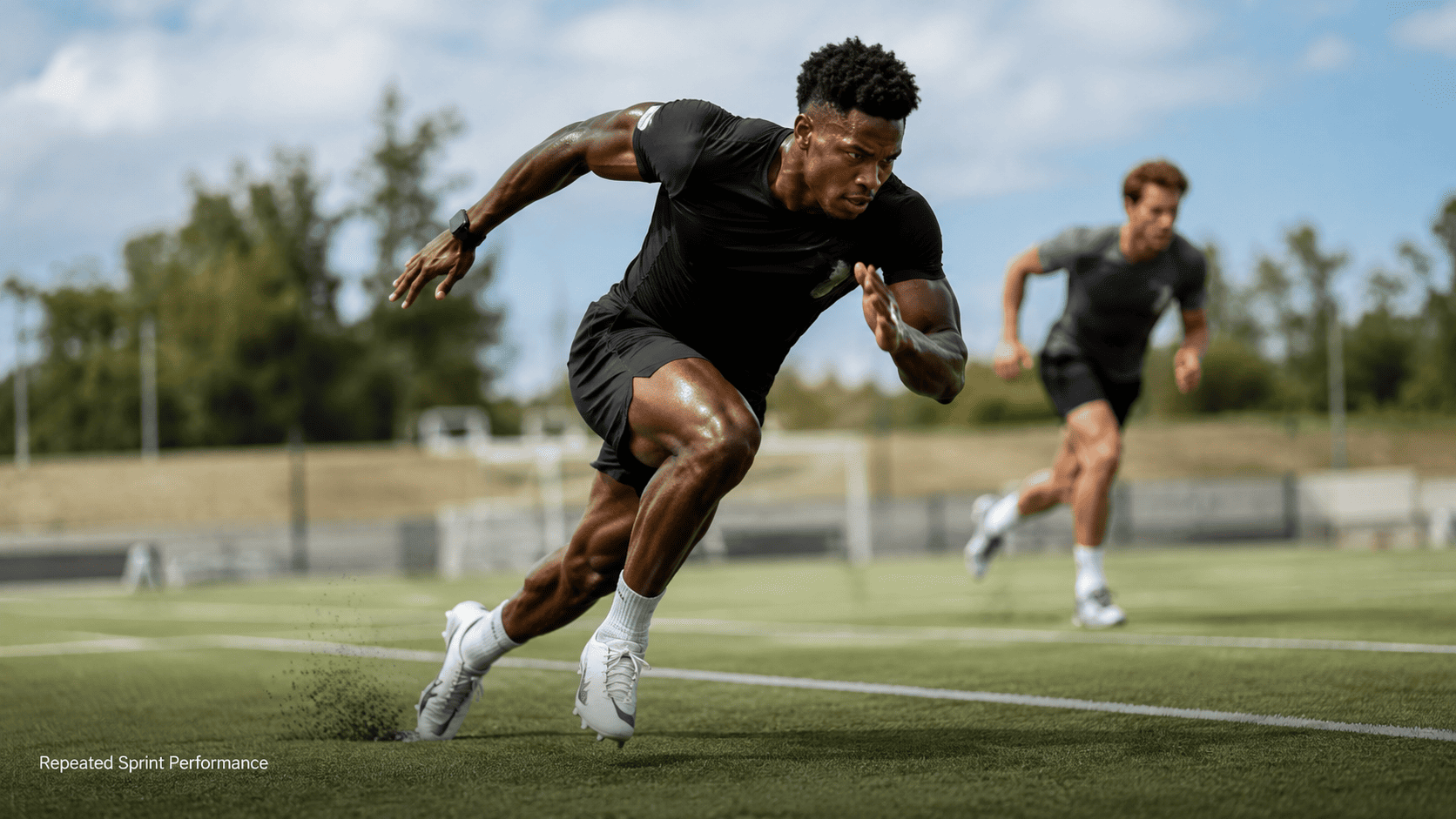
H2: Creatine for Repeated Sprint Performance: What 38 Trials Found
The review included nine swimming studies, seven cycling studies and five studies involving rowing, canoeing or kayaking. Other trials examined runners, triathletes, soccer players, basketball players, hockey players and racket-sport athletes.
Several individual studies reported favorable changes in repeated-sprint and power-endurance performance.
In cyclists, one trial found that creatine loading increased sprint peak power by 8.2% and sprint mean power by 9.29% compared with placebo.
In trained soccer players, average, maximum and minimum repeated-sprint power were 15.1%, 18.8% and 26.1% higher, respectively, than placebo.
Among elite kayak paddlers, total work was 16.2% higher during a 90-second test and 6.63% higher during a 300-second test.
These figures came from individual trials rather than one pooled result. Even so, they reveal a consistent application pattern: creatine appears particularly relevant when athletes must repeatedly generate high power within a longer endurance or mixed-sport activity.

H2: Creatine for Cyclists, Runners and Team Sports
For cyclists, creatine may support the demands of sprint finishes, repeated attacks, climbing surges and high-intensity interval sessions.
For runners, the most relevant opportunities include interval training, repeated changes in pace, hill sessions and races requiring a strong finishing effort.
Creatine for team sports may have an even clearer application. Soccer, basketball, hockey and racket sports repeatedly combine sustained movement with acceleration, rapid changes of direction and limited recovery.
Swimming, rowing and kayaking also combine prolonged effort with powerful starts, turns, interval work and high-output finishes.
These applications provide a credible route beyond traditional bodybuilding and strength products. They also create opportunities for products designed specifically as creatine for mixed-sport athletes rather than using one broad message for every endurance activity.
H2: Creatine Monohydrate for Sports Nutrition: Dosing and Product Opportunities
Approximately 27 of the 38 trials used a loading protocol of around 20 g per day for five to seven days. Some studies then continued with a maintenance dose of 2–5 g per day.
These protocols suggest several practical formulation directions:
creatine electrolyte powder formats;
single-serving stick packs;
pre-training and interval-training formulas;
creatine-carbohydrate blends;
capsules or tablets for daily maintenance;
products designed for hybrid and mixed-sport athletes.
Short-term loading was often associated with a 0.6%–2.5% increase in body mass, influenced partly by intracellular water and glycogen-associated fluid.
For product developers, this supports sport-specific serving strategies. A distance runner, sprint cyclist and soccer player may require different dosing approaches, product formats and communication.
The research does not prove that one finished-product format is superior. Instead, it provides an evidence-based starting point for matching the dose and delivery format to the demands of the sport.
H2: Could Creatine Also Support Recovery?
Selected trials reported favorable changes in inflammatory markers after demanding exercise.
In trained soccer players, one study reported 32.5% lower C-reactive protein and 23.8% lower TNF-α compared with placebo. Another trial conducted after a 30-kilometre race reported lower PGE2 and TNF-α concentrations in the creatine group.
Results for creatine kinase and other indirect muscle-damage markers were less consistent. These findings make recovery an interesting area for further research, but they do not support a universal recovery claim.
For brands, this distinction matters. Product communication should remain linked to the sports, doses and outcomes that were actually studied.
H2: Why Ingredient Quality Still Matters
Clinical research evaluates creatine monohydrate as an ingredient category. It does not automatically verify every commercial batch.
For sports-nutrition manufacturers, ingredient evaluation should also include:
creatine assay;
creatinine, DCD and DHT controls;
heavy-metal and microbiological specifications;
particle size and dispersibility;
bulk density and processing performance;
batch traceability and supply consistency.
These factors can influence processing efficiency and finished-product quality in drink powders, electrolyte blends, tablets and capsules.
For example, particle size may affect dispersibility, while bulk density can influence filling and packaging performance. Batch-specific quality documentation helps manufacturers translate research on creatine monohydrate into a consistent commercial product.
H2: What This Means for Sports-Nutrition Brands
Evidence from 38 randomized trials suggests that creatine monohydrate has meaningful applications beyond traditional strength training.
Its strongest opportunities appear in endurance and mixed sports requiring repeated sprints, rapid accelerations, high-power intervals or strong finishing efforts.
For brands, this creates a research-supported pathway into cycling, swimming, running intervals, rowing, kayaking, team sports and hybrid training products.
The opportunity is not simply to place the words “creatine for endurance” on a label. It is to develop a dose, product format and quality profile that match the actual demands of the athlete.
Ingredient quality, formulation suitability and batch-level documentation remain essential when translating research evidence into commercial sports-nutrition products.
H2: References
Wesołowski I, Dzienisiewicz J, Langa D, et al. Creatine Supplementation in Endurance and Mixed-Sport Contexts: A Scoping Review of Performance, Recovery, and Body Composition. Nutrients. 2026;18(11):1677. doi: 10.3390/nu18111677.
Fernández-Landa J, et al. Effects of Creatine Monohydrate on Endurance Performance in a Trained Population: A Systematic Review and Meta-Analysis. Sports Medicine. 2023;53:1017–1027. doi: 10.1007/s40279-023-01823-2.
Forbes SC, et al. Creatine Supplementation and Endurance Performance: Surges and Sprints to Win the Race. Journal of the International Society of Sports Nutrition. 2023;20:2204071.
Kreider RB, et al. International Society of Sports Nutrition Position Stand: Safety and Efficacy of Creatine Supplementation in Exercise, Sport, and Medicine. JISSN. 2017;14:18. doi: 10.1186/s12970-017-0173-z.
Post time: Jul-23-2026


