

Supplier A reports a creatine monohydrate bulk density of 550 g/L. Supplier B reports 500 g/L. Is Supplier A’s material actually denser?
Not necessarily.
Bulk density can affect filling, tableting, packaging volume and powder handling. But two numbers are only comparable when the test procedures and reporting conditions match. This matters when buyers set specifications, approve suppliers or investigate differences between a supplier COA and incoming QC.
Bulk Density Depends on Particle Packing
Bulk density is the mass of a powder divided by the bulk volume it occupies, including the spaces between particles. It is different from the true density of the creatine crystals.
The result therefore depends partly on how particles are arranged in the measuring vessel. USP General Chapter 〈616〉 provides harmonized procedures for measuring untapped and tapped bulk density.
A specification stating only:
does not fully identify the measurement. Buyers still need to know whether it is untapped or tapped and which procedure was used.
Untapped and Tapped Density Are Different Results
Untapped bulk density is measured before intentional mechanical compaction. Tapped density is obtained after a defined tapping procedure allows the powder bed to settle. Tapped density will normally be higher because the same mass occupies less volume after settling.
Harmonized procedures include different tapping methods. Buyers should identify the specific procedure rather than recording only “USP 〈616〉” or “Ph. Eur. 2.9.34.”
In practical terms, 500 g/L untapped density and 500 g/L tapped density are not equivalent specifications.
Why Can Results Differ?

Bulk-density testing looks simple, but results can be influenced by:
- the selected procedure;
- sample mass and measuring vessel;
- how powder enters the vessel;
- unintended tapping or vibration;
- sample handling and moisture condition;
- particle-size distribution and morphology.
A difference between supplier and incoming-QC results does not automatically prove that the material has changed or failed specification. Both parties should first compare the procedures, units and sample preparation.
These principles come from standardized powder-characterization methods and general powder science. They explain why testing conditions must be aligned, but they do not establish one universal bulk-density range for every creatine monohydrate grade.
What Happens During Transport?
Powder may settle inside a bag or drum during pallet handling, trucking and sea freight. Package settling, however, is not itself an untapped bulk-density test. The reportable result should still come from a representative sample tested under the agreed procedure. Buyers should not apply a fixed “transport correction”; retesting under aligned conditions is more useful than attributing a difference to transport alone.
How Should Density Appear in a Specification?
A useful purchasing specification identifies:
For example:
Untapped bulk density: 0.48–0.58 g/mL, tested using the agreed procedure based on USP 〈616〉, Method X.
This example illustrates specification structure; it is not a recommended range for all creatine products.
Whether to use a minimum or a range should depend on the application and supporting batch data. An unnecessarily narrow limit can create disputes without improving performance. The specification should support the intended process—not simply demand the highest available density.
A Practical Incoming-QC Comparison
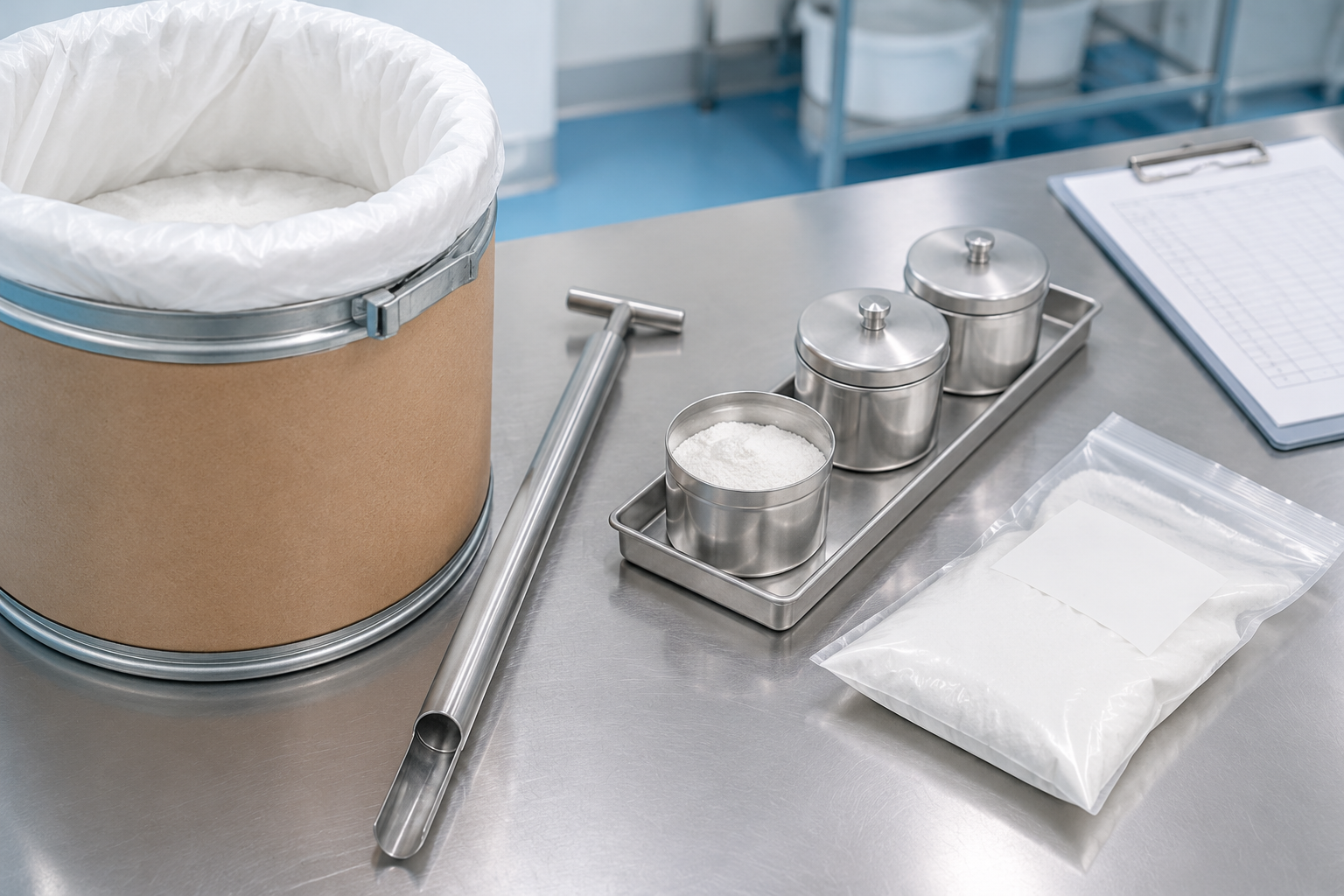
When density is a critical purchasing parameter, buyers should:
1
Confirm the exact supplier procedure and reporting unit.
2
Obtain a representative sample under an agreed sampling plan.
3
Avoid unintended vibration, compression or pre-tapping before the untapped measurement.
4
Use the specified vessel, sample mass and loading procedure.
5
Report untapped and tapped density as separate results.
6
Record the method, result, unit and any permitted procedural variation.
If results differ materially, a repeat test under aligned conditions can help distinguish material variation from measurement variation before the batch is declared non-conforming.
Density Does Not Predict Every Manufacturing Result
Bulk density estimates the volume occupied by a given mass of creatine, but it does not prove flowability, compactability or filling performance. Particle-size distribution, particle shape, moisture, formulation and equipment also matter. USP 〈1174〉 similarly treats powder flow as a multifaceted property for which no single simple test is sufficient. Two creatine materials with similar bulk density may still behave differently on a capsule filler, tablet press or packaging line.
Compare the Method Before Comparing the Supplier
A higher density number is not automatically evidence of better creatine monohydrate. Buyers should determine whether the results were generated on the same basis and whether the proposed range supports manufacturing needs.
SRS Nutrition Express can provide creatine monohydrate specifications, representative batch data, COAs and samples for customer evaluation. Final acceptance limits should be agreed using an aligned method and linked to the intended application.
Need to compare creatine density data?
Share your application, target density requirement and current test method with SRS so the appropriate specification and sample grade can be discussed before commercial ordering.
References
1. United States Pharmacopeia. General Chapter 〈616〉 Bulk Density and Tapped Density of Powders. USP–NF.
2. European Directorate for the Quality of Medicines & HealthCare. Pharmacopoeial Discussion Group harmonisation status for general texts. Bulk Density of Powders, G-02; Ph. Eur. 2.9.34.
3. European Directorate for the Quality of Medicines & HealthCare. G-02 Bulk Density of Powders, pharmacopoeial harmonisation sign-off document.
4. United States Pharmacopeia. General Chapter 〈1174〉 General Chapter 〈1174〉 Powder Flow. USP–NF.
5. Aulton ME, Taylor KMG, editors. Aulton’s Pharmaceutics: The Design and Manufacture of Medicines. 6th ed. Elsevier; 2021.
Post time: Aug-28-2026


