

Adding creatine monohydrate to a pre-workout is not mainly a question of whether the ingredients can appear on the same label. The practical questions are whether a meaningful dose fits the serving, whether the blend remains uniform and free-flowing, and what happens after an acidic powder is mixed with water.
These decisions should be made for the finished formula. Research on creatine or caffeine alone does not prove the performance, stability or tolerability of a multi-ingredient SRS or customer product.
Start with the Creatine Dose, Not the Ingredient List
The International Society of Sports Nutrition describes 3–5 g/day as a common maintenance intake. A loading strategy of about 0.3 g/kg/day for 5–7 days has also been studied, but it is not necessary for every product or user.
In a pre-workout serving, 3–5 g of creatine may be one of the largest components. Citrulline, beta-alanine, electrolytes, flavors, acids and sweeteners increase the total scoop weight further. The formulator should calculate:
● creatine delivered per full serving;
● total powder volume using loose bulk density;
● scoop or stick-pack capacity and acceptable serving count;
● flavor load and sweetness required for the final water volume.
Reducing creatine below the intended dose simply to fit a small scoop creates a labeling and product-positioning decision; it should not be hidden behind a proprietary blend.
Acidity Has Different Meanings in Dry Powder and Solution
Citric, malic and other food acids are common in fruit-flavored pre-workouts. Their presence does not mean that dry creatine instantly converts to creatinine in the container. Moisture and molecular mobility are critical.
In a storage study, crystalline creatine remained highly stable while it stayed below the conditions associated with deliquescence. In pH 4 model systems containing water, however, degradation increased with water activity and temperature. This distinction matters: a dry acidic blend, a freshly mixed drink and a shelf-stable acidic RTD are three different stability problems.
For dry powder, control humidity uptake, caking and packaging integrity. For instructions such as “mix and drink,” assess the realistic time between preparation and consumption. An acidic liquid intended to remain on shelf requires a separate stability program; dry-powder evidence cannot establish its shelf life.
Solubility Sets a Limit on the Consumer Experience
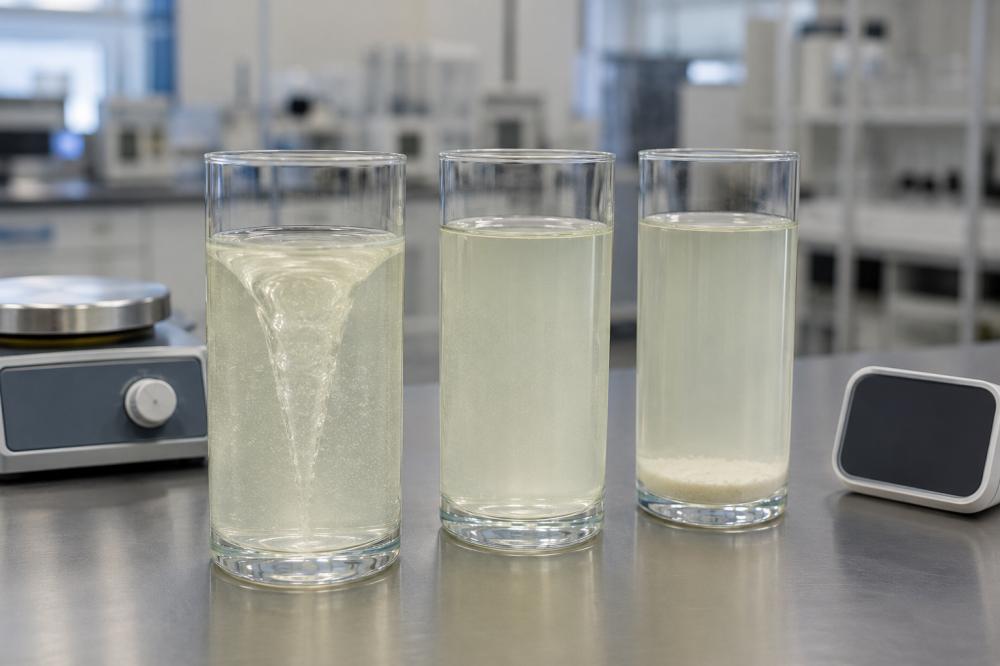
Creatine monohydrate has moderate solubility in water. Published data place solubility near 14 g/L at 20°C and show that it increases with temperature. A 5 g serving mixed into 250 mL equals 20 g/L, so complete dissolution at room temperature should not be assumed.
Acidification can change apparent solubility, but a clearer drink at the moment of mixing is not automatically a more stable drink during storage. The finished formula should be tested using defined water temperature, volume, shaking or stirring time, standing time and sediment criteria. Claims such as “instant” or “fully soluble” need support under the stated preparation conditions.
Creatine and Caffeine Can Share a Formula, but Claims Need Care
Caffeine is widely used in pre-workouts. The ISSN position stand reports that 3–6 mg/kg body mass can improve performance for many users, while responses and side effects vary. It also notes ambiguity around chronic high-dose caffeine during creatine loading; this is not evidence that normal amounts of the two ingredients chemically conflict in a dry powder.
For formulators, the immediate concerns are dose accuracy, bitter taste, stimulant warnings, serving instructions and the destination market’s caffeine rules. Performance results from a finished multi-ingredient study cannot show which component produced the effect, and a study of one formula should not be transferred to another formula with different doses.
Citrulline, Beta-Alanine and Electrolytes Change the Powder System
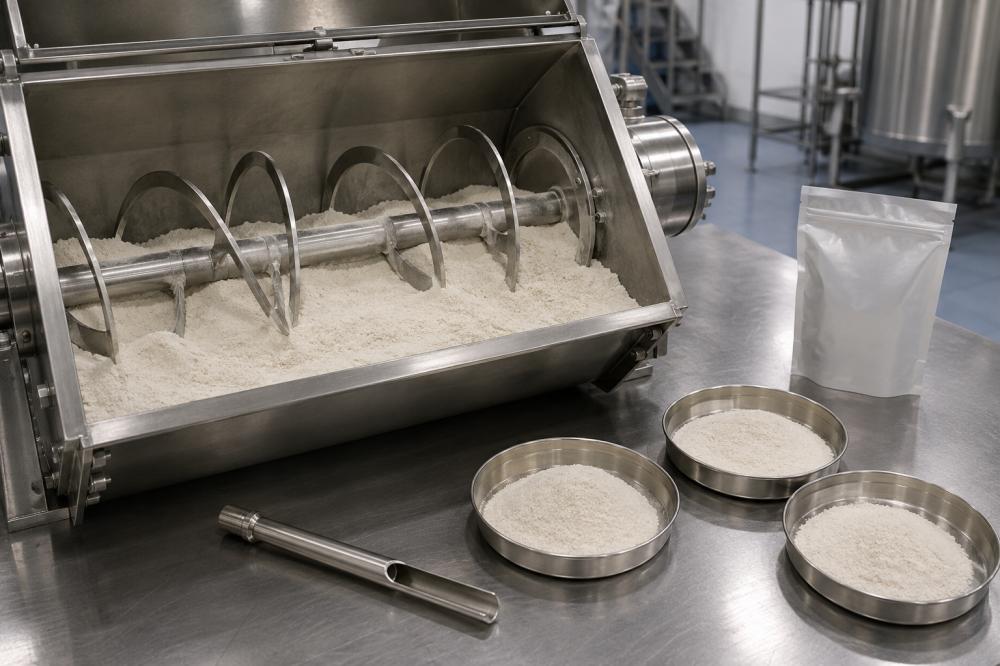
These ingredients are commonly combined with creatine, but “compatibility” includes more than chemical stability:
Different particle sizes and densities can promote segregation during transport;
Hygroscopic ingredients can change flow and caking behavior;
Acids, minerals and amino acids affect taste and sweetener requirements;
Beta-alanine and high stimulant doses may influence user tolerability;
Mineral salts can affect ionic strength, dispersion and flavor.
Blend uniformity should be checked at the beginning, middle and end of a production run. If low-dose components such as caffeine, vitamins or intense sweeteners are included, premixing and validated sampling become especially important.
What to Confirm Before Scale-Up
Target market, serving size and maximum daily servings;
Creatine, caffeine and other active doses per serving;
Particle-size distribution, loose/tapped density and flow method;
Blend uniformity and segregation after handling or transport simulation;
Mixing water, temperature, dispersion and sediment acceptance criteria;
Moisture-barrier packaging and seal integrity;
Finished-product stability, microbiology and contaminant requirements;
Label warnings, permitted claims and caffeine rules for the destination.
SRS Nutrition Express can provide creatine monohydrate samples, physical-property information, specifications and batch documentation for formulation trials. Where a project also uses citrulline, beta-alanine, amino acids or mineral ingredients, the complete blend should be evaluated rather than assuming that individual raw-material results predict finished-product performance.
Developing a pre-workout formula? Send SRS the destination market, target serving, complete active-ingredient doses, flavor direction, packaging format and annual volume to discuss suitable samples and trial documentation.
References
● Kreider RB, Kalman DS, Antonio J, et al. International Society of Sports Nutrition position stand: safety and efficacy of creatine supplementation in exercise, sport, and medicine. Journal of the International Society of Sports Nutrition. 2017;14:18.
● Guest NS, VanDusseldorp TA, Nelson MT, et al. International Society of Sports Nutrition position stand: caffeine and exercise performance. Journal of the International Society of Sports Nutrition. 2021;18:1.
● Song L, Pan Y, Chen J. Solution thermodynamics of creatine monohydrate in ethanol + water mixtures from 278.15 to 328.15 K. Journal of Chemical Thermodynamics. 2016;93:107–113.
● Uzzan M, Nechrebeki J, Zhou P, Labuza TP. Effect of water activity and temperature on the stability of creatine during storage. Drug Development and Industrial Pharmacy. 2009;35(8):1003–1008.
● Harty PS, Zabriskie HA, Erickson JL, et al. Multi-ingredient pre-workout supplements, safety implications, and performance outcomes: a brief review. Journal of the International Society of Sports Nutrition. 2018;15:41.
● Douligeris A, et al. Effects of four weeks of in-season pre-workout supplementation on physical performance in trained soccer players. 2024.
Post time: Aug-25-2026


