

Creatine monohydrate looks simple on a specification sheet, but a high-dose stick pack has to move through a filler, fit within a practical pack volume, keep powder away from the seal and still mix acceptably for the user. Those requirements are related, and none can be selected from mesh size alone.
The best starting point is the intended serving, filling equipment and consumer preparation method. A grade that performs well in one plant may behave differently after a change in particle-size distribution, blending, humidity or line speed.
Start with Dose and Available Pack Volume
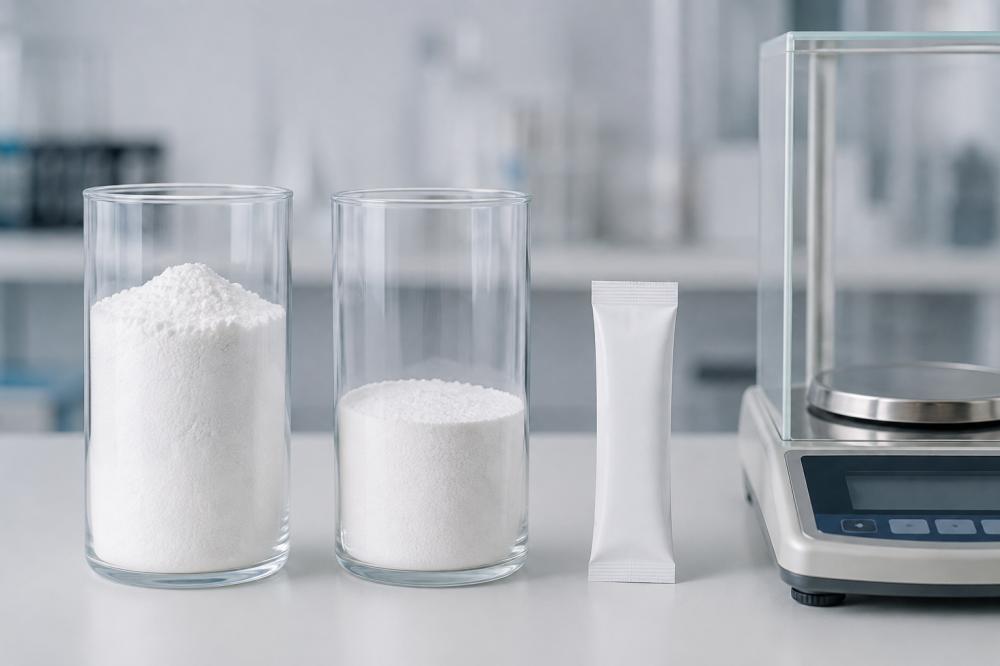
The International Society of Sports Nutrition describes 3–5 g/day as a common maintenance intake, while faster loading protocols use about 0.3 g/kg/day divided across several doses. A single 5 g stick is therefore commercially familiar, but it also creates a substantial powder-volume requirement.
Loose bulk density links dose to approximate fill volume:
Theoretical fill volume = powder mass ÷ loose bulk density
For illustration, 5 g of powder at 0.50 g/mL occupies about 10.0 mL; at 0.65 g/mL it occupies about 7.7 mL. These are calculations, not specifications for SRS material. Actual packs also need headspace and a clean sealing zone, and vibration or machine handling may change powder packing.
USP General Chapter 〈616〉 defines bulk density using powder mass and the unsettled sample volume, including interparticulate voids. Buyers should therefore state whether a value is loose bulk density or tapped density and confirm the test method.
Powder Flow Cannot Be Reduced to Mesh Size
“200 mesh” or “fine powder” does not predict dosing consistency by itself. Particle-size distribution, particle shape, fines, density, electrostatic behavior and ambient humidity can all affect hopper discharge, auger feeding, dust and seal contamination.
USP General Chapter 〈1174〉 notes that powder flow is multifaceted and that no single simple test adequately characterizes it. For a stick-pack project, useful development data may include:
particle-size distribution and method;
loose and tapped density;
the selected flow test and test conditions;
fill-weight variation at the intended machine speed;
observations of bridging, dust and powder in the sealing area.
A finer grade may support dispersion, yet it may also be more cohesive. This is a formulation and equipment trade-off, not a universal ranking of quality.
Mixing Expectations Need a Defined Test
Creatine monohydrate is only moderately soluble in room-temperature water. Published equilibrium data indicate approximately 13–14 g/L near 20–25°C, with solubility increasing as temperature rises. By comparison, 5 g in 250 mL equals 20 g/L. Complete dissolution should not be assumed under that condition; a well-dispersed suspension with some settling may be the realistic consumer experience.
Brands should define water volume, temperature, mixing time, vessel and acceptable sediment before using terms such as “instant” or “fully soluble.” Acids, flavors, sweeteners and other actives can change wetting, taste and physical stability, so the finished blend—not the raw material alone—requires testing.
Packaging Is Part of the Stability System
Dry creatine is more stable than creatine held in solution. The ISSN position stand reports increasing degradation in aqueous systems as pH falls and temperature rises; after three days at 25°C, reported degradation was 4% at pH 5.5, 12% at pH 4.5 and 21% at pH 3.5. These solution data support keeping a single-serve product dry until use, but they do not establish the shelf life of any finished stick pack.
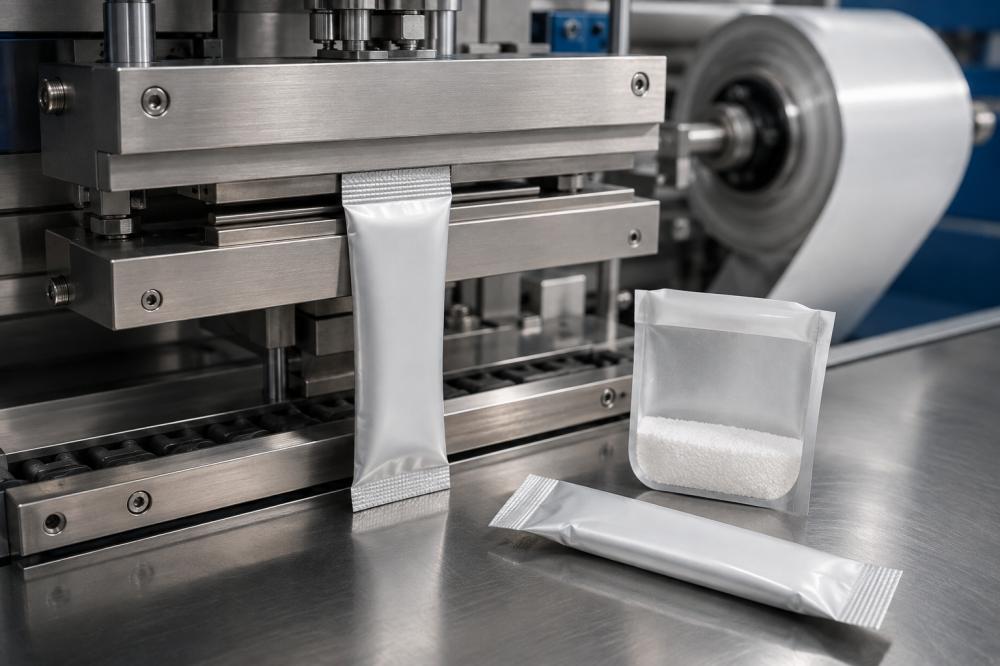
For the dry product, humidity uptake can contribute to caking and inconsistent discharge. Film structure, water-vapor barrier, seal window, seal integrity and the amount of powder entering the seal must be evaluated with the packaging supplier and contract manufacturer. Barrier values alone are insufficient if seals fail during filling or distribution.
Shelf life should be supported by finished-pack stability work under conditions relevant to the destination market, together with seal-integrity and net-weight checks. Packaging compliance also depends on the food-contact rules of the intended market.
What to Confirm Before a Production Trial
Creatine dose, total blend weight and number of sticks per daily serving;
Target stick dimensions, fill system and planned line speed;
Particle-size method, loose/tapped density and agreed flow measurements;
Fill-weight variation and sealing performance using the actual blend;
Mixing instructions and defined dispersion or sediment criteria;
Film structure, barrier data, seal settings and destination climate;
Batch COA requirements, including assay, impurities, microbiology and individual metals;
Stability protocol, transport evaluation and retained samples.
Choosing a Creatine Grade for Stick Packs
There is no universal “stick-pack grade.” The suitable option depends on dose, machine, blend composition, pack dimensions, consumer mixing expectations and destination-market specification. Laboratory flow or solubility results can narrow the choice, but they cannot replace a pilot filling run.
SRS Nutrition Express can provide creatine monohydrate samples, particle-size and physical-property information, specifications and batch documentation for project evaluation. These documents describe the relevant material or lot; they should not be treated as proof of performance in every customer formulation or machine.
Planning a creatine stick-pack project? Send SRS the target market, dose per stick, blend composition, proposed pack size, filling equipment and annual volume. The technical team can help identify samples and documentation for formulation and line trials.
References
Kreider RB, Kalman DS, Antonio J, et al. International Society of Sports Nutrition position stand: safety and efficacy of creatine supplementation in exercise, sport, and medicine. Journal of the International Society of Sports Nutrition. 2017;14:18.
United States Pharmacopeia. General Chapter 〈616〉 Bulk Density and Tapped Density of Powders. USP–NF.
United States Pharmacopeia. General Chapter 〈1174〉 Powder Flow. USP–NF.
Jäger R, Purpura M, Shao A, Inoue T, Kreider RB. Analysis of the efficacy, safety, and regulatory status of novel forms of creatine. Amino Acids. 2011;40:1369–1383.
Song L, Pan Y, Chen J. Solubility of creatine monohydrate in aqueous solutions of ethanol from 278.15 to 328.15 K. Journal of Chemical Thermodynamics. 2016;93:107–113.
Post time: Aug-26-2026


