

Creatine monohydrate looks simple on a formulation sheet. In production, its gram-level serving creates an immediate constraint: the active must share the tablet with the excipients needed for flow, compression, ejection and disintegration.
For brands and contract manufacturers, the real question is not whether creatine can be compressed. It is whether the selected grade and complete formulation can reach the target dose with an acceptable tablet count, size and manufacturing performance.
A 5 g Serving Quickly Becomes a Large Tablet
Daily creatine monohydrate intakes of 3–5 g are widely used in supplementation research, although the labeled serving remains a product- and market-specific decision.
The example below assumes creatine represents 80% of finished tablet weight. It is a planning calculation, not a recommended formula.
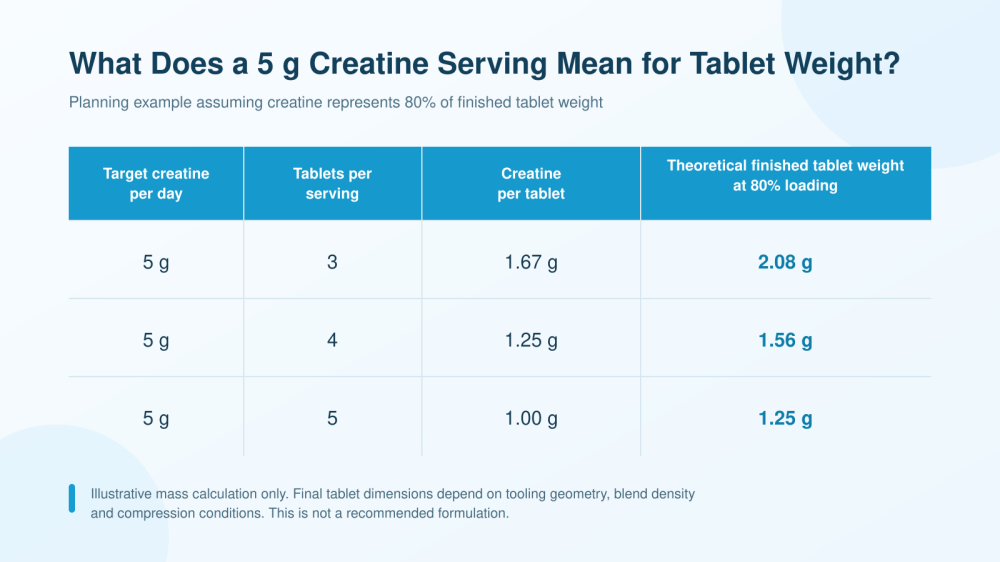
These figures describe mass, not final dimensions. Tablet length, width and thickness depend on tooling geometry, blend density and the solid fraction reached during compression. Still, the trade-off is clear: fewer tablets generally require heavier individual tablets, while a smaller format increases the daily tablet count.
Can Creatine Be Directly Compressed?
Chemical purity does not guarantee direct-compression performance. A blend must flow consistently into the die and form a compact that survives ejection, coating, packaging and transport.
Creatine should therefore be evaluated as both a chemical ingredient and a physical powder. If the complete blend lacks adequate flow or compactability, the manufacturer may adjust the excipient system or consider granulation. Granulation can improve particle uniformity and handling, but it adds cost, processing steps and new variables. The decision should follow trial data rather than a mesh designation alone.
Particle Size and Density Are Screening Tools
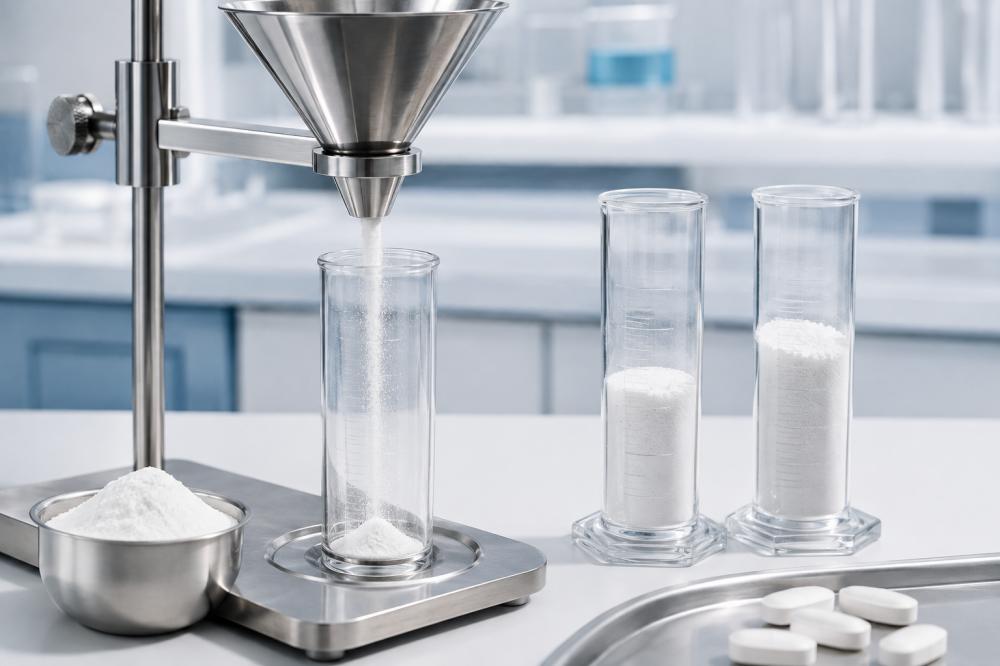
Particle-size distribution can affect cohesion, segregation, packing and die filling. Very fine powder may be more cohesive and harder to feed consistently; a coarser material may flow differently, but performance also depends on particle shape, moisture, density and the other ingredients.
Bulk density describes the mass of powder within its untapped bulk volume. Tapped density reflects the volume after mechanical settling. The two can be used to calculate the Hausner ratio and Carr compressibility index, but no single result predicts behavior under every hopper, feed-frame and press condition.
Useful screening may include:
● bulk and tapped density;
● Hausner ratio and Carr index;
● angle of repose or flow through an orifice;
● shear-cell testing where appropriate;
● actual die-feeding performance.
For high-dose tablets, a lower-density blend occupies more die volume for the same mass. However, selecting the highest-density powder without checking compactability, flow and the full formula can simply exchange one problem for another.
Excipients Compete for Tablet Space
Binders, lubricants, disintegrants and glidants may be required, but every addition reduces the percentage available for creatine. There is no universal excipient percentage suitable for every creatine tablet.
Excess lubricant can alter bonding or disintegration; insufficient lubrication may increase ejection force or sticking. The relevant levels depend on the excipient, tooling, press conditions and desired tablet properties. High active loading therefore requires balancing serving convenience against manufacturability—not merely maximizing the headline creatine content per tablet.
What Should a Compression Trial Measure?
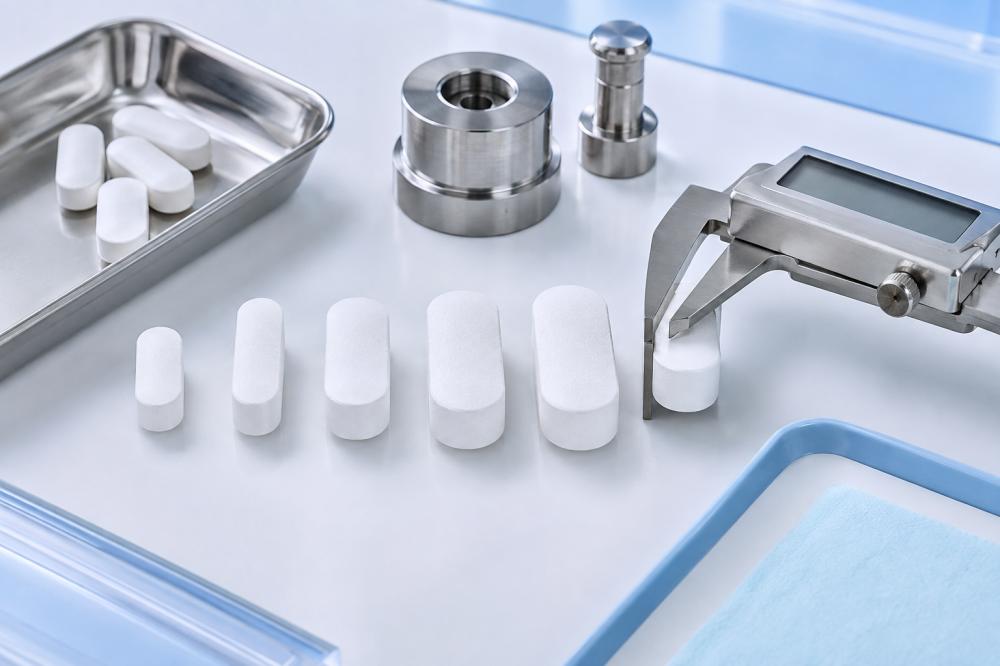
A trial should assess more than whether intact tablets leave the press. Useful checks may include:
● tablet weight, dimensions and weight variation;
● breaking force, friability and disintegration;
● capping, lamination, sticking or picking;
● ejection force and press consistency;
● blend uniformity and finished-product creatine assay;
● dosage-unit uniformity where applicable.
Weight variation can reveal inconsistent die filling, but similar tablet weights do not prove equal creatine content if the blend segregates. Applicable compendial and regulatory requirements depend on the product and target market. In the United States, dietary supplement manufacturers must establish appropriate finished-product specifications for identity, purity, strength and composition under 21 CFR Part 111.
The Final Decision Requires the Actual Formula and Press
Powder tests help compare candidate materials, but they cannot reproduce a production press. Published tablet-engineering principles explain why particle size, density and flow matter; they do not prove that one creatine mesh grade will perform best in every formulation.
A meaningful comparison uses the intended creatine loading, excipients, tooling and equipment. SRS Nutrition Express can provide candidate creatine monohydrate specifications, representative COAs and samples for comparative flow and pilot-compression trials. Final formulation, process parameters and finished-product specifications should be confirmed by the tablet manufacturer.
Developing a creatine monohydrate tablet? Share your target daily dose, tablets per serving, target tablet weight, process and preferred tooling with SRS to discuss suitable sample grades for manufacturing evaluation.
References
1. Kreider RB, Kalman DS, Antonio J, et al. International Society of Sports Nutrition position stand: safety and efficacy of creatine supplementation in exercise, sport, and medicine. Journal of the International Society of Sports Nutrition. 2017;14:18.
2. United States Pharmacopeia. General Chapter 〈616〉 Bulk Density and Tapped Density of Powders. USP–NF.
3. United States Pharmacopeia. General Chapter 〈1174〉 Powder Flow. USP–NF.
4. United States Pharmacopeia. General Chapter 〈1216〉 Tablet Friability. USP–NF.
5. United States Pharmacopeia. General Chapter 〈1217〉 Tablet Breaking Force. USP–NF.
6. United States Pharmacopeia. General Chapter 〈701〉 Disintegration. USP–NF.
7. United States Pharmacopeia. General Chapter 〈905〉 Uniformity of Dosage Units. USP–NF.
8. US. Food and Drug Administration. 21 CFR Part 111—Current Good Manufacturing Practice for Dietary
Post time: Aug-28-2026


