

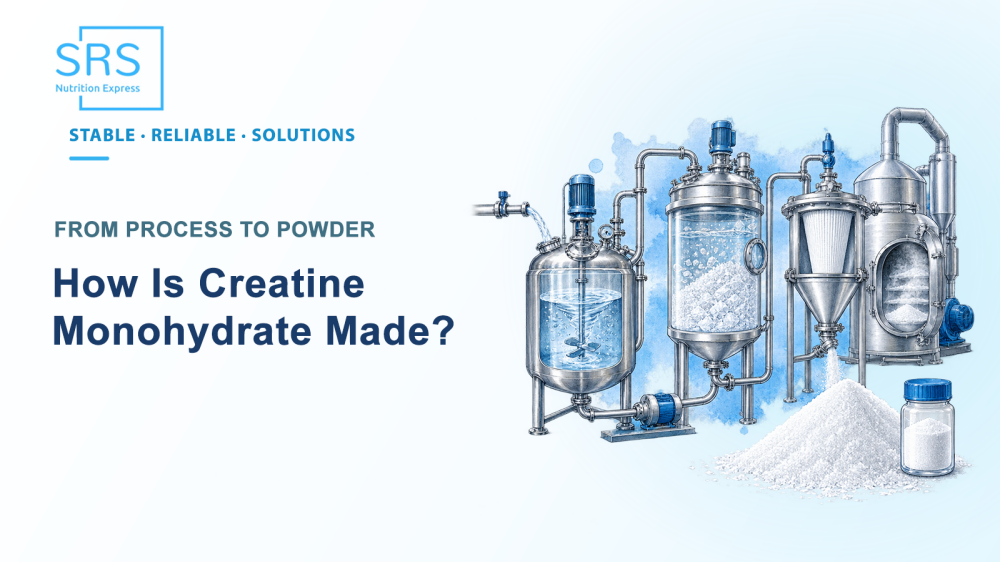
The creatine monohydrate used in sports nutrition is generally not extracted from meat or muscle tissue. Commercial material is commonly produced through controlled chemical synthesis, followed by crystallization, purification and powder processing.
For buyers, the important point is that creatine quality is not determined by the final milling step alone. Starting-material quality, reaction control, separation, drying and particle-size processing can all affect the finished specification.
This article provides a general overview based on published patent and technical literature. Actual raw materials, equipment and operating parameters vary between manufacturers.
1 A Published Industrial Route Uses Sarcosinate and Cyanamide
One well-documented industrial route reacts sodium or potassium sarcosinate with cyanamide in an aqueous system.
Published patents describe controlling temperature, pH and reactant addition to form creatine, which can then be recovered as creatine monohydrate. Some processes use acids to adjust pH, while a later patented approach describes using carbonic acid generated from carbon dioxide.
These patents demonstrate established production routes, but their examples should not be interpreted as the operating conditions used by every creatine manufacturer.
For supplier qualification, the main takeaway is that process control begins before creatine crystals are formed.
2 Reaction Control Affects Yield and Purification
Creatine synthesis involves more than combining two raw materials.
Variables such as pH, temperature, reactant ratio, addition rate and reaction time influence the reaction environment. Published process literature also shows that cyanamide can participate in competing reactions under certain conditions.
The resulting purification requirement therefore depends partly on the quality of the starting materials and the consistency of the reaction.
This is why buyers should not evaluate creatine monohydrate from assay alone. Potential synthesis-related or degradation compounds—including creatinine, dicyandiamide and certain triazine-related compounds—may also be relevant to an agreed specification.
Their presence does not, by itself, identify a single manufacturing failure. Analytical results need to be interpreted together with the production route, purification process, methods and limits applied.
3 Creatine Is Recovered Through Crystallization
After the reaction, creatine must be separated from the surrounding liquid.
Depending on the process, crystals may form during the reaction and subsequent cooling, or through a separately controlled crystallization step. Published patents describe cooling the reaction mixture and recovering a crystalline product.
Crystallization is both a recovery and purification stage. It influences how effectively the solid product can be separated from the remaining liquid and washed.
The resulting crystals are not necessarily the final commercial powder. Further drying and particle-size processing may still be required.
4 Separation and Washing Remove the Liquid Phase
Filtration, centrifugation or other solid–liquid separation equipment can be used to recover the creatine crystals.
The remaining liquid, often called the mother liquor, may contain soluble salts, residual starting materials and reaction by-products. Washing removes more of this liquid from the crystal surface. Where needed, recrystallization may provide additional purification.
A high creatine assay is important, but it does not fully describe the impurity profile of a batch. One published analysis of 33 commercial creatine supplements found considerable differences in creatinine and other measured contaminants, illustrating why specifications and test methods matter.
5 Drying Must Preserve the Intended Form
Recovered crystals contain surface or process moisture that must be removed before further processing and packaging.
The objective is not simply to achieve the lowest possible moisture result.
Creatine monohydrate is a defined crystalline form containing one molecule of water for each molecule of creatine. Its theoretical crystal-water content is approximately 12.1% by weight. More extensive drying under sufficiently elevated temperatures can remove crystal water and produce anhydrous creatine.
Drying conditions must therefore remove unwanted moisture while maintaining the intended creatine monohydrate form. Moisture results should always be interpreted according to the specified analytical method.
6 Milling and Classification Create the Commercial Grade
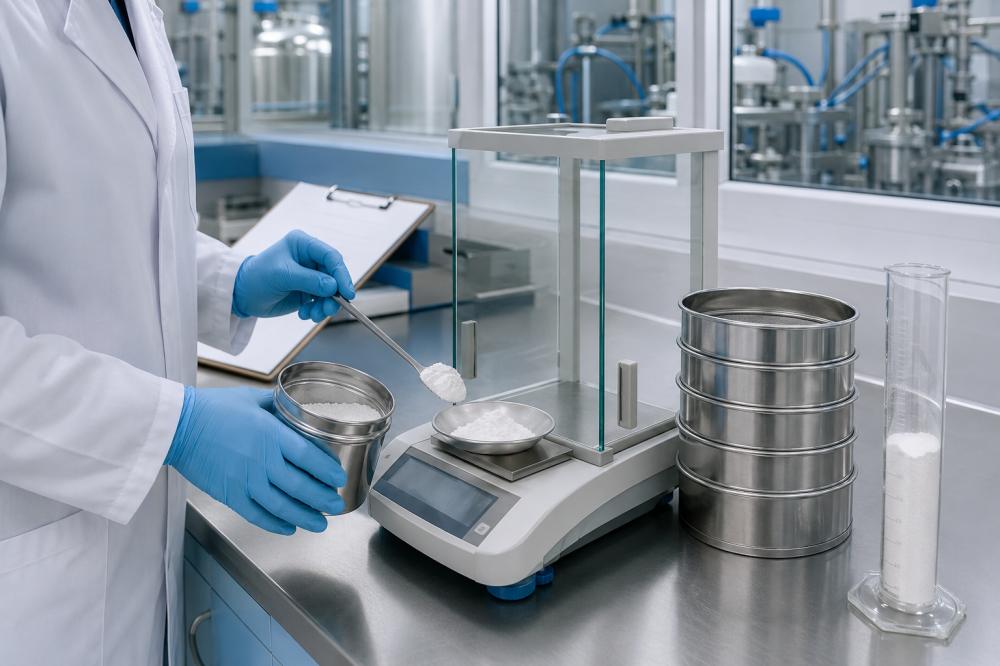
After drying, creatine may be milled, sieved or classified to achieve the required particle-size specification.
This is where commercial descriptions such as 80 mesh, 200 mesh or finer grades become relevant.
Particle-size processing does not create a chemically different ingredient, but it can influence:
- ● powder flow;
- ● dust generation;
- ● blending and dispersion;
- ● bulk density;
- ● filling performance;
- ● tablet compression.
The finest grade is therefore not automatically the best choice for every application. Manufacturers should match the physical specification to the intended formulation and equipment.
7 Finished Batches Are Tested Before Release
Before release, each batch should be evaluated against its established specification.
Depending on the supplier, customer and destination market, the test panel may include:
- ● identification and assay;
- ● moisture;
- ● particle-size distribution;
- ● bulk or tapped density;
- ● creatinine and specified process-related impurities;
- ● heavy metals;
- ● microbiological parameters.
The applicable tests and acceptance limits depend on the agreed specification, analytical methods, intended market and customer requirements.
A COA reports batch results, but buyers should also review the specification and methods behind those numbers.
What Should Buyers Ask a Creatine Manufacturer?
Two white creatine powders may look identical while differing in particle size, density, impurity profile and manufacturing consistency.
Supplier qualification should therefore go beyond asking only for creatine assay. Buyers may also want to confirm:
- ● where the material is manufactured;
- ● which parameters are routinely controlled;
- ● how particle size and density are tested;
- ● which impurity limits are applied;
- ● whether representative samples and batch documentation are available.
SRS Nutrition Express supplies creatine monohydrate in multiple particle-size specifications and can provide specifications, batch COAs, samples and supporting technical documentation.
For capsules, tablets and powder-filling applications, evaluating the selected grade in the intended formulation and equipment remains an important step before commercial scale-up.
References
1. Weiss S, Krommer H. Process for the preparation of creatine or creatine monohydrate. European Patent EP0754679.
2. Kessel K, Scherr G, Klunge M, et al. Process for the preparation of creatine or creatine monohydrate. US Patent 6,759,553.
3. Moret S, Prevarin A, Tubaro F. Levels of creatine, organic contaminants and heavy metals in creatine dietary supplements. Food Chemistry. 2011;126(3):1232–1238. doi:10.1016/j.foodchem.2010.12.028.
4. Jäger R, Purpura M, Shao A, Inoue T, Kreider RB. Analysis of the efficacy, safety, and regulatory status of novel forms of creatine. Amino Acids. 2011;40:1369–1383. doi:10.1007/s00726-011-0874-6.
5. Kreider RB, Jäger R, Purpura M. Bioavailability, efficacy, safety, and regulatory status of creatine and related compounds: a critical review. Nutrients. 2022;14(5):1035. doi:10.3390/nu14051035.
Post time: Aug-27-2026


