


Creatine gummies promise an easier way to take a familiar ingredient. But convenience is not the same as evidence. Until recently, most creatine research used powders, leaving a practical question unanswered: can a gummy deliver enough stable creatine monohydrate to produce measurable results?A 2026 randomized controlled trial offers an encouraging—but narrow—answer. A verified gummy providing 5 g of creatine monohydrate per day improved selected performance measures in female beach volleyball athletes. The study supports the feasibility of the format. It does not prove that every commercial creatine gummy delivers a research-grade dose.
What Did the 2026 Creatine Gummy Trial Test?
The trial included 32 collegiate and professional female beach volleyball athletes aged 18–40. Seventeen consumed 5 g of creatine monohydrate in gummy form each day for 10 weeks, while 15 continued without creatine. Participants maintained their usual training, diet and recovery practices.
Researchers assessed countermovement jump height, change-of-direction speed, reaction time and body composition before and after the intervention. The gummy used in the study had been independently verified to contain its stated creatine dose—an important detail when interpreting the results.
Which Results Improved—and Which Did Not?
The creatine group improved countermovement jump height by an average of 2.10 cm, while the control group declined by 1.70 cm. Change-of-direction time improved by 0.34 seconds in the creatine group, compared with 0.02 seconds in controls.

Body fat mass and percentage remained broadly stable in the creatine group but increased in controls. These findings should not be interpreted as evidence that gummies directly reduce body fat: diet and training load were not strictly controlled, and body composition was measured using bioelectrical impedance, which can be influenced by hydration.
The study found no significant group differences in lean body mass, skeletal muscle mass, total body mass or reaction time. It therefore supports selected explosive-performance outcomes, not universal improvements across strength, cognition and body composition.
What Does the Trial Prove About the Gummy Format?
It shows that creatine monohydrate delivered through a gummy can be associated with measurable performance benefits when the product supplies a verified 5 g daily dose and is used consistently for 10 weeks.
That is meaningful, but the study did not compare gummies directly with creatine powder. It cannot establish superior absorption, equal bioavailability or better performance than an equivalent powder dose. Muscle creatine concentrations were not measured, so the trial also cannot confirm how much creatine reached the athletes’ muscles.
The absence of a placebo matters too. Participants knew whether they were receiving gummies, creating the possibility of expectation effects. The study was not prospectively registered, and its relatively small, geographically concentrated sample limits generalization beyond trained female beach volleyball athletes.
A Verified Study Product Is Not the Same as a Market Category
The active ingredient may be well established, but a finished gummy is a separate formulation challenge. Creatine monohydrate is highly stable as a dry powder. In a moisture-containing matrix, however, pH, temperature, water activity, processing conditions and storage time can influence conversion to creatinine.
This means a certificate for the incoming creatine raw material cannot confirm the amount remaining in the finished gummy months later. Nor can one successful trial validate other brands, recipes, manufacturing processes or shelf lives.
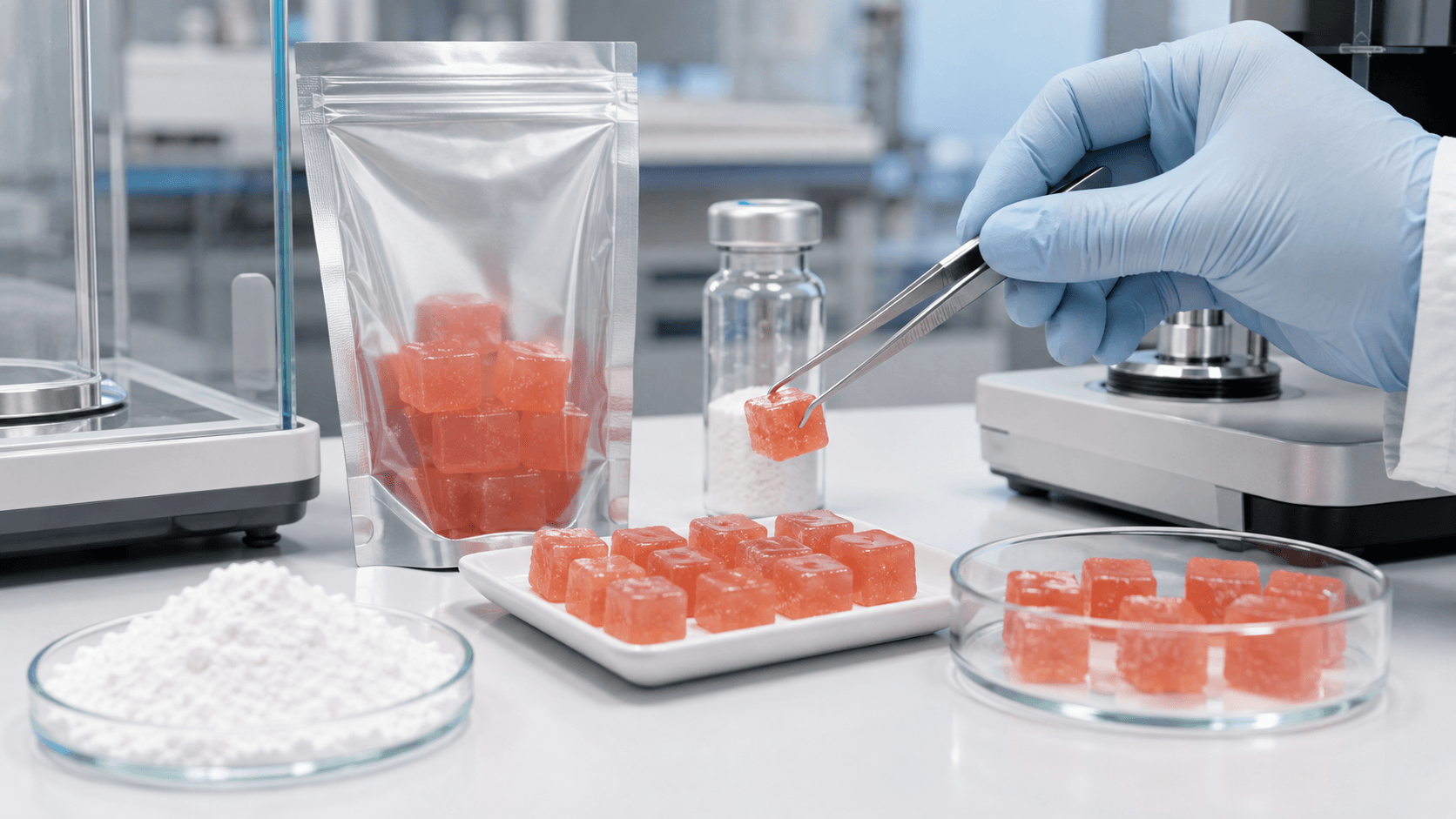
For product developers, “research-grade” should mean more than adding 5 g at the mixing stage. It requires a formulation that delivers the labeled dose per serving, controls content uniformity and continues to meet specification throughout its stated shelf life.
What Brands Should Validate Before Launch?
A credible creatine gummy program should confirm creatine identity and assay in the raw material, finished-product potency, serving-level uniformity and creatinine formation. Stability work should use the actual formulation and packaging under relevant real-time and accelerated conditions, with testing at release and planned shelf-life intervals.
Palatability and convenience may improve adherence, but only if the required number of gummies remains realistic. Brands should also account for sugar or polyol content, texture changes, packaging moisture protection and the cost per effective gram—not simply the number of gummies per bottle.
The Practical Conclusion
The 2026 trial moves creatine gummies beyond a theoretical format. A verified product delivering 5 g per day improved jump and change-of-direction performance in female athletes.
The correct takeaway is not that all creatine gummies work like research powder. It is that a gummy can deliver research-relevant results when dose, formulation stability and consistent use are demonstrated. For brands, the evidence supports development—but it also raises the standard for finished-product testing.
SRS Nutrition Express supplies creatine monohydrate for sports nutrition development and supports brands in defining raw-material specifications, particle-size options and testing requirements. For gummy projects, finished-product potency and stability must still be validated in the final formulation.
Recommended Reading
- ● Creatine Dosage vs Delivery Format: Why Evidence-Based Dosing Still Matters
- ● Creatine Monohydrate Safety: What Large-Scale Evidence Shows
- ● Creatine Mesh Size vs Particle Size Distribution in Product Development
References
- Pereira F, Forbes SC, Romano V, Christopher P, Santana JC, Antonio J. Effects of Creatine Monohydrate Gummies on Performance and Body Composition in Female Beach Volleyball Athletes. Journal of Functional Morphology and Kinesiology. 2026;11(1):105.
- Antonio J, Candow DG, Forbes SC, et al. Common questions and misconceptions about creatine supplementation: what does the scientific evidence really show? Journal of the International Society of Sports Nutrition. 2021;18:13.
- Kreider RB, Jäger R, Purpura M. Bioavailability, efficacy, safety, and regulatory status of creatine and related compounds: a critical review. Nutrients. 2022;14(5):1035.
Post time: Sep-01-2026


