

Creatine is easy to connect with metabolic nutrition: it supports rapid energy transfer in muscle, and muscle is central to glucose disposal. The commercial conclusion, however, is less straightforward.
Small human trials have reported changes in glucose tolerance, HbA1c or muscle GLUT4 when creatine was combined with exercise. Pooled evidence has not confirmed a consistent effect on fasting glucose or insulin resistance. Creatine should therefore not be positioned as a glucose-lowering ingredient or diabetes treatment.
The Biological Rationale Starts in Muscle
Creatine and phosphocreatine help regenerate ATP when energy demand rises. Exercise also increases skeletal-muscle glucose uptake through insulin-dependent and contraction-related pathways, including movement of the GLUT4 transporter toward the cell membrane.
This creates a credible research question: could higher muscle creatine availability influence glucose handling directly, or indirectly by supporting training and muscle adaptation? A plausible pathway is not a clinical outcome. Evidence on glycogen storage or GLUT4 must be interpreted separately from evidence on fasting glucose, oral glucose tolerance and HbA1c.
One Small Diabetes Trial Produced a Notable Result
In a 12-week randomized, double-blind trial, 25 people with type 2 diabetes completed exercise training and received either 5 g/day creatine or placebo. HbA1c changed from 7.4% to 6.4% with creatine and from 7.5% to 7.6% with placebo. The between-group difference was -1.1 percentage points (95% CI -1.9 to -0.4). Meal-test glucose exposure and GLUT4 translocation also improved, while surrogate measures of insulin sensitivity did not differ.
The result is relevant, but it is not sufficient for a broad claim. The sample was small, follow-up lasted 12 weeks, and both groups exercised. The design cannot show that creatine would produce the same outcome without training.
Other Human Results Are Mixed
A three-month study in 22 sedentary healthy men paired aerobic training with approximately 10 g/day creatine. Glucose exposure during an oral glucose-tolerance test declined relative to placebo, but fasting insulin and HOMA did not change significantly.
By contrast, a study in 17 healthy men found no change in glucose tolerance or insulin sensitivity after a five-day loading phase followed by 3 g/day for 28 days. Another trial reported an 18 +/- 5% rise in muscle glycogen after five days of 20 g/day, without increased GLUT4 gene or protein expression. These studies used different populations, doses and endpoints, so they do not answer one identical question.
What Systematic Reviews Add
A 2022 systematic review and meta-analysis included nine studies. Five reported a benefit in at least one diabetes-related parameter, but the pooled analysis found no significant effect on fasting glucose (SMD 0.05; 95% CI -0.53 to 0.63) or insulin resistance (SMD -0.38; 95% CI -0.90 to 0.14).
A separate 2022 review of type 2 diabetes trials included only three RCTs and 87 participants. It described possible improvements compared with placebo, but rated the evidence as low certainty; study bias ranged from unclear to high, and control groups differed. A 2025 review continues to describe creatine plus exercise as promising, while calling for larger trials that define dose, training conditions and long-term outcomes.
What This Means for Product Positioning
The defensible opportunity is not a stand-alone “blood sugar” supplement. Creatine fits more naturally into concepts built around exercise, muscle maintenance, active aging and energy metabolism. Any consumer-facing language must match the destination market and should not imply disease prevention, treatment or replacement of diet, exercise or medication.
Study results also belong to the tested materials and protocols. They do not prove that every creatine raw material, or every finished formula, will perform identically.
Formulation and Procurement Questions
-
Can the Format Deliver the Intended Serving?
The most relevant diabetes trial used 5 g/day. Powder formats accommodate multi-gram servings easily; capsule and tablet products may require several units. Combination formulas should be checked for realistic serving size, taste and consumer adherence rather than borrowing a study dose without context.
-
Does the Specification Fit Production?
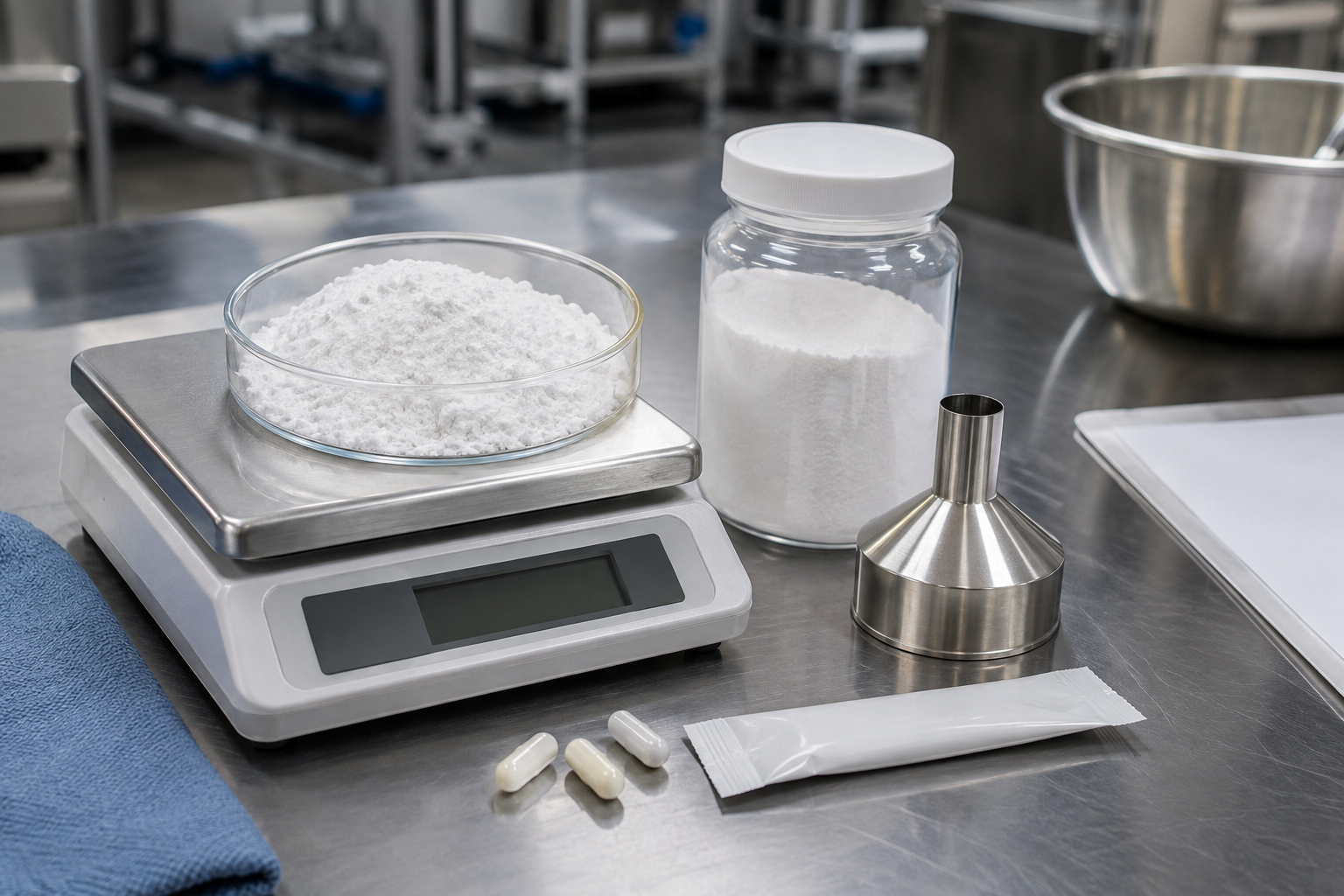
Buyers should define identity, assay, relevant impurities, particle-size distribution, microbiological limits and batch documentation. Density and flow can affect sticks, capsules and tablets; dispersibility and sedimentation matter in drink powders. Finished-product testing should confirm uniformity, stability and sensory performance.
A Measured Opportunity for Metabolic Nutrition
Research connects creatine with muscle energy and glucose handling, but clinical evidence remains limited and inconsistent. Brands can use that science to inform exercise-led or healthy-aging concepts without turning an emerging hypothesis into a settled claim.
SRS Nutrition Express supplies creatine monohydrate in application-specific physical specifications and supports development with specifications, batch COAs, samples and technical documentation. Share the intended market, format, serving and manufacturing process with SRS to discuss a suitable grade and trial sample.
References
- Gualano B, et al. Creatine in type 2 diabetes: a randomized, double-blind, placebo-controlled trial. Medicine & Science in Sports & Exercise. 2011;43(5):770-778.
- Gualano B, et al. Effects of creatine supplementation on glucose tolerance and insulin sensitivity in sedentary healthy males undergoing aerobic training. Amino Acids. 2008;34(2):245-250.
- Newman JE, et al. Effect of creatine ingestion on glucose tolerance and insulin sensitivity in men. Medicine & Science in Sports & Exercise. 2003;35(1):69-74.
- van Loon LJC, et al. Creatine supplementation increases glycogen storage but not GLUT-4 expression in human skeletal muscle. Clinical Science. 2004;106(1):99-106.
- Delpino FM, Figueiredo LM. Does creatine supplementation improve glycemic control and insulin resistance in healthy and diabetic patients? A systematic review and meta-analysis. Clinical Nutrition ESPEN. 2022;47:128-134.
- de Sousa MM, et al. Creatine supplementation in type 2 diabetic patients: a systematic review of randomized clinical trials. Current Diabetes Reviews. 2022;18(3):e120721194709.
- Mlynarska E, et al. Creatine supplementation combined with exercise in the prevention of type 2 diabetes: effects on insulin resistance and sarcopenia. Nutrients. 2025;17(17):2860.
- Richter EA, Hargreaves M. Exercise, GLUT4, and skeletal muscle glucose uptake. Physiological Reviews. 2013;93(3):993-1017.
Post time: Sep-03-2026


