

“How many steaks would I have to eat to get what’s in this scoop?” It’s the kind of question a customer might ask at a trade-show tasting. The person at the stand has a few seconds to answer. The people developing the product have a more interesting job: making sure the answer on the tub, the answer on the website and the amount in the scoop all agree.
Take a 200 g raw steak. One published analysis of beef puts its creatine content at roughly 0.8 g. A 5 g serving of pure creatine monohydrate contains approximately 4.4 g of creatine by molecular weight. That gives the customer a sense of scale. Before turning those figures into a pack claim, though, a brand team needs to decide exactly what its five grams describe. [1,2]
What Would You Actually Print on the Pack?
Imagine two early packaging mock-ups. One says “5 g creatine monohydrate per serving.” The other says “5 g creatine per serving,” with monohydrate listed as the source. A designer could reasonably see the second as a shorter headline. To a formulator, that edit changes the calculation.

Pure creatine monohydrate is approximately 87.9% creatine by weight. On that theoretical basis, a target of 5 g creatine requires about 5.69 g of pure monohydrate. If the entire proposed stick pack weighs 5 g, the second mock-up already asks more of the formula than the pack can deliver. The first wording can fit a 5 g single-ingredient powder. Add flavouring and the total serving weight needs to rise, or the target amount needs to change. [2]
Settle that line while the artwork is still easy to edit. Give the formulation team the ingredient amount, the total serving weight and the proposed wording together. Have the label reviewed for the intended market before approving it.
Keep the Steak Comparison Where It Works
A food comparison earns its place in a retailer FAQ because it answers a question people already ask. A fixed steak count invites questions that a short headline cannot easily accommodate. In one study, beef cheek contained about two-thirds as much creatine as eye of round. Researchers have also measured creatine in beef cooking liquid, so a raw steak, sliced roast beef and a bowl of stew give you different starting points. [3,4]
For a product page, one usable answer is: “Beef naturally contains creatine, and the amount varies with the cut and preparation. Each serving of our powder provides 5 g of creatine monohydrate.” That last sentence belongs on the page only when it matches the finished product. It gives the sales team an answer they can use without asking the customer to weigh dinner.
Take the Scoop and Stick Film to the First Trial
Suppose the first product is a plain powder in a tub and the second is a flavoured stick. Both briefs call for 5 g of monohydrate. The tub team has already ordered a scoop. The stick-pack team has a film width and sealing line they would prefer to keep. Each now has a different question for the same ingredient.
For the Tub
Fill the proposed scoop the way the consumer instructions describe, level it and weigh it. Repeat across several fills and record the spread. Two grades can occupy different volumes at the same weight. If a level scoop consistently misses the target, catching it here is much easier than changing serving instructions after the tubs have been printed.
For the Stick
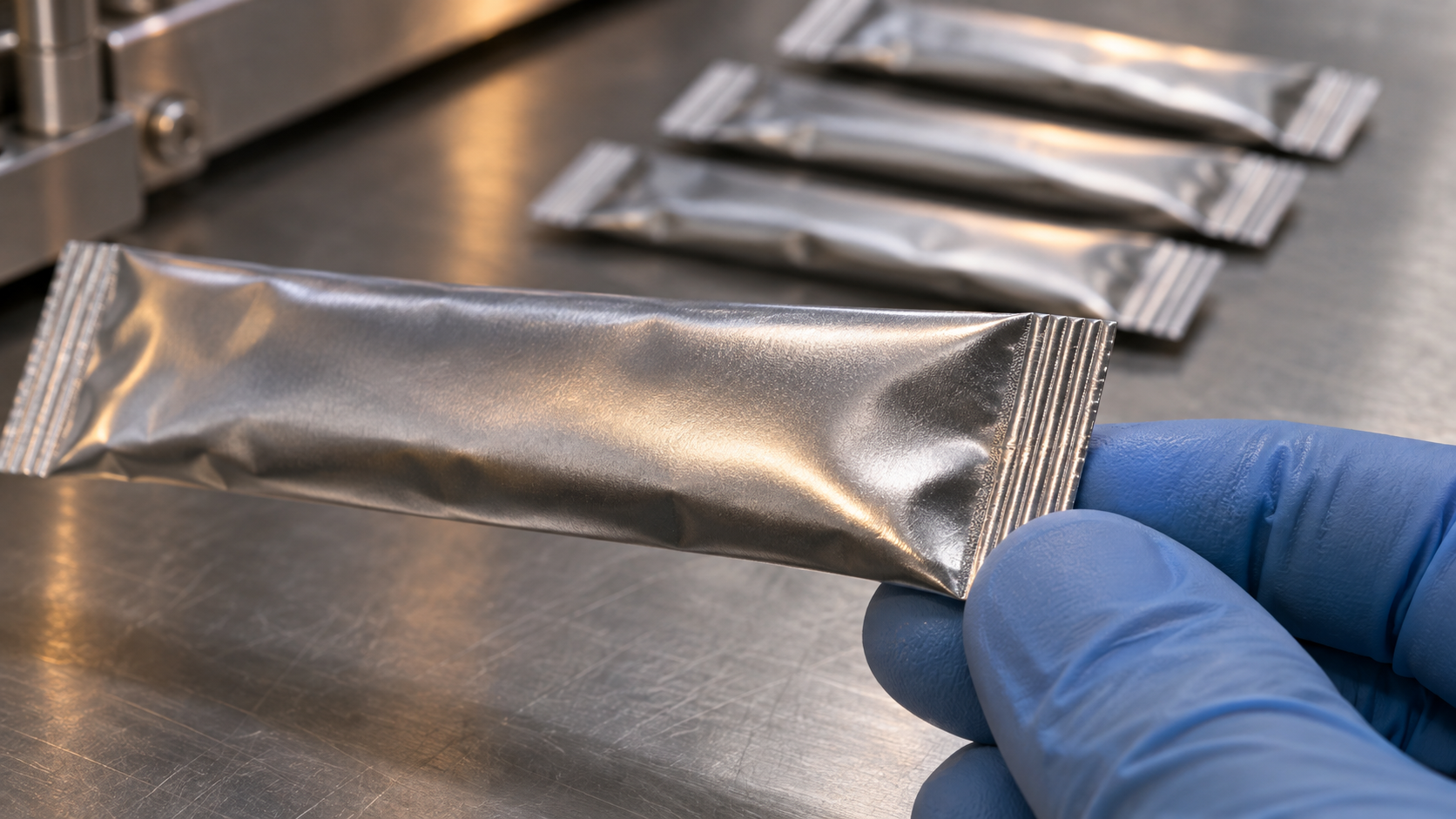
Run a trial with the complete flavoured blend. Check the filled weight across the run and inspect the seal area for trapped powder. A trial using only the neat ingredient leaves the flavour system and actual fill behaviour out of the decision. In a blend, total fill weight also leaves one question open: how evenly is the creatine distributed? Agree with the manufacturing and quality teams how the finished serving will be verified.
Which Creatine Sample Is Worth Testing?
Start with the decision the sample needs to settle. If your existing scoop is the constraint, compare how candidate grades fill that scoop. If you’re developing a premium line, put the proposed impurity limits alongside the assay and ask which values appear on the batch COA. Mesh size answers a particle-size question. The specification and batch documentation answer different questions about composition and quality.
SRS Nutrition Express can provide 80-, 200- and 500-mesh samples for format trials. Your team can also request its specification and a batch certificate of analysis to review creatinine, dicyandiamide (DCD) and dihydrotriazine (DHT). Bring the same serving target to the sample review that you intend to put on the pack. That gives R&D, quality and marketing a common point of reference
Trial a Grade in Your Own Pack
Send us your proposed serving statement, format and any scoop or stick-pack dimensions already fixed. We can use that brief to recommend a grade to trial and provide a sample, specification and batch COA for your team.
Evidence Boundaries
- The 0.8 g example uses an average reported for uncooked beef. A meal prepared at home would need its own analysis for an exact figure.
- The 4.4 g example assumes five grams of pure creatine monohydrate. A finished product’s actual content depends on its formulation and can be checked by testing.
- These calculations compare quantities. They do not establish equal effects on exercise performance or an individual need for supplementation.
References
- Harris RC, et al. (1997). The concentration of creatine in meat, offal and commercial dog food. Research in Veterinary Science.
- United States Pharmacopeia. Creatine monograph: molecular formulas and weights.
- Purchas RW, et al. (2004). Concentrations in beef and lamb of taurine, carnosine, coenzyme Q10, and creatine. Meat Science.
- Elbir Z, Oz F. (2021). Determination of creatine, creatinine, free amino acid and heterocyclic aromatic amine contents of plain beef and chicken juices. Journal of Food Science and Technology.
Post time: Nov-25-2026


