

For supplement brands and contract manufacturers, developing creatine monohydrate capsules is not simply a matter of selecting a capsule size. Bulk density, particle-size distribution and powder flow determine how much creatine can be filled consistently—and therefore affect capsule count, bottle size, production efficiency and finished-product cost.
This becomes especially important when targeting a 3–5 g daily serving, a range commonly used in creatine research. Even a modest difference in achievable fill weight can change the serving from five capsules to seven or more.
How Much Creatine Can Fit in a Capsule?
Capsule size determines nominal volume, not guaranteed fill weight. Common approximate volumes are 1.37 mL for size 000, 0.95 mL for size 00 and 0.68 mL for size 0. Exact volumes should be confirmed with the capsule-shell supplier.
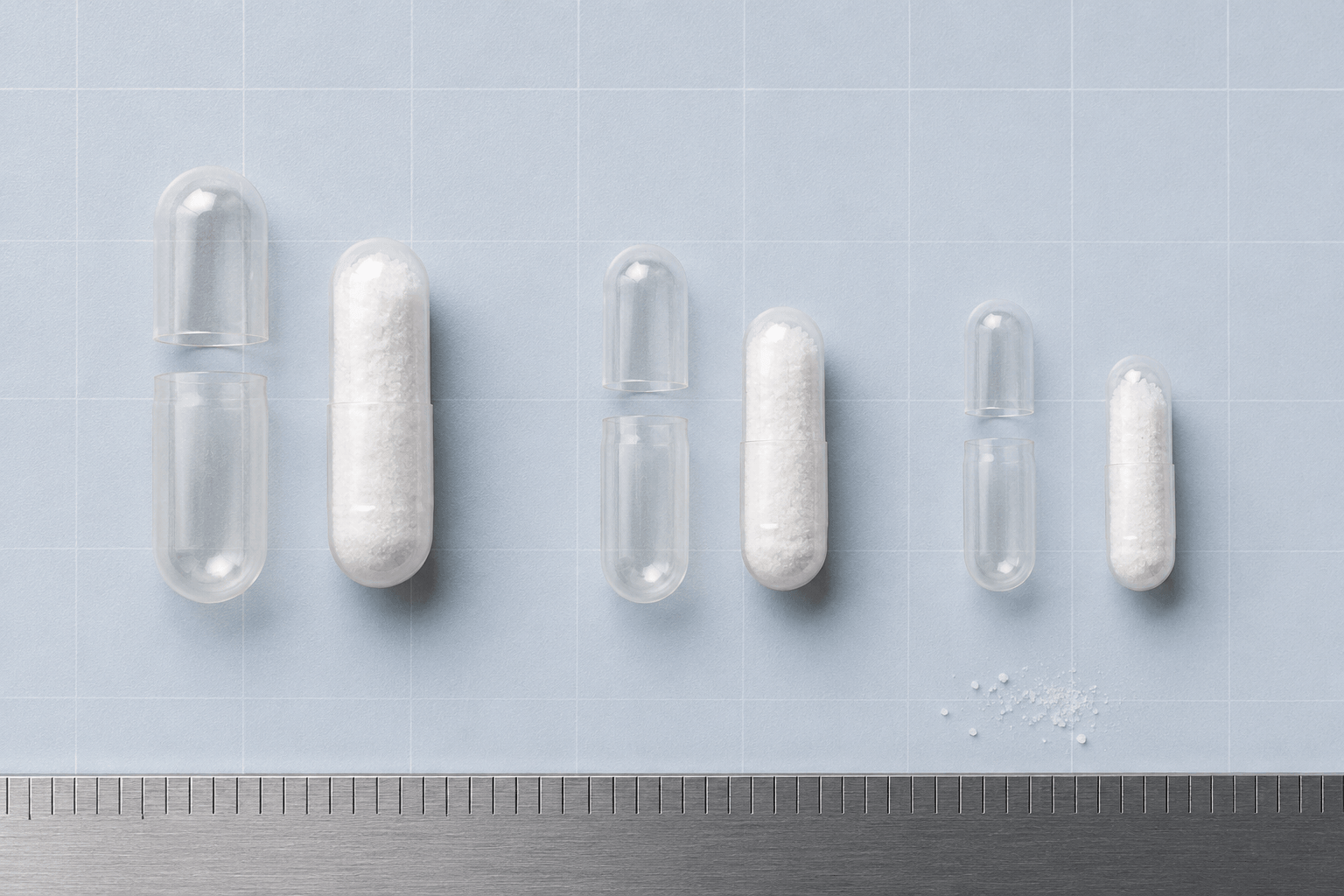
A preliminary estimate can be calculated as:
Estimated fill weight (mg) = capsule volume (mL) × assumed effective fill density (g/mL) × 1,000
The following table uses an illustrative effective fill-density range of 0.50–0.60 g/mL.
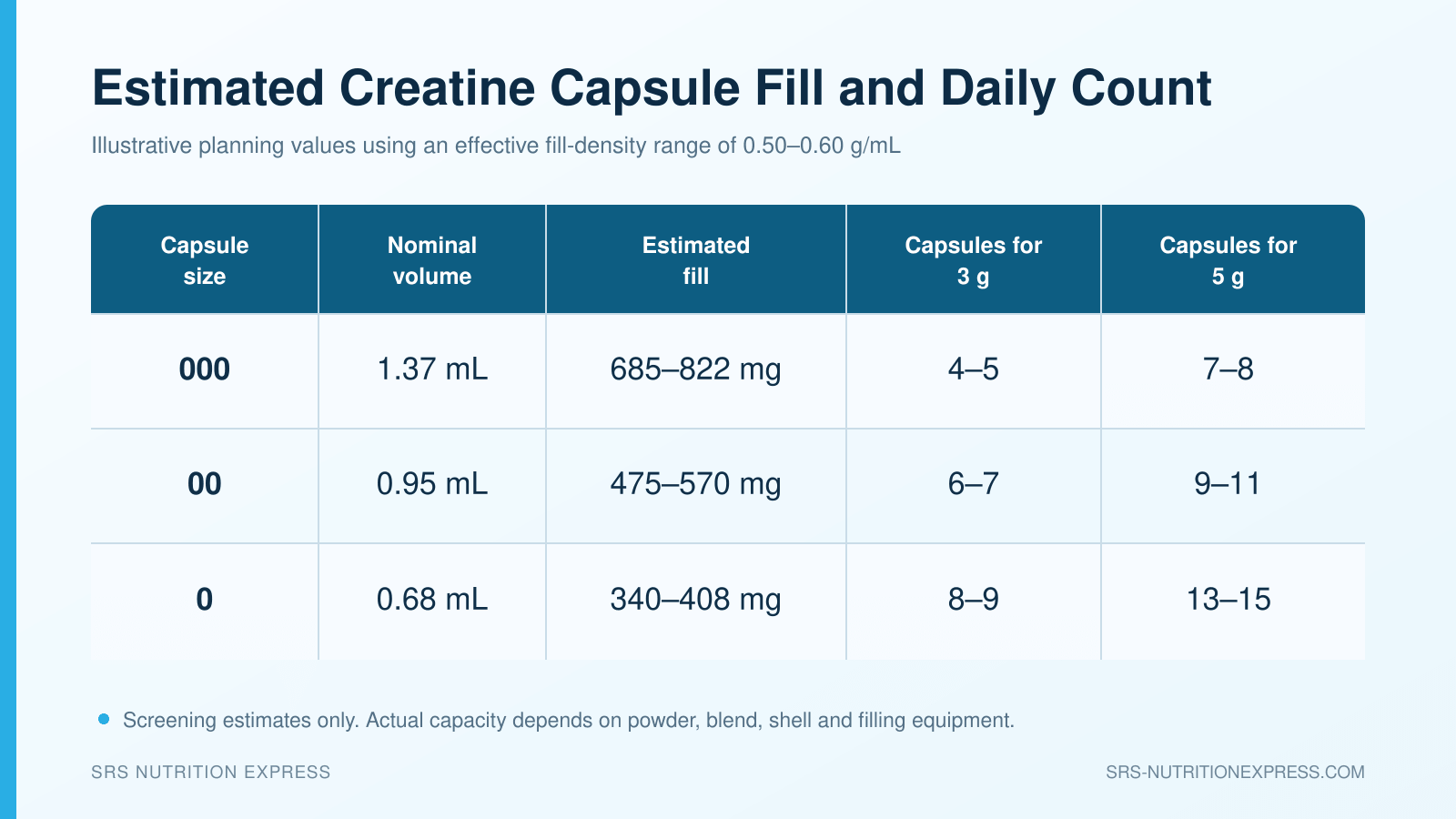
These are screening estimates. Effective density inside the dosing system may differ from the untapped bulk density shown on a raw-material specification.
Why Bulk Density Is Not a Fixed Fill Value
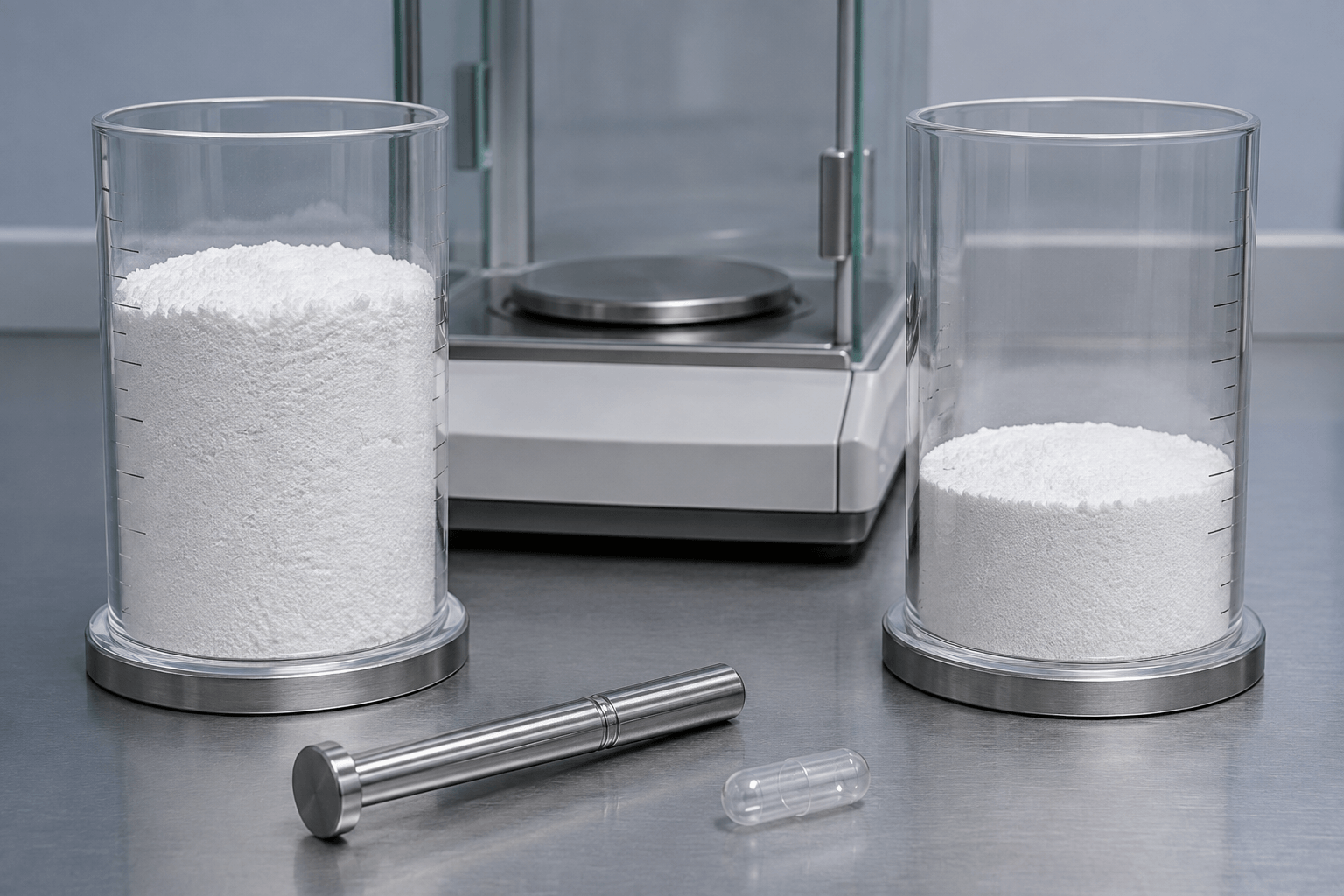
Bulk density measures the mass of an untapped powder relative to its apparent volume, including spaces between particles. Tapped density measures the powder after controlled mechanical tapping.
During capsule manufacturing, tamping pins, dosators and other filling systems consolidate powder differently. Fill weight can also change with powder-bed level, machine speed, moisture, excipients and equipment settings. Research on capsule filling confirms that powder density and flow properties influence both average fill weight and weight variability.
Which Creatine Grade Is Better for Capsule Filling?
A finer mesh does not automatically provide higher capsule capacity. Very fine creatine may be more cohesive, while a coarser grade may flow and consolidate differently. Mesh designation alone cannot predict the final fill weight.
An 80-mesh grade may be a practical starting point for some capsule or tablet applications, but it should not be treated as universally superior. Manufacturers should compare particle-size distribution, bulk and tapped density, flow behaviour and actual machine performance.
If glidants, lubricants or other active ingredients are added, the complete blend—not creatine alone—must be evaluated.
How Fill Weight Affects Product Cost
Capsule count affects more than consumer convenience. It changes shell consumption, filling time, bottle size, label design, packaging cost and freight volume.
A six-capsule daily serving requires 180 capsules for a 30-day supply. At nine capsules per day, the same supply needs 270 capsules. The brand may therefore need a larger bottle, fewer servings per container or a higher finished-product price.
Compared with powder, capsules usually require more individual units to deliver several grams of creatine. Their commercial advantages are portability, portion control and format differentiation—not greater intrinsic effectiveness.
What Should Buyers Request From a Creatine Supplier?
Before selecting a commercial grade, brands, OEMs and procurement teams should request:
● particle-size specification and test method;
● untapped and tapped density with test method;
● representative COA for the proposed grade;
● information on relevant batch variation;
● sample availability for pilot filling;
● packaging, MOQ, lead time and supply location;
● quality documents for the destination market.
A single density result should not be treated as a permanent production guarantee. If the label concept depends on a narrow fill-weight range, the specification, method and acceptable variation should be discussed before commercial ordering.
Why a Pilot Fill Is Still Necessary
Raw-material data can narrow the grade selection, but it cannot replace a production trial. The intended capsule shell, excipients and filling equipment should be used to confirm achievable fill weight, weight uniformity, machine performance, capsule count and finished-product creatine content.
Serving size, bottle format and retail cost should be finalised only after these results are available.
Need Creatine Monohydrate for a Capsule Project?
SRS Nutrition Express supplies creatine monohydrate raw material in multiple particle-size specifications for formulation and manufacturing trials.
Send us your target creatine weight per capsule, capsule size and shell material, filling-machine type, excipient plan, destination market and estimated volume. We can provide the relevant specification, representative COA, available density and particle-size data, qualification sample options, current availability and quotation.
Request a creatine capsule qualification sample and technical data from SRS Nutrition Express.
Evidence Boundaries
● Capsule volumes, fill weights and capsule counts are approximate planning values, not guaranteed commercial capacities.
● Bulk and tapped density can vary by grade, batch, test method, handling and storage.
● The cited capsule-filling studies used pharmaceutical model powders or blends rather than creatine monohydrate. They support general processing principles, not guaranteed creatine-specific fill weights.
● The article does not establish that one creatine particle size is universally superior for capsule filling.
● The 3–5 g examples reflect commonly used research protocols, not individual medical advice or a market-specific authorised claim.
● Commercial suitability must be confirmed using the proposed raw-material grade and intended production equipment.
References
1. Kreider RB, et al. International Society of Sports Nutrition position stand: safety and efficacy of creatine supplementation in exercise, sport, and medicine. Journal of the International Society of Sports Nutrition. 2017;14:18.
2. Antonio J, et al. Common questions and misconceptions about creatine supplementation: what does the scientific evidence really show? Journal of the International Society of Sports Nutrition. 2021;18:13.
3. United States Pharmacopeia. General Chapter <616>: Bulk Density and Tapped Density of Powders.
4. Stranzinger S, et al. Predicting capsule fill weight from in-situ powder density measurements using terahertz reflection technology. International Journal of Pharmaceutics: X. 2019;1:100004.
5. Osorio JG, Muzzio FJ. Effects of powder flow properties on capsule filling weight uniformity. Drug Development and Industrial Pharmacy. 2013;39(9):1464–1475.
6. Faulhammer E, et al. The effects of material attributes on capsule fill weight and weight variability in dosator nozzle machines. International Journal of Pharmaceutics. 2014;471(1–2):332–338.
7. Torpac. Empty Hard Gelatin Capsule Physical Specifications and Size Chart.
Post time: Aug-26-2026


