

Creatine monohydrate is generally chemically stable as a dry crystalline powder. Its handling properties, however, can still change during storage and transport through moisture exposure, consolidation, particle rearrangement or environmental cycling.
For brands and OEMs, the practical question is not simply whether a batch met its CoA at release. It is why a powder later shows different flow, bulk density, caking or dispensing behaviour – and whether the change originated in the material, packaging, process or logistics route. A useful investigation starts by separating chemical stability from physical powder behaviour rather than assuming that every lump indicates degradation or poor raw-material quality.
Separate Chemistry from Powder Behaviour
Three questions should be assessed separately:
- Chemical stability: Has creatine meaningfully converted to creatinine under the actual conditions?
- Solid-state condition: Has hydration state, crystal structure or particle arrangement changed?
- Handling performance: Have flow, density, compressibility or dispersibility changed enough to affect manufacturing or use?
Research shows that creatine monohydrate has distinct solid-state behaviour and can dehydrate at high temperatures. Separate work on creatine anhydrate shows hydration to the monohydrate at higher humidity, but this does not prove that commercial creatine monohydrate rapidly absorbs moisture under ordinary warehouse conditions. Caking alone also does not establish potency loss.
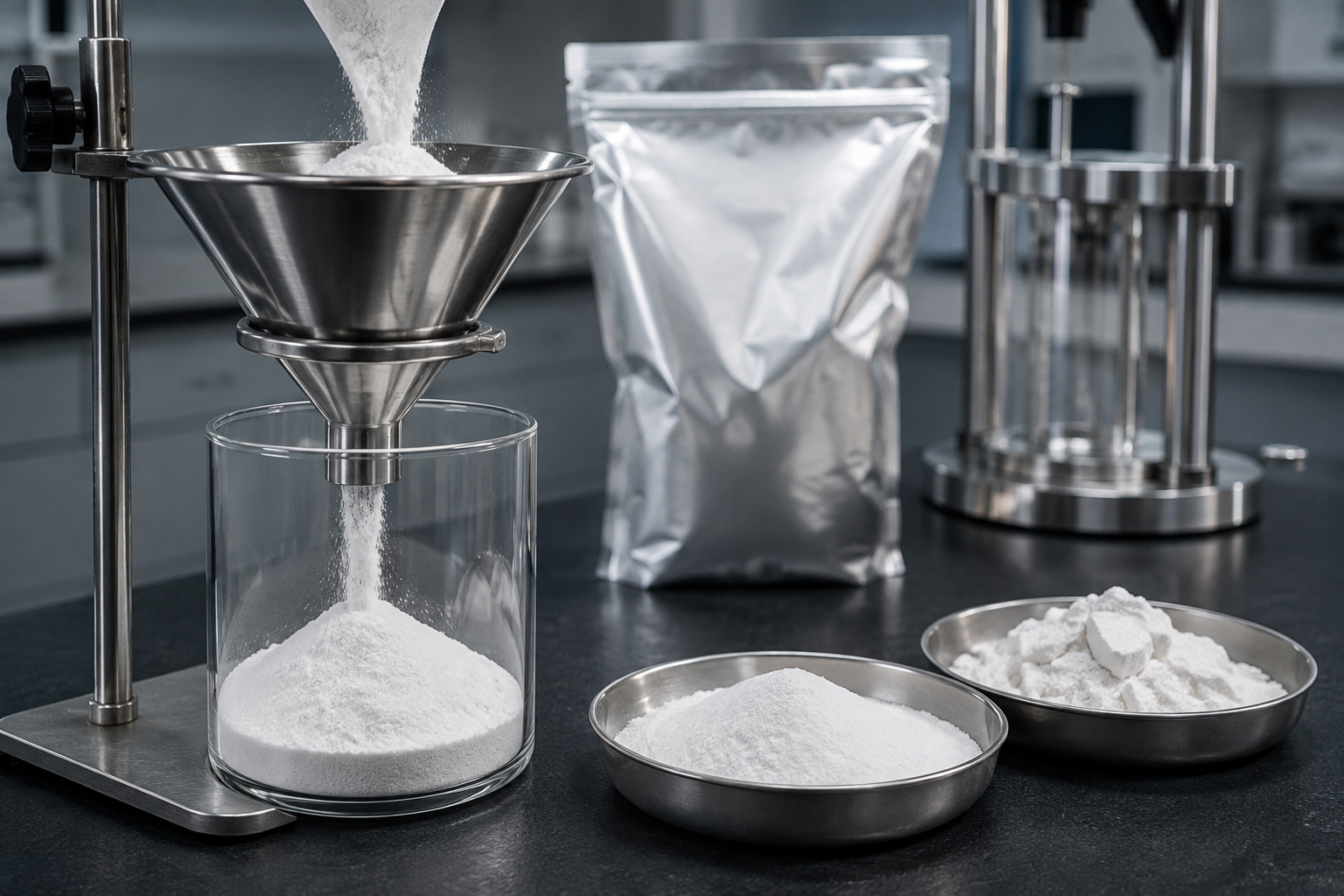
Why Caking Is Not Always a Moisture Problem
Moisture ingress can strengthen liquid or solid bridges between particles, but several mechanisms can produce similar observations:
- Static pressure from stacking and prolonged storage;
- Vibration and particle rearrangement during road or ocean transport;
- Temperature-humidity cycling combined with inadequate packaging protection;
- Changes in fines created by milling, screening or repeated handling;
- Other ingredients in a blend, including sugars, acids, flavours and mineral salts.
A complaint involving a finished flavoured powder therefore cannot automatically be attributed to the creatine component. Packaging integrity, blend composition, pallet loading and the point at which the change first appeared all matter.
Particle Size and Density Need Context
Fine powders are often more cohesive because interparticle forces become more influential as particle size decreases. Even so, mesh designation alone cannot predict storage performance. Two grades meeting the same sieve claim may differ in full particle-size distribution, particle shape, fines, surface characteristics and packing history.
Buyers evaluating a caking or flow issue should compare particle-size distribution, bulk and tapped density, and a relevant flow method using the same procedures applied to both affected and reference samples. A nominal 80- or 200-mesh label is not enough to establish cause.
Interpret LOD and Karl Fischer Carefully
Creatine monohydrate contains water of crystallisation; its theoretical water content is approximately 12.1%. Loss on drying (LOD) may reflect both surface moisture and water released from the crystal under the selected temperature and time. Karl Fischer measures water by a different principle, but its result must still be interpreted against the expected hydration state and a defined method.
Neither result should be labelled simply as ‘foreign moisture’. When investigating storage change, use the same validated or agreed method used at release wherever possible. Compare the result with the specification, method conditions, historical batch data and an appropriate retained sample.
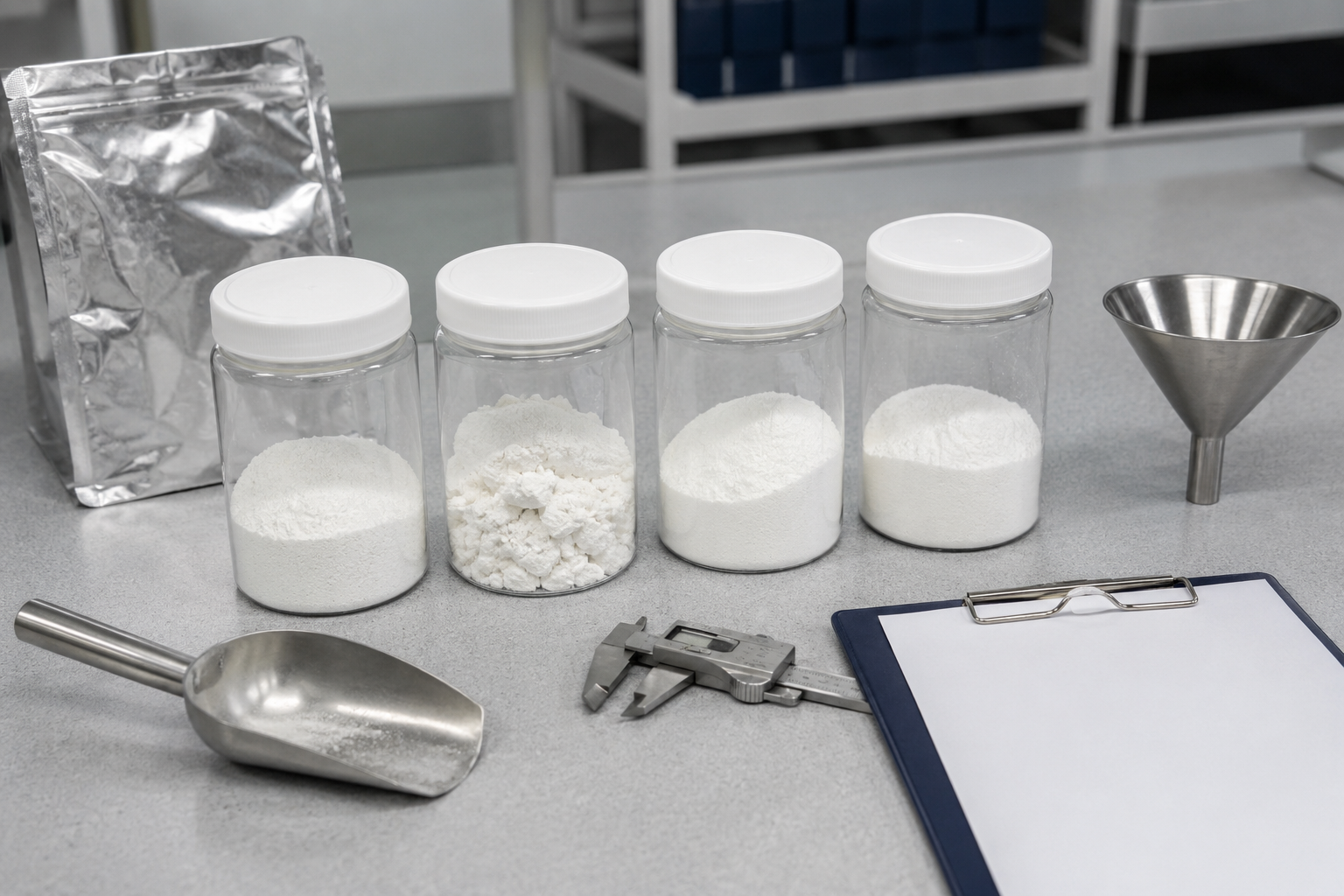
Use a Same-Batch Investigation
The strongest investigation compares like with like. Where available, examine:
- The affected or complaint sample;
- An unopened supplier retain from the same batch;
- An unaffected sample from the same batch and supply chain;
- A reference batch tested using the same methods.
Document where each sample was stored, whether the pack was opened, stack height, transport route and any seal or liner damage. Targeted testing may include assay, creatinine, water or LOD, particle-size distribution, bulk/tapped density and an agreed flow test. Packaging inspection may include seal condition and, where relevant, moisture-barrier data.
The objective is not to decide in advance that either the supplier or warehouse is responsible. It is to identify which combination of material attributes, packaging, processing and logistics explains the observed change.
What Brands and OEMs Should Specify
Before commercial production, align the attributes that matter for the intended process:
- Particle-size distribution and test method, rather than mesh terminology alone;
- Bulk and tapped density with the agreed method;
- LOD or water method, conditions and acceptance range;
- Primary packaging, liner and sealing configuration;
- Storage, open-bag handling and stacking instructions;
- Stability observations covering caking, flow and dispersibility where these are commercially important.
A raw-material CoA records batch results at a defined time. It does not demonstrate how a finished multi-ingredient product will behave throughout its shelf life. Finished-product stability and packaging suitability remain formulation- and market-specific
Need Creatine with Defined Physical Specifications?
SRS Nutrition Express supplies creatine monohydrate in multiple particle-size and physical specifications. For qualification projects, we can provide specifications, representative CoAs, available particle-size and density information, samples, current availability and quotation.
Send us your intended format, filling process, destination market, packaging plan and volume so the proposed grade can be evaluated against the actual manufacturing requirement.
Evidence Boundaries
- Published creatine-specific evidence on warehouse caking and long-term flow change is limited; several principles discussed here come from broader powder science.
- The article does not establish universal humidity, temperature or stacking limits for creatine monohydrate.
- Caking does not by itself prove chemical degradation, moisture ingress or supplier non-conformance.
- Commercial suitability must be confirmed using the proposed material, packaging, process and distribution conditions.
References
- Sakata Y, Shiraishi S, Otsuka M. Effect of pulverization on hydration kinetic behaviors of creatine anhydrate powders. Colloids and Surfaces B: Biointerfaces. 2004;39(4):187-193. https://doi.org/10.1016/j.colsurfb.2004.07.016
- Dash AK, Mo Y, Pyne A. Solid-state properties of creatine monohydrate. Journal of Pharmaceutical Sciences. 2002;91(3):708-718. https://doi.org/10.1002/jps.10073
- Uzzan M, Nechrebeki J, Zhou P, Labuza TP. Effect of water activity and temperature on the stability of creatine during storage. Drug Development and Industrial Pharmacy. 2009;35(8):1003-1008. https://doi.org/10.1080/03639040902755197
- Shah DS, Moravkar KK, Jha DK, et al. A concise summary of powder processing methodologies for flow enhancement. Heliyon. 2023;9(6):e16498. https://doi.org/10.1016/j.heliyon.2023.e16498
- United States Pharmacopeia. General Chapter <616>: Bulk Density and Tapped Density of Powders. https://doi.org/10.31003/USPNF_M99375_02_01
- United States Pharmacopeia. General Chapter <1174>: Powder Flow. USP-NF.
Post time: Sep-01-2026


