

A creatine monohydrate specification sheet should define material that is chemically acceptable, suitable for the destination market and workable in the intended product—not simply list the strictest numbers a supplier can offer.
Requirements differ by application. Scoop-based powder may need different physical properties from creatine intended for capsules or high-load tablets. The right purchasing specification therefore starts with the finished product.
Start with Identity, Assay and Reporting Basis
Identity confirms the ingredient is creatine monohydrate. Assay describes measured creatine content, but apparently similar results may use different bases or methods.
The USP dietary supplement monograph defines creatine as containing one molecule of water of hydration and states its assay on a dried basis. The FCC monograph separately describes creatine monohydrate as the synthetic hydrated ingredient. Buyers should therefore confirm:
- The material and CAS number being specified;
- Whether the assay is reported as-is, on a dried basis, or as creatine equivalent;
- The analytical method and acceptance range.
A higher assay does not by itself demonstrate lower impurities or better manufacturing performance.
Interpret Loss on Drying Correctly
Water is part of the creatine monohydrate crystal structure. Loss on drying should not automatically be interpreted as unwanted free moisture or judged on a “lower is always better” basis.
Assess the result against the stated material, method and specification. For caking or poor flow, packaging, humidity and physical powder properties may matter more than loss on drying alone.
Give Process-Related Impurities Clear Limits
Creatine monohydrate is commonly produced from sarcosine and cyanamide followed by purification. Relevant specifications may therefore include:
- Creatinine;
- Dicyandiamide (DCD);
- Dihydro-1,3,5-triazine (DHT).
EFSA’s 2004 opinion evaluated a specific preparation with defined limits for these compounds. These provide technical context but are not automatically a universal legal specification for every raw material.
“Not detected” is incomplete unless the method and reporting limit are known. Important requirements should define the analyte, limit, method and required LOD or LOQ.
Set Metals Requirements from the Finished Product Backwards
For international projects, individual results for lead, cadmium, arsenic and mercury may be more useful than one “total heavy metals” line.
The appropriate raw-material limits depend on the destination, product category, daily serving and contribution from other ingredients. EU contaminant rules establish maximum levels for specified foods, including finished food supplements. California Proposition 65 uses exposure-based safe-harbor levels; for lead, the reproductive-toxicity MADL is expressed in micrograms per day rather than as one universal raw-material ppm limit.
Brands should first determine the finished-product requirement, then calculate an ingredient limit allowing for serving size and other sources.
Match Particle Size and Density to the Dosage Form
Particle size, bulk density and flow are application attributes—not general measures of purity.
A fine grade may disperse differently but can also be cohesive or dusty. Capsules and tablets may require density and consistent filling; stick packs need reliable dosing and clean sealing at production speed.
If these properties matter, “80 mesh” or “200 mesh” may not be enough. Define the particle-size method, whether full distribution data are required, and whether density means loose bulk or tapped density.
Keep Core, Application and Market Requirements Separate
Separating requirements makes a specification easier to approve and maintain.
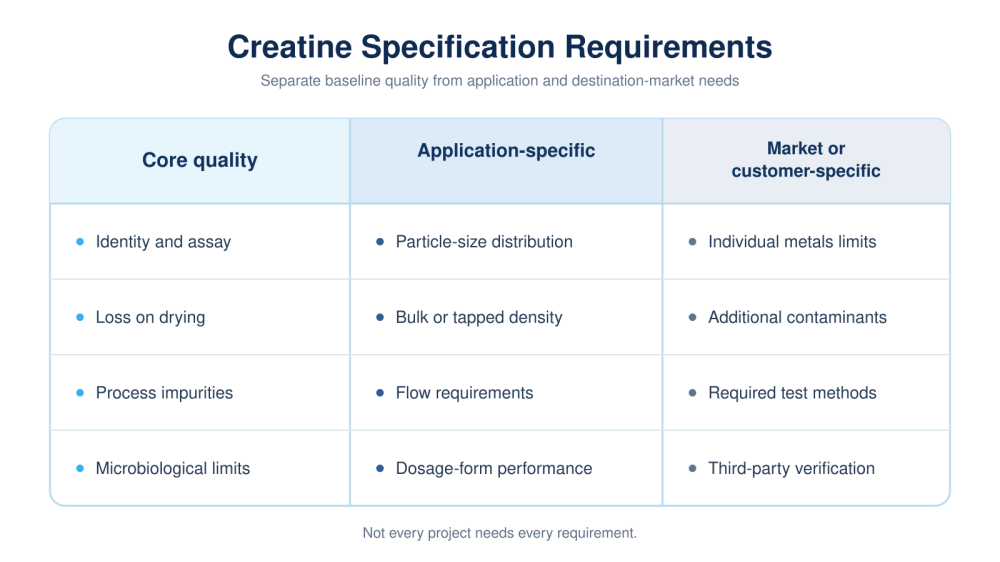
Not every project needs every item. Unnecessary limits can add testing cost, restrict supply and create failures that do not improve the finished product.
Specification Sheet and Batch COA Are Different

The specification sheet defines acceptance criteria. A batch Certificate of Analysis reports the results for a particular lot. Buyers should review both, together with methods where results are critical.
A representative COA shows typical reporting but does not replace the batch COA for shipped material. Historical data or independent testing may suit tightly controlled projects.
What to Include in a Creatine RFQ
Before requesting a final quotation, provide:
- Destination market and product category;
- Dosage form and creatine per serving
- Required particle size, density or flow properties;
- Impurity and individual metals limits;
- Microbiological requirements;
- Required methods, LOD/LOQ or third-party testing;
- Annual volume, packing format and documentation needs.
SRS Nutrition Express supplies creatine monohydrate in different particle-size and physical specifications and can provide specifications, batch COAs, samples and technical documentation. Where a project has particular density, impurity or contaminant requirements, these should be aligned before ordering and confirmed through suitable testing and manufacturing trials.
Planning a creatine project? Send SRS your destination market, dosage form, target specification and annual volume to discuss suitable grades and representative samples.
References
- United States Pharmacopeia. Creatine Monograph. USP–NF, Dietary Supplement Monographs.
- United States Pharmacopeia. Creatine Monohydrate. Food Chemicals Codex.
- European Food Safety Authority. Opinion Related to Creatine Monohydrate for Use in Foods for Particular Nutritional Uses. EFSA Journal. 2004;2(4):36.
- U.S. Food and Drug Administration. GRAS Notice No. 931: Creatine Monohydrate. Closure date: November 12, 2020.
- European Commission. Commission Regulation (EU) 2023/915 on Maximum Levels for Certain Contaminants in Food.
- California Office of Environmental Health Hazard Assessment. Lead—Proposition 65 Safe-Harbor Levels.
- United States Pharmacopeia. General Chapter 〈616〉: Bulk Density and Tapped Density of Powders. USP–NF.
Post time: Aug-24-2026


