

A brand may describe its launch as one creatine order while the factory sees several separate products: different pack sizes, labels, formulas or destinations. The total kilograms help estimate ingredient demand, but they do not define every production and packaging requirement.
Before requesting a minimum order quantity, list the products you want to sell and the number of finished units for each. That gives the supplier a basis for reviewing which elements can be shared and which require separate arrangements.
1 Define What Makes Each Product Different
Start with the formula, approved grade, pack type, net contents, label language and destination. State whether two proposed items contain the same powder or require different blends.
A different label may still require separate artwork control, printed materials and finished-product identification even when the powder is identical. A formula change may also introduce separate preparation, testing and cleaning requirements. Ask the manufacturer which differences matter in its actual process.
2 Convert Finished Units Into Ingredient Demand
For illustration, 1,000 tubs containing 300 g each represent 300 kg of declared net contents. Another 600 tubs containing 500 g each represent a further 300 kg. Together they represent 600 kg across 1,600 retail units.
This assumes the same single-ingredient powder in both products. It is not a manufacturing input calculation or a minimum-order offer. Samples, setup quantities, actual fill controls and justified process losses must be handled separately in the production plan.
3 Ask What the Minimum Quantity Applies To
A quoted minimum might refer to a raw-material purchase, a production run, a finished SKU or a printed packaging item. Ask the supplier to state the basis instead of assuming that one combined order meets every requirement.
Sharing an ingredient or a standard container does not automatically allow quantities to be combined across different labels or formulas. Conversely, some common materials may be usable across products if the supplier confirms the arrangement. Get that distinction in writing before committing to the range.
4 Approve the Identity of Every Retail Item
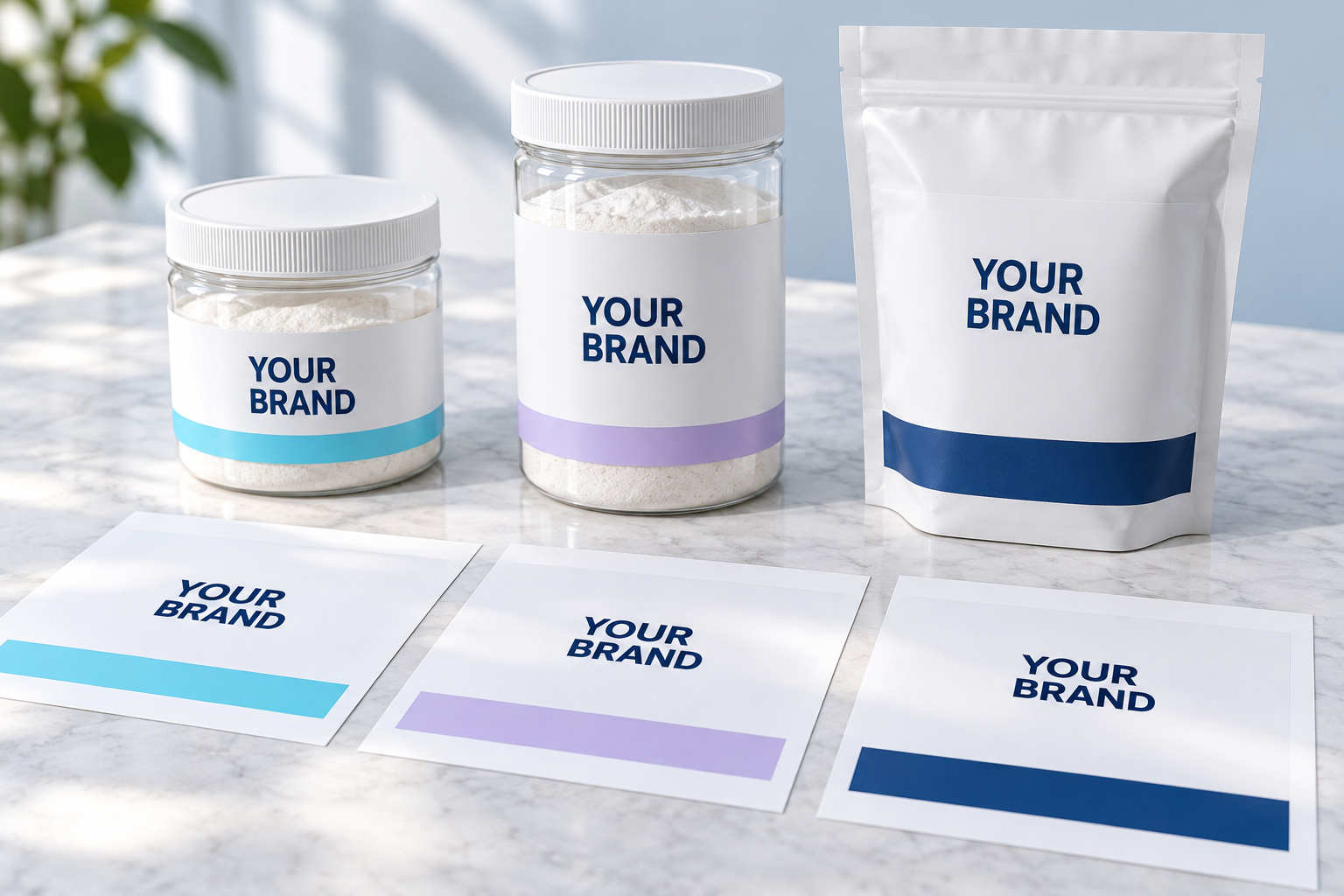
Keep an approved specification and artwork version for each product. Check that net contents, serving information where applicable, batch coding and carton identification match the item being ordered.
If your products use GS1 identification, review the GTIN Management Standard when defining variants. Its declared-net-content rule requires a new GTIN when the legally required declared net content on the pack changes. A 300 g and 500 g planning decision therefore also has identification implications. [1]
5 Consider a Staged Range Rather Than an Unfunded Assortment
If the complete range cannot meet the confirmed quantities or budget, compare launching one priority product first with launching several at once. Use the actual quotations, packaging commitments and demand assumptions for each option.
If printed materials will remain for later orders, confirm ownership, storage, charges and what happens after an artwork change. Do not treat unused packaging as future finished stock or assume that a later production slot is reserved.

6 Request a Proposal With One Line per SKU
For each product, send the intended formula or specification, pack type, net weight or count, finished-unit quantity, destination and artwork status. Identify shared materials you would like the supplier to consider, along with the priority launch item and required date.
SRS Nutrition Express can review a proposed creatine range and discuss available ingredient, format, packaging and supply support within the agreed project scope. [2] Ask for confirmed quantities, included work and any separate development or packaging charges for each item.
You do not need a finished range before starting the discussion. A short list of products with realistic quantities is enough to begin reviewing options. Feasibility, minimum orders, sample arrangements, costs and timing must then be confirmed for the individual project.
Evidence Boundaries
- The two-pack-size calculation is illustrative and is not an SRS minimum order, production yield or confirmed customer launch.
- No pooling of minimum quantities across formulas, pack sizes or artwork versions is promised.
- GS1 identification rules are cited within their own scope; applicable market and trading-partner requirements must also be checked.
- A staged range is a planning option, not a forecast of sales, savings or launch success.
Recommended Reading
References
1. GS1. GTIN Management Standard. Declared net content rule.
2. SRS Nutrition Express. Custom Supplement Development From Ingredients to Your Own Brand. Published 15 October 2026. Company service scope.
Post time: Oct-22-2026


