

Combining creatine with carbohydrates and electrolytes is a logical sports-nutrition concept, but the evidence behind each component is not equally strong. Human studies show that large carbohydrate doses can increase creatine retention during short loading protocols. Electrolytes, by contrast, are justified mainly by the hydration and exercise context; direct evidence of a special creatine–electrolyte synergy is limited.
For brands and OEMs, the commercial question is therefore not whether the ingredients can appear on the same label. It is whether creatine dose, carbohydrate concentration, electrolyte profile, serving volume, taste and shelf-life requirements can work together in the intended format.
What Human Studies Show About Creatine and Carbohydrate
Two controlled studies by Green and colleagues found that carbohydrate co-ingestion increased whole-body creatine retention and skeletal-muscle creatine accumulation compared with creatine alone. The protocols used approximately 5 g of creatine with about 93–96 g of simple carbohydrate per feeding during short loading periods. A later study found that roughly 50 g of protein plus 47 g of carbohydrate produced creatine retention comparable to about 96 g of carbohydrate.
These findings support an insulin-mediated effect under controlled, high-macronutrient conditions. They do not establish 20–40 g of carbohydrate as an optimal commercial dose, prove that post-workout timing is always superior, or show that fibers and low-glycaemic carbohydrates produce the same response as the study protocols.
A lower carbohydrate quantity may still make sense for calories, taste, serving size or product positioning. It should be described as a formulation decision—not as a dose proven to maximize creatine uptake.、

Electrolytes Serve the Hydration Context
Sodium, potassium and magnesium may be relevant when a drink is intended for fluid replacement, prolonged exercise or recovery after meaningful sweat loss. Their levels should reflect the use occasion, expected fluid volume, exercise duration, climate, hourly consumption and destination-market requirements.
Creatine can increase intracellular water associated with muscle creatine storage, but this does not prove that adding electrolytes amplifies creatine’s effects. Brands should avoid presenting a creatine–electrolyte combination as a demonstrated hydration or recovery synergy unless the finished formula has direct supporting evidence.
Osmolality Depends on the Complete Dissolved System
Osmolality is driven by the number of dissolved particles, not simply the total grams of powder in a serving. Simple sugars and mineral salts can contribute substantially, while higher-molecular-weight carbohydrates generally contribute fewer particles per gram. Creatine monohydrate may remain partly suspended at typical serving levels, so its labelled dose does not translate directly into an equivalent dissolved-particle load.
An intra-workout hydration drink and a post-exercise recovery drink should not be designed to the same assumptions. Post-exercise products may use a higher carbohydrate concentration, but serving volume, ingestion rate, osmolality and gastrointestinal tolerance still require product-specific testing.
Dry Formats and RTDs Have Different Stability Risks
Creatine monohydrate is stable as a dry crystalline powder when appropriately manufactured, packaged and stored. This makes scoopable powders and stick packs the most straightforward formats for delivering a defined dose together with adjustable carbohydrate and electrolyte levels.
Once creatine is dissolved, it can cyclize to creatinine. The reaction accelerates as pH decreases and also depends on temperature and storage time. Highly acidified beverages therefore present a greater stability challenge, irrespective of the named flavour profile. Moving pH closer to neutral may help creatine stability but can complicate flavour, microbial control and thermal-processing design.
A long-shelf-life RTD should be treated as an application-development project. Creatine and creatinine should be measured after processing and at suitable points throughout real-time and, where justified, accelerated stability studies. A raw-material CoA cannot establish retention of creatine in the finished beverage.
Solubility, Mouthfeel and Use Instructions
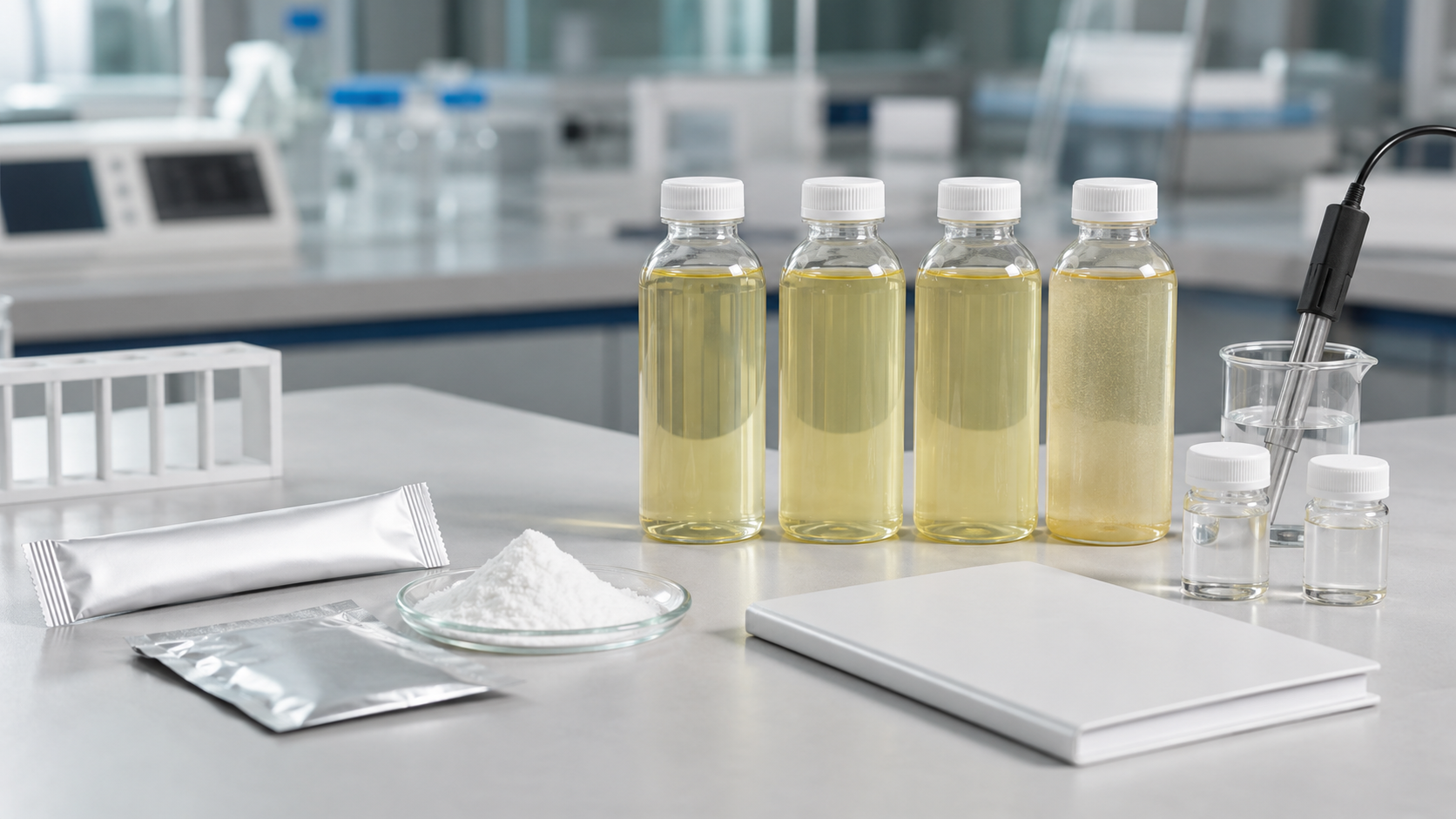
Creatine monohydrate has limited solubility in water, and a multi-gram dose can produce visible sediment or a particulate mouthfeel. Finer particles may reduce perceived grittiness in some systems, but they can also change wetting, agglomeration, dusting and blend flow. Particle-size distribution, water volume, mixing method and expected standing time should be evaluated together.
Carbohydrate and electrolyte choices also shape sweetness, saltiness and flavour intensity. Bench trials should compare the complete formula at the intended dilution and consumption temperature rather than evaluating creatine or the flavour system in isolation.
What Brands and OEMs Should Confirm
- the creatine dose and whether it fits the serving size without unacceptable sediment or mouthfeel;
- the role of carbohydrate—retention strategy, recovery nutrition, flavour contribution or energy delivery;
- the electrolyte profile in relation to fluid volume, use occasion and regulatory limits;
- finished-drink osmolality and gastrointestinal tolerance where these are relevant;
- creatine and creatinine results after processing and during RTD shelf life;
- packaging, moisture protection and mixing instructions for dry formats.
Practical Conclusion
Human evidence supports increased creatine retention when creatine is consumed with large carbohydrate loads under specific loading conditions. It does not define a universal carbohydrate dose for sports drinks. Electrolytes should be included because the intended hydration scenario requires them—not because their combination with creatine has been shown to create a unique effect.
For most projects, dry powders and stick packs provide the simplest balance of dose flexibility and stability. RTDs are feasible, but pH, thermal exposure and shelf life make finished-product analytical validation essentia
Need Creatine Monohydrate for a Sports or Recovery Formula?
SRS Nutrition Express supplies creatine monohydrate in multiple particle-size specifications for sports and recovery product development. Brands and OEMs can request specifications, a representative CoA, available density and particle-size information, sample options, current availability and quotation.
For RTD concepts, SRS can provide raw-material specifications and available technical information. Finished-product processing and shelf-life stability must be established by the brand, OEM or a qualified application laboratory using the proposed formula and packaging system.
Evidence Boundaries
- The carbohydrate studies used large, short-term dosing protocols and do not establish an optimal commercial carbohydrate level.
- Evidence for a specific creatine–electrolyte synergy is limited.
- Osmolality, taste, sedimentation and gastrointestinal tolerance depend on the complete formula and serving conditions.
- Dry-powder stability does not demonstrate creatine stability in an acidic RTD.
- A raw-material CoA does not prove finished-product stability, performance or a market-specific health claim.
References
- Green AL, Hultman E, Macdonald IA, Sewell DA, Greenhaff PL. Carbohydrate ingestion augments skeletal muscle creatine accumulation during creatine supplementation in humans. American Journal of Physiology. 1996;271(5 Pt 1):E821–E826. https://doi.org/10.1152/ajpendo.1996.271.5.E821
- Green AL, Simpson EJ, Littlewood JJ, Macdonald IA, Greenhaff PL. Carbohydrate ingestion augments creatine retention during creatine feeding in humans. Acta Physiologica Scandinavica. 1996;158(2):195–202. https://doi.org/10.1046/j.1365-201X.1996.528300000.x
- Steenge GR, Simpson EJ, Greenhaff PL. Protein- and carbohydrate-induced augmentation of whole body creatine retention in humans. Journal of Applied Physiology. 2000;89(3):1165–1171. https://doi.org/10.1152/jappl.2000.89.3.1165
- Jäger R, Purpura M, Shao A, Inoue T, Kreider RB. Analysis of the efficacy, safety, and regulatory status of novel forms of creatine. Amino Acids. 2011;40(5):1369–1383. https://doi.org/10.1007/s00726-011-0874-6
- Ganguly S, Jayappa S, Dash AK. Evaluation of the stability of creatine in solution prepared from effervescent creatine formulations. AAPS PharmSciTech. 2003;4(2):E25. https://doi.org/10.1208/pt04022
Post time: Aug-31-2026


