

A European warehouse quotation may look more expensive per kilogram. A direct factory quotation may look cheaper. Neither comparison is useful until both routes include the same quantity, grade, delivery responsibility and quality scope.
For creatine buyers, the best route usually depends on four questions: how much material is required, when production starts, who will manage the import and whether the available batch matches the approved specification.
Start With the Production Deadline
If production begins within weeks, material already released and stored in Europe may remove much of the international transport and import lead time. The buyer may still need to arrange local collection, receiving inspection and internal quality release, but the supply chain is shorter.
That advantage only exists when the required creatine grade, quantity and documentation are actually available. “In EU stock” should therefore be confirmed against:
- the physical quantity available for sale;
- manufacturing lot and grade;
- commercial-lot COA;
- remaining shelf life or retest period;
- packaging condition;
- pickup or delivery location.
A warehouse listing is not proof that the material is uncommitted, released or suitable for the intended product.
When European Stock Makes More Sense
European stock is often worth evaluating for pilot production, urgent replenishment, smaller orders or customers that do not want to manage a direct import.
Local stock may also help when a brand needs several hundred kilograms before committing to a larger annual program. The higher unit price can reflect earlier freight, customs handling, warehousing and inventory financing rather than a difference in the creatine itself.
For an urgent production run, the practical value of local stock may outweigh a higher unit price.

Buyers should still confirm whether the quotation is FCA warehouse, delivered locally or based on another agreed term. Collection, pallet configuration and local freight can materially affect the final cost.
When Direct Factory Shipment Becomes More Attractive
Direct shipment is generally more relevant when the buyer has predictable demand, sufficient order volume and time to manage production, testing, export preparation and international transport.
It may also offer more flexibility for:
- 80-, 200- or 500-mesh creatine;
- high-density or application-specific requirements;
- customer-approved specifications;
- alternative packaging configurations;
- pre-shipment testing;
- full-pallet, multi-tonne or container orders.

Direct import also assigns more work somewhere in the transaction. An EORI number is mandatory for EU customs clearance, and import VAT is normally addressed during customs release. The responsible importer, customs broker and document flow should therefore be agreed before shipment—not after the container arrives. [1–3]
Compare Total Landed Cost, Not the First Price
A useful comparison should place both options at the same delivery point.
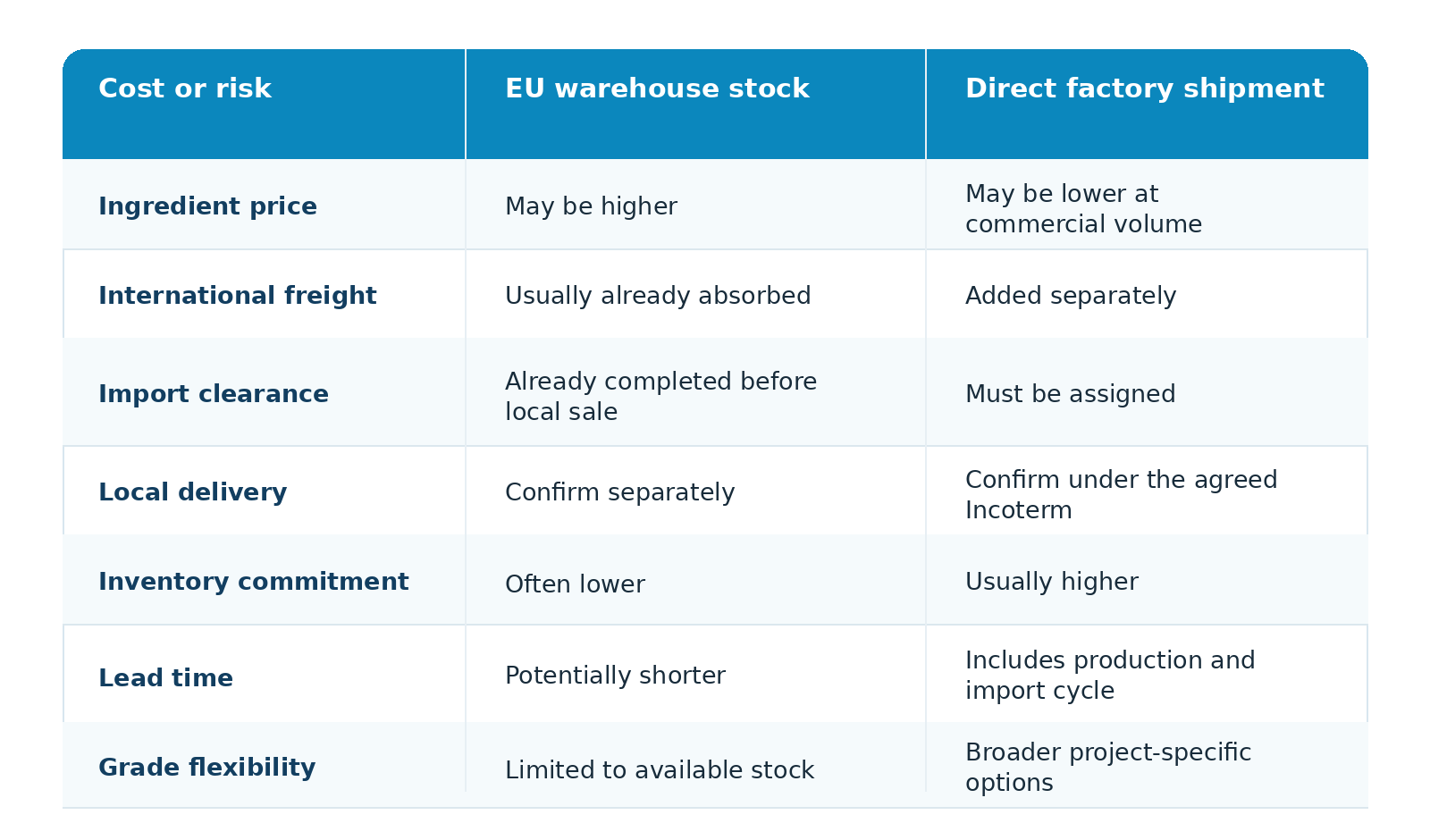
Incoterms clarify the tasks, costs and risks assigned to the seller and buyer; they do not determine product quality or total landed cost by themselves. The named place must also be stated clearly. [4]
The Batch Still Has to Fit the Product
Neither route removes the need for technical qualification.
For EU stock, verify that the available lot matches the approved grade and has sufficient remaining shelf life. For direct shipment, confirm the commercial specification, test methods, packaging and release documents before production or allocation.
A lower delivered cost is not a saving if the powder creates filling problems, misses a required particle-size profile or arrives without the documents needed for release.
A Hybrid Supply Plan Can Be More Practical
The choice does not always need to be permanent. A brand may use European stock for a qualification run or urgent launch, then move repeat demand to planned factory shipments.
Another option is to import commercial volume directly while maintaining a smaller European buffer for unexpected demand. Any reserved inventory, storage period, call-off schedule and ownership terms must be agreed commercially; warehouse stock should never be assumed to be a free supply guarantee.
Compare Creatine Supply Routes With SRS
SRS Nutrition Express can review European-stock and direct-shipment options for a specific creatine project.
Send us:
- required grade and specification;
- quantity and annual forecast;
- destination and requested delivery date;
- preferred packaging;
- required batch documents and testing;
- intended product format.
Where the requested grade and quantity are available, SRS can provide the applicable batch information and local supply proposal. For planned commercial demand, we can also discuss factory shipment, packaging, documentation and delivery terms.
Evidence Boundaries
- European stock availability, batch, quantity and remaining shelf life must be confirmed at the time of quotation.
- Direct shipment is not automatically cheaper after freight, import costs and inventory carrying costs.
- Incoterms allocate delivery responsibilities and risk; they do not replace a supply contract or quality agreement.
- The buyer remains responsible for confirming applicable import, tax and finished-product requirements.
Recommended Reading
- → How Much Creatine Should You Order for a Product Launch?
- → Creatine Annual Purchasing and Delivery Planning
- → What Should You Include in a Creatine Monohydrate RFQ?
References
- European Commission. Economic Operators Registration and Identification Number.
- European Commission. Guide for Import of Goods.
- European Commission. Value Added Tax on Imported Goods.
- International Chamber of Commerce. Incoterms Rules.
Post time: Oct-26-2026


