

“Please quote creatine monohydrate” may start a conversation, but it is not enough to produce a reliable commercial offer.
A supplier can respond with a price, yet that price may assume the wrong particle size, packaging, quantity, delivery term or quality specification. Once these details are corrected, the apparent low-cost offer may no longer be the lowest-cost option.
A useful creatine monohydrate RFQ should allow suppliers to quote the same requirement—and allow procurement, formulation and quality teams to compare more than price per kilogram.
1 Start With the Finished-Product Application
State how the creatine will be used:
- powder or pre-workout blend
- capsules or tablets
- gummies
- stick packs
- ready-to-mix beverages
- another finished-product format
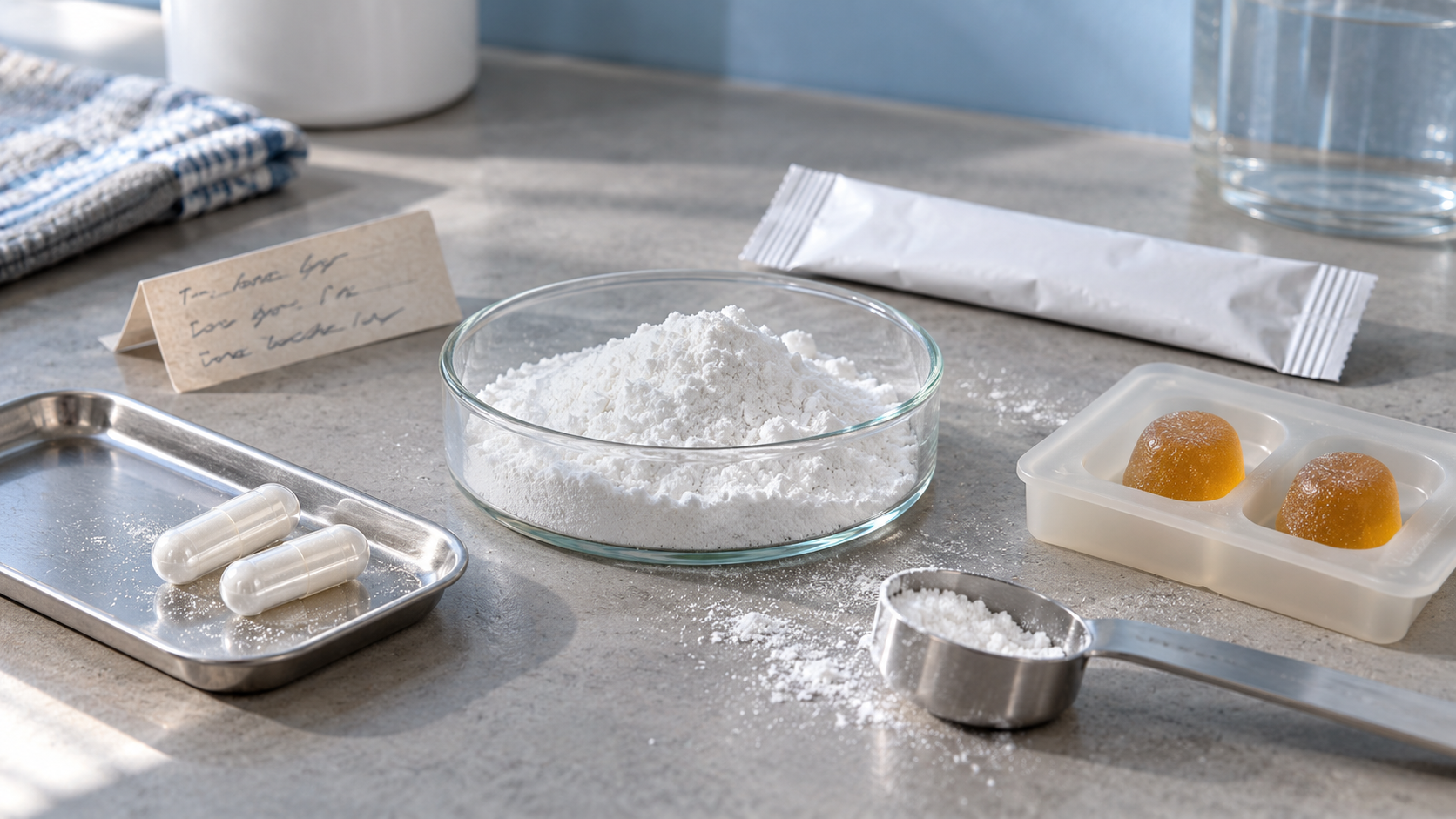
The application affects which physical properties need attention. A capsule project may depend on bulk density, flow and achievable fill weight. A drink powder may place greater emphasis on particle-size distribution, dispersibility and mouthfeel. A gummy project may require evaluation of mixing, processing conditions, moisture and finished-product stability.
A supplier cannot guarantee finished-product performance from a grade name alone, but knowing the application makes the first sample recommendation more relevant.

2 Identify the Grade—Without Relying Only on Mesh
If your approved specification already names a grade, include it. If it does not, describe the performance you need rather than requesting the finest available powder.
An RFQ may include:
- requested grade or nominal mesh;
- particle-size specification and test method;
- Dv(10), Dv(50) and Dv(90), where relevant;
- untapped or tapped bulk density;
- flow or application-specific requirements;
- an existing reference sample or specification.
An “80 mesh,” “200 mesh” or “500 mesh” label is not a complete particle-size distribution. Two materials carrying the same mesh description can differ in fines, density, cohesion and processing behaviour.
3 Define the Chemical and Microbiological Specification
Attach your approved specification whenever possible. At minimum, clarify:
- identity and assay requirement;
- assay reporting basis;
- as-is or dried-basis;
- water/LOD limits;
- Creatinine, DCD and DHT;
- Heavy metals (Pb, Cd, As, Hg);
- Microbiological limits;
- Specific market criteria.
For US dietary-supplement manufacturing, reliance on a supplier COA requires qualification; the COA is not a substitute for the buyer’s quality system. [1–3]
4 State the Quantity and Commercial Stage
“Best price” has little meaning without volume. Specify the request type:
State whether partial deliveries or stock held in Europe would be useful. This allows for comparing direct shipment with local inventory.
5 Include Destination and Delivery Terms
A quote should identify what the price includes. Provide destination, Incoterms (EXW, FOB, DDP), and required delivery dates. The buyer should compare total landed cost, not only the supplier’s headline price.
6 List the Documents Needed Before Approval
- Product specification
- Representative COA
- TDS and SDS
- Flow chart
- Allergen/GMO status
- Food-safety certs
- Origin information
- Stability data
7 Make the Sample Request Match the Project
A free sample has limited value if it is not representative. Ensure the sample is large enough for analytical review and pilot processing (blending, tableting, etc.).
Copy-and-Paste Creatine RFQ Template
Application: ____________________
Requested grade/mesh: ____________________
Target specification: ____________________
Required quantity: ____________________
Estimated annual volume: ____________________
Packaging requirement: ____________________
Destination & Postal code: ____________________
Preferred Incoterm: ____________________
Required delivery date: ____________________
Documents required: ____________________
Sample qty & trial type: ____________________
Request a Creatine Quote From SRS
SRS Nutrition Express supplies creatine monohydrate in multiple particle-size grades and supports qualification projects with grade-specific specifications, samples and commercial-lot documentation. Send us your project details for a tailored recommendation.
Evidence Boundaries
- A quotation does not confirm material suitability for every application.
- Mesh designation alone does not define complete particle-size distribution.
- A representative COA differs from a commercial lot COA.
- Buyers are responsible for qualifying suppliers and validating performance.
Recommended Reading
References
- Electronic Code of Federal Regulations. 21 CFR §111.70
- Electronic Code of Federal Regulations. 21 CFR §111.75
- U.S. Food and Drug Administration. Small Entity Compliance Guide: CGMP for Dietary Supplements.
- U.S. Food and Drug Administration. GRAS Notice No. 931: Creatine Monohydrate
Post time: Oct-07-2026


