

H1: Global Creatine Supply in 2026: What Brands Should Monitor
There is no complete, independently audited database showing global creatine output, plant utilization or available inventory. Public evidence does, however, show a market where demand is expanding while new capacity remains at very different stages of approval, construction, commissioning and commercial release.
SPINS data cited by NutraIngredients showed U.S. creatine retail sales rising 60.6% year over year. That does not prove a global raw-material shortage, but it confirms that demand at the consumer end is growing quickly.
H2: Creatine Demand Is Growing Through New Formats
Powders still accounted for 74.7% of creatine category dollar sales in SPINS data published in April 2026. At the same time, creatine gummies increased 277% in dollar sales and 244% in unit sales.
Creatine is also appearing in beverages, soft chews and combination products, expanding the category beyond its traditional gym audience.
This matters to ingredient buyers because format growth can create new demand rather than simply moving existing consumers from one powder brand to another.
H2: New Creatine Capacity Does Not Become Inventory Overnight
Alzchem provides one useful European example.
The company reported that almost all available creatine capacity was called off and sold during the first quarter of 2024. An incremental expansion commissioned in the third quarter of 2025 began making a significant volume contribution in the first quarter of 2026.
Alzchem has also approved an approximately €120 million investment covering creatine production, precursor capacity, laboratories and supporting infrastructure. Staged commissioning is not expected to begin until the second half of 2027.
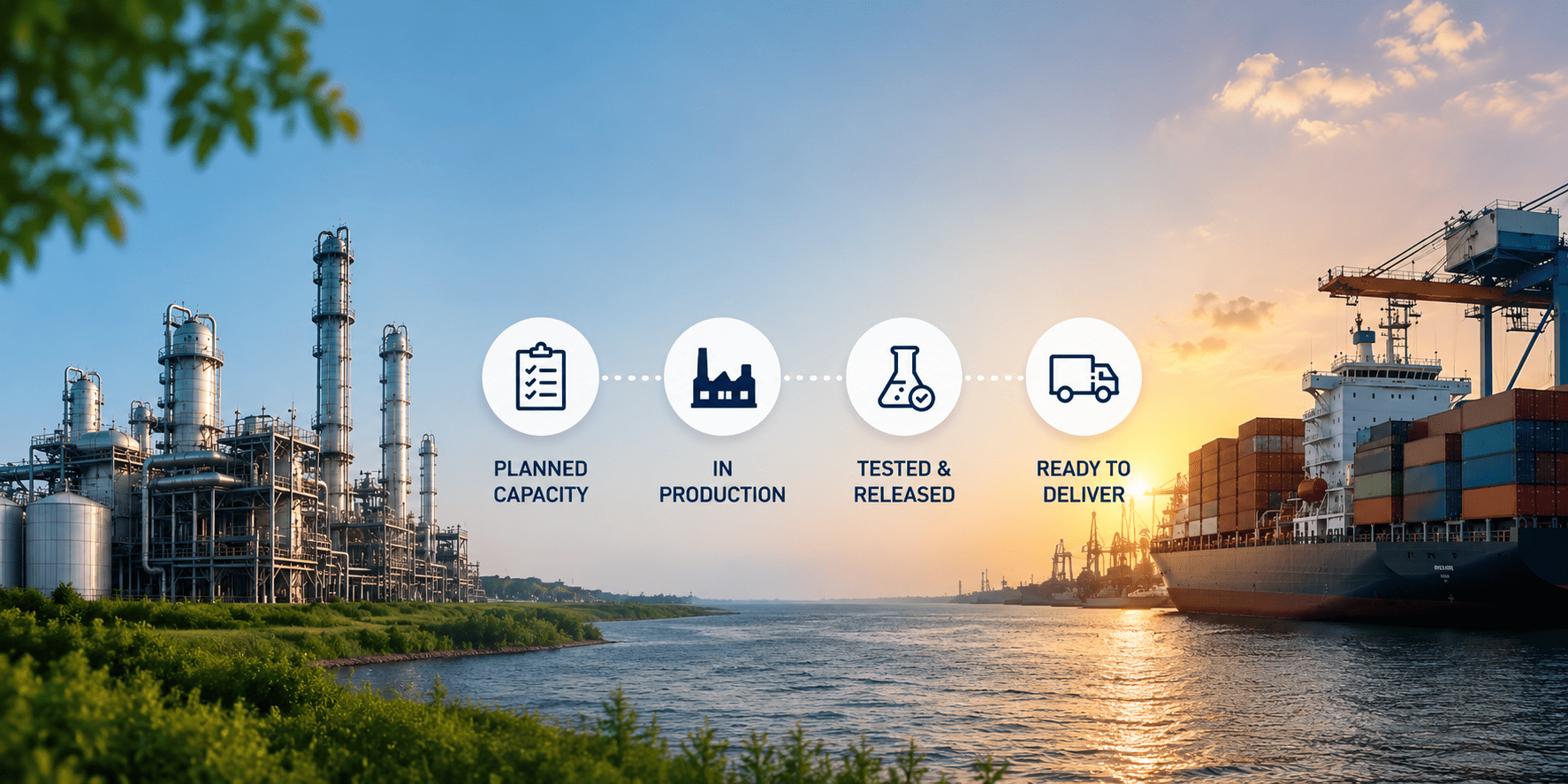
The lesson is not that every factory requires the same timeline. It is that announced capacity still has to pass through construction, commissioning, process stabilization, testing and customer qualification before it becomes sellable material.
H2: Asian Project Filings Show Capacity—But Not One Supply Status
Government records show several creatine projects under development in Asia, but they are not all at the same stage.
In September 2025, Chinese regulators approved the environmental documentation for a Shandong Aifute project covering 20,000 metric tons of sodium sarcosinate and 5,000 metric tons of creatine monohydrate per year. Approval confirms the project plan; it does not confirm that the full capacity is already operating or available for export.
In Inner Mongolia, public documents describe an expansion involving 1,500 metric tons of creatine monohydrate per year. The project appeared in public-participation documentation in late 2024 and in a proposed approval notice in March 2025. These are signs of investment, not evidence of released inventory.
A third case shows why operating status also requires context. Ningxia Taikang’s 1,500-ton high-purity creatine line began production in August 2023, but the company was fined RMB 700,000 because required environmental facilities had not been completed. Its wastewater-treatment station was completed in May 2024 and began commissioning in June; later government reporting stated that the related rectification passed expert acceptance in July 2025.
Together, these examples show why project capacity, operating capacity and compliant commercial output should not be treated as the same number.
H2: Why Creatine Sourcing Cannot Be Based on Price Alone
A quotation rarely shows the full supply position. Brands should confirm whether the volume is:
- · already produced and released;
- · reserved against a production allocation;
- · waiting for analytical testing;
- · or dependent on a future batch.
Technical comparability also matters. Creatine assay, creatinine, DCD, DHT, heavy metals, microbiological limits, particle size, bulk density and packaging can all affect processing and finished-product release.
A lower quotation may create a higher total cost when delays, formulation changes, additional testing or rejected production time are included.
H2: When Should Brands Secure Creatine Supply?
Earlier planning becomes more important when a launch date is fixed, retail promotions have been booked, consumption is growing quickly or only one source has been approved.
A practical plan should distinguish between:
- · forecast demand;
- · purchase orders;
- · confirmed production allocation;
- · tested and released inventory;
- · stock already in transit.
These quantities may look similar in a spreadsheet, but they represent different levels of supply certainty.
A second source should also be sampled, tested and approved before the primary route is disrupted. A supplier name on a backup list is not yet a qualified supply route.
H2: European and Asian Creatine Supply Work Differently
The global creatine supply structure is concentrated but not simple. Alzchem represents the main publicly documented Western production base, while Asian supply is distributed across a larger group of manufacturers.
Public filings indicate that additional capacity is being planned in Asia. However, there is no consolidated, independently audited dataset showing how much of that capacity is operating, qualified for export or available as released inventory.
For overseas buyers, announced annual capacity is therefore less useful than five practical questions:
- · Has the material already been produced?
- · Has the batch completed testing and release?
- · Is the volume allocated to a confirmed customer order?
- · Can the supplier maintain the same specification across future batches?
- · Does the producer have a reliable export and delivery record?
European sourcing may offer branded origin and a more concentrated traceability route. Asian sourcing may offer broader supplier choice and greater commercial flexibility. Neither geography removes the need for qualification.
Assay, creatinine, DCD, DHT, heavy metals, microbiological limits, particle size, bulk density and batch consistency still need to be reviewed against the requirements of the finished product.
For brands, a dependable second source is not simply another quotation. It is material that has already been sampled, tested, approved and incorporated into the supply plan before disruption occurs.
H2: References
1. SPINS. What SPINS Saw at Expo West 2026. April 2026.
2. NutraIngredients. Alzchem Confronts Capacity Pressures as Demand for Creatine Booms. May 2026.
3. Alzchem Group AG. Quarterly Statement Q1 2026.
4. Alzchem Group AG. Company Presentation, May 2026.
5. Jining Municipal Ecology and Environment Bureau. Approval of Shandong Aifute’s 5,000-Ton Creatine Monohydrate Project. September 2025.
6. Wuhai Municipal Ecology and Environment Bureau. Inner Mongolia Yize 1,500-Ton Creatine Monohydrate Project Documents. 2024–2025.
Shizuishan Municipal Government. Rectification Records for Ningxia Taikang’s 1,500-Ton High-Purity Creatine Project. 2025–2026.
Post time: Jul-23-2026


