

Sending the same creatine sample to two laboratories does not guarantee comparable results. Differences in procedure, reference standard, sample preparation, moisture correction or calculation basis can produce two defensible—but commercially conflicting—numbers.
A method transfer is intended to establish that the receiving laboratory can perform an analytical procedure as intended. It is not simply a second test and should not begin after one laboratory has already reported an unexpected result.
Method Transfer Is Different From Retesting
Retesting asks whether a result can be reproduced. Method transfer asks whether another laboratory has the equipment, instructions, materials and technical understanding required to perform the procedure correctly.
USP General Chapter <1224> describes analytical procedure transfer as a documented process used to qualify a receiving laboratory to perform a procedure originating elsewhere. Depending on the situation, the approach may involve comparative testing, co-validation, partial or complete revalidation, or a scientifically justified transfer waiver.
For creatine projects, this distinction matters when:
- a buyer replaces its contract laboratory;
- a manufacturer and customer use different laboratories;
- a method moves from an ingredient supplier to an OEM;
- a raw-material method is adapted for a finished product;
- two laboratories repeatedly report different assay or impurity results.
Start With the Intended Analytical Result
Before transferring the procedure, both laboratories should agree on exactly what is being measured.
For a creatine assay, confirm whether the result is expressed as:
- creatine monohydrate;
- anhydrous creatine equivalent;
- an as-is result;
- a dried-basis result.
The protocol should also identify the applicable specification, reporting unit, calculation formula and rounding convention. A transfer can appear unsuccessful when the laboratories are actually reporting different analytes or applying different moisture corrections.
The method must also suit the sample matrix. A procedure used for unflavoured creatine monohydrate may not be sufficiently selective for a gummy, capsule blend or flavoured powder containing other ingredients.
Build a Complete Transfer Package
The receiving laboratory needs more than a short method summary. The transfer package should include:
- the controlled analytical procedure and current version;
- sample preparation and dilution instructions;
- instrument parameters and system-suitability requirements;
- chromatographic integration rules;
- reference-standard identity, lot and assigned potency;
- calculation formulas and reporting basis;
- representative chromatograms or other raw-data examples;
- known interferences, critical steps and handling precautions;
- approved specification and reporting template.
ICH Q2(R2) treats validation as evidence that an analytical procedure is fit for its intended purpose. ICH Q14 places the procedure within a lifecycle that includes knowledge management, risk assessment and management of later changes. These documents concern pharmaceutical analytical procedures, but their scientific principles can provide a useful framework for creatine method transfer.

Use Common Samples and Reference Materials
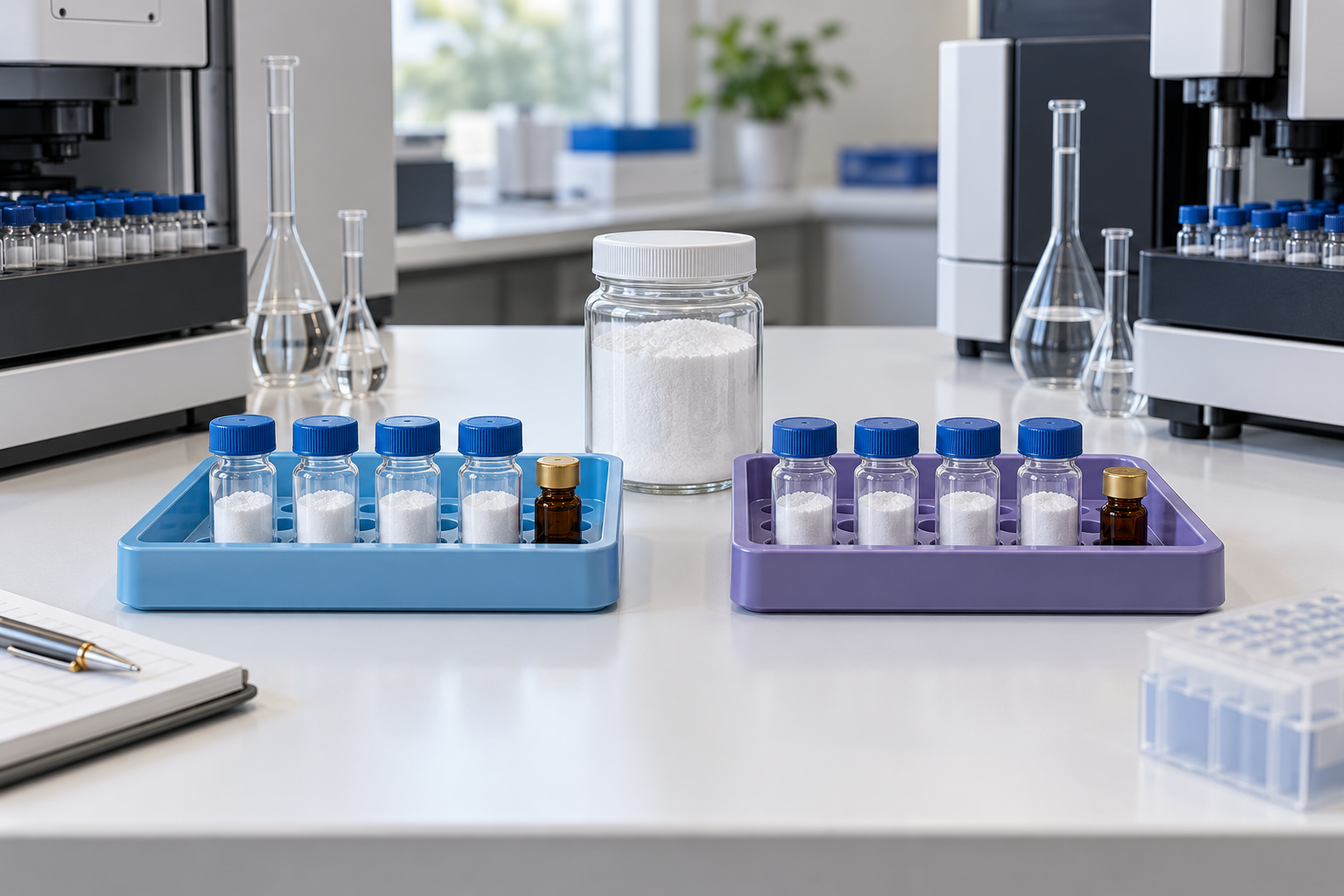
A useful comparison requires controlled materials. Both laboratories should test samples from the same homogeneous source, preferably supplied and identified under an agreed sampling plan.
The study may include:
- a representative commercial-lot sample;
- a second lot covering normal product variation;
- a sample near a relevant specification limit, when legitimately available;
- the same reference-standard lot or fully documented equivalent standards;
- blank or matrix samples where finished products are involved.
Sending separately collected samples from different bags can introduce sampling variation before laboratory performance is compared. For particle size, bulk density or other physical measurements, conditioning and sample handling may be as important as the instrument itself.
Agree on Acceptance Criteria Before Testing
The protocol should state how comparability will be evaluated before either laboratory knows the results.
Acceptance criteria should reflect the method, specification, analytical variability and intended decision. They should not be invented after an unexpected comparison appears.
Depending on the procedure, the plan may evaluate:
- system suitability;
- individual and mean results;
- repeatability within each laboratory;
- differences between laboratories;
- accuracy or recovery;
- impurity detection and quantification capability;
- chromatographic selectivity.
There is no universal percentage-difference limit for every creatine procedure. A suitable criterion for a high-level assay may be inappropriate for a trace impurity such as creatinine, DCD or DHT.
Investigate Differences Instead of Testing Into Agreement
If the transfer does not meet its predefined criteria, compare the complete analytical records rather than immediately testing more samples.
Review preparation weights, dilutions, standard potency, instrument configuration, system suitability, calculations, integrations and moisture corrections. Also determine whether the analyst received adequate method-specific training.
A transfer failure does not automatically prove that the commercial batch is defective. Likewise, a later passing run should not erase the original discrepancy without a documented scientific explanation.
FDA’s OOS guidance emphasizes investigating the original result and avoiding repeated testing designed merely to obtain a passing outcome. Although the guidance is written for pharmaceutical production, the same principle is relevant when laboratories investigate conflicting creatine results.
Document Approval and Future Changes
The final report should identify the laboratories, procedure version, instruments, analysts, samples, standards, raw results, deviations, statistical evaluation and conclusion.
Approval should also define which changes require reassessment. A new chromatographic column, different reference-standard source, revised sample preparation, new instrument platform or change from raw material to finished-product testing may justify additional verification or partial revalidation.
For U.S. dietary supplements, 21 CFR §111.75 requires tests used to determine compliance with specifications to be appropriate and scientifically valid. A successful transfer supports laboratory comparability, but it does not remove the manufacturer’s responsibility to establish suitable specifications and testing controls.
How SRS Supports Creatine Laboratory Comparisons
When laboratories report different creatine results, SRS Nutrition Express can provide the applicable specification, lot COA, reporting basis, available method information, batch traceability and appropriately identified retained or representative samples.
Send SRS both complete laboratory reports, including the method, sample preparation, units, calculations and chromatograms where available. This makes it possible to identify differences in terminology, method conditions or sample identity before further testing is arranged.
SRS does not validate or approve a customer laboratory. Final method suitability, transfer acceptance and batch disposition remain the responsibility of the relevant laboratories and quality teams.
Evidence Boundaries
- Method transfer is not the same as routine retesting.
- A successful raw-material method transfer does not prove suitability for every finished-product matrix.
- USP, ICH and FDA pharmaceutical guidance provide useful scientific frameworks but are not automatically mandatory procedures for every creatine ingredient transaction.
- Acceptance criteria must be defined for the specific method and intended use.
- Comparable laboratory results do not replace representative sampling or finished-product validation.
Recommended Reading
- How to Investigate an Out-of-Specification Creatine Result
- Creatine Assay Explained: Monohydrate Basis vs Anhydrous Creatine Basis
- How to Read a Creatine Monohydrate Specification Sheet
References
- United States Pharmacopeia. General Chapter <1224>: Transfer of Analytical Procedures.
- International Council for Harmonisation. ICH Q2(R2): Validation of Analytical Procedures. 2023.
- International Council for Harmonisation. ICH Q14: Analytical Procedure Development. 2024.
- U.S. Food and Drug Administration. Analytical Procedures and Methods Validation for Drugs and Biologics. 2015.
- U.S. Food and Drug Administration. Investigating Out-of-Specification Test Results for Pharmaceutical Production. 2022.
- Electronic Code of Federal Regulations. 21 CFR §111.75—Testing and Examination Requirements
Post time: Sep-16-2026


