

A formula containing 1,000 mg of L-carnitine L-tartrate does not provide 1,000 mg of L-carnitine. Part of the ingredient’s weight comes from L-tartaric acid, which forms the salt and contributes to its physical properties.
This distinction affects serving calculations, label declarations, capsule or tablet size and supplier comparisons. Before approving a specification, buyers need to know whether the reported result refers to the complete salt or to its L-carnitine equivalent.
What Is L-Carnitine L-Tartrate?
L-carnitine L-tartrate, commonly abbreviated as LCLT, is formed from L-carnitine and L-tartaric acid. The commonly described composition contains two molecules of L-carnitine for each molecule of L-tartaric acid.
PubChem lists levocarnitine tartrate with the molecular formula C₁₈H₃₆N₂O₁₂. Based on the idealised 2:1 composition:
- ✓ two L-carnitine molecules contribute approximately 322.4 g/mol;
- ✓ one L-tartaric acid molecule contributes approximately 150.1 g/mol;
- ✓ the complete salt has a calculated molecular weight of approximately 472.5 g/mol.
The theoretical L-carnitine proportion is therefore approximately:
322.4 ÷ 472.5 × 100 = 68.2%
The remaining approximately 31.8% is attributable to the tartaric-acid portion. FDA’s GRAS Notice 993 also describes the evaluated LCLT ingredient as approximately 68% L-carnitine and 32% L-tartaric acid.
Free L-Carnitine Equivalent Is Not Total Salt Weight
“L-carnitine equivalent” refers to the amount of L-carnitine represented within the salt. It should not be confused with the total weight of LCLT added to the formula.
For example, if the material provides 68.2% L-carnitine:
1,000 mg LCLT × 68.2% = approximately 682 mg L-carnitine
Conversely, a product targeting 1,000 mg of L-carnitine from LCLT theoretically requires:
1,000 mg ÷ 0.682 = approximately 1,466 mg LCLT
This calculation is a formulation estimate. Commercial input should use the approved raw-material assay rather than relying only on the theoretical percentage.

Why Do COA Results Sometimes Appear Different?
A COA may report:
- L-carnitine content;
- L-carnitine L-tartrate assay;
- L-carnitine equivalent;
- assay on an as-is basis;
- assay on a dried basis;
- a range rather than a single theoretical value.
These are not automatically interchangeable. Moisture, residual solvents, manufacturing variation, impurities and the calculation basis can affect the reported percentage. A dried-basis result mathematically corrects for measured moisture, whereas an as-is result represents the sample in the condition received.
Before comparing two suppliers, confirm the analyte, method, units and reporting basis. A result of “99%” is not meaningful if one supplier means total LCLT and another means L-carnitine content.
Does 68% L-Carnitine Prove the Material Is LCLT?
Not by itself. A result close to 68% may be consistent with the theoretical composition, but one numerical assay cannot independently establish identity, stereochemistry, salt ratio or impurity control.
A complete qualification program may include:
- identification testing;
- L-carnitine assay;
- tartaric-acid or compositional testing where required;
- specific optical rotation;
- moisture or loss on drying;
- pH and appearance;
- related substances;
- heavy metals and microbiological criteria;
- residual solvent limits where relevant.
The specification should identify which characteristic each method is intended to confirm.
Which Analytical Method Should Buyers Review?
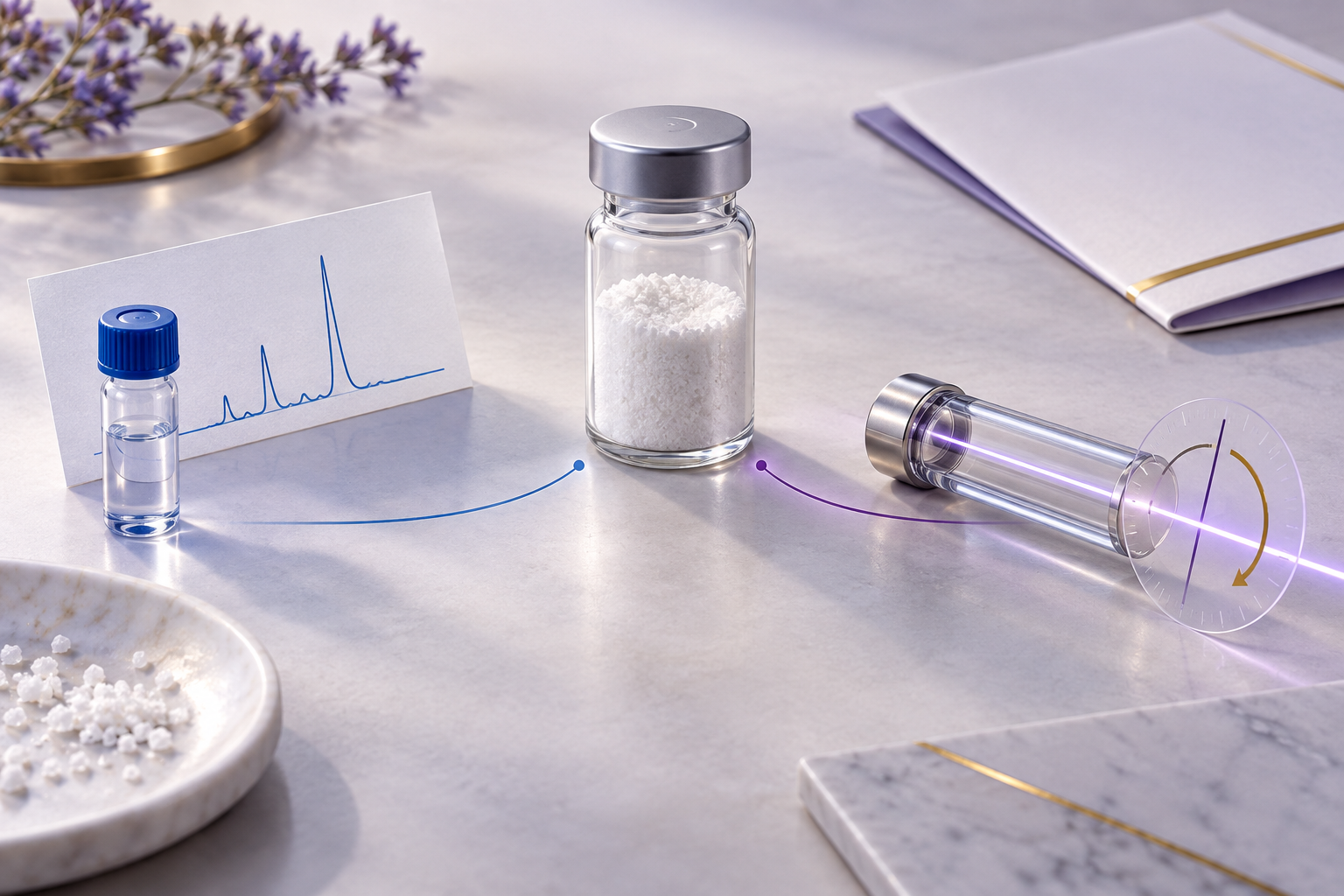
L-carnitine can be measured using chromatographic or other scientifically valid methods. HPLC methods may require appropriate detection conditions because L-carnitine has limited native ultraviolet absorption.
A method suitable for a relatively pure LCLT raw material may not perform equally well in a finished product containing amino acids, vitamins, flavours or other compounds. Recovery, specificity, sample preparation, reference-standard assignment and calculation basis should be demonstrated for the intended matrix.
Specific optical rotation can support identity and stereochemical control, but it is not a substitute for quantitative assay or impurity testing.
How Does the Assay Affect Finished-Product Design?
The difference between total salt weight and L-carnitine equivalent affects:
- capsule or tablet count;
- powder serving size;
- label and claim wording;
- excipient capacity;
- active cost per serving;
- finished-product assay targets.
For a formula targeting 2 g of L-carnitine equivalent, theoretical LCLT input would be approximately 2.93 g before considering the approved assay, moisture and any justified manufacturing adjustment.
If the front label states “L-Carnitine L-Tartrate 2,000 mg,” that communicates something different from “L-Carnitine 2,000 mg from L-Carnitine L-Tartrate.” Regulatory wording should be reviewed for the intended market.
What Should Buyers Request From a Supplier?
Before approving commercial material, request:
- grade-specific specification;
- batch COA with numerical results;
- L-carnitine assay method and reporting basis;
- identity and optical-rotation requirements;
- moisture or loss-on-drying method;
- relevant impurity limits;
- contaminant and microbiological criteria;
- representative sample for formulation testing;
- packaging, storage and retest information.
The quotation should also state whether pricing comparisons are based on kilograms of LCLT or cost per kilogram of delivered L-carnitine equivalent.
How SRS Can Support L-Carnitine Formulation
SRS Nutrition Express supplies L-carnitine and L-carnitine L-tartrate raw materials for dietary-supplement and sports-nutrition development.
We can provide grade-specific specifications, representative COAs, assay information and samples for formulation assessment. Share your target L-carnitine equivalent, dosage form, serving-size limit, destination market and expected volume so the proposed material can be assessed against the actual product brief.
SRS documentation describes the supplied raw material. Finished-product content, claims and label compliance remain subject to validation in the completed formulation.
Evidence Boundaries
- The 68.2% figure is a theoretical value based on an idealised 2:1 LCLT composition.
- Commercial calculations should use the approved specification and batch data.
- A matching L-carnitine assay does not independently prove identity or stereochemical purity.
- FDA GRAS Notice 993 concerns a specified ingredient and intended infant-formula use; it is not blanket approval for every LCLT product or application.
- Finished-product label rules depend on the destination market and product category.
Recommended Reading
- Magnesium Bisglycinate Assay Explained: Elemental Magnesium vs Compound Content
- How to Read a Creatine Monohydrate Specification Sheet
- Can One Raw-Material Specification Work for Every Finished Product?
References
- National Center for Biotechnology Information. PubChem Compound Summary: Levocarnitine Tartrate, CID 57349413.
- U.S. Food and Drug Administration. GRAS Notice No. 993: L-Carnitine-L-Tartrate.
- European Commission. Commission Implementing Regulation (EU) 2015/662 concerning L-carnitine and L-carnitine L-tartrate.
- Khoshkam R, Afshar M. Validation of a Stability-Indicating RP-HPLC Method for Determination of L-Carnitine in Tablets. Journal of Analytical Methods in Chemistry. 2014.
Post time: Sep-23-2026


