

Two pea protein specifications land in your inbox. Both say 80% protein. One comes with a friendlier price.
Procurement smiles. The spreadsheet has a winner. The production trial, however, has not voted yet.
The lower-priced material may be a perfectly good choice. Before replacing an approved ingredient, though, find out what the matching number actually tells you—and what still needs a trial.
1 First, Are Those Two “80s” Speaking the Same Language?
Check whether protein is reported as-is or on a dry-matter basis. Record the test method, nitrogen-to-protein conversion factor where relevant, moisture and whether the figure is a specification minimum or an actual batch result.
For illustration: A powder containing 80% protein on a dry-matter basis and 6% moisture contains 75.2% protein as supplied: 80% × 94%. A 25 g portion would therefore contribute 18.8 g on that calculation, rather than the 20 g obtained by treating 80% as an as-is value. This is hypothetical arithmetic, not an SRS batch result or a finished-product label calculation.
Align the basis before comparing price per unit of protein. Otherwise, the spreadsheet may be comparing two different things with impressive confidence.
2 The Remaining Composition Has a Job Too
Request the relevant composition information, including moisture, fat, ash and any added ingredients. Review available particle-size and density information when mixing or filling matters. Similar total protein does not establish an identical ingredient.
Published extraction research has connected pea-protein processing and structure with differences in solubility, emulsification and gelation. Those studies support checking functionality separately from protein content; they do not establish the performance of a proposed SRS grade. [1,2]
3 Your Formula Did Not Approve the Purchase Order
Start with the actual product. A shake needs an assessment of preparation and drinking experience. A bar needs evaluation of its dough, forming behaviour and texture. A heated beverage needs trials covering its intended process and storage.
A tidy glass of powder mixed into water is a useful observation. It cannot approve a recipe containing flavours, oils, minerals or other proteins. Test the proposed grade at the intended use level with the other ingredients and processing conditions recorded.
4 A Small Trial Can Ask Some Expensive Questions
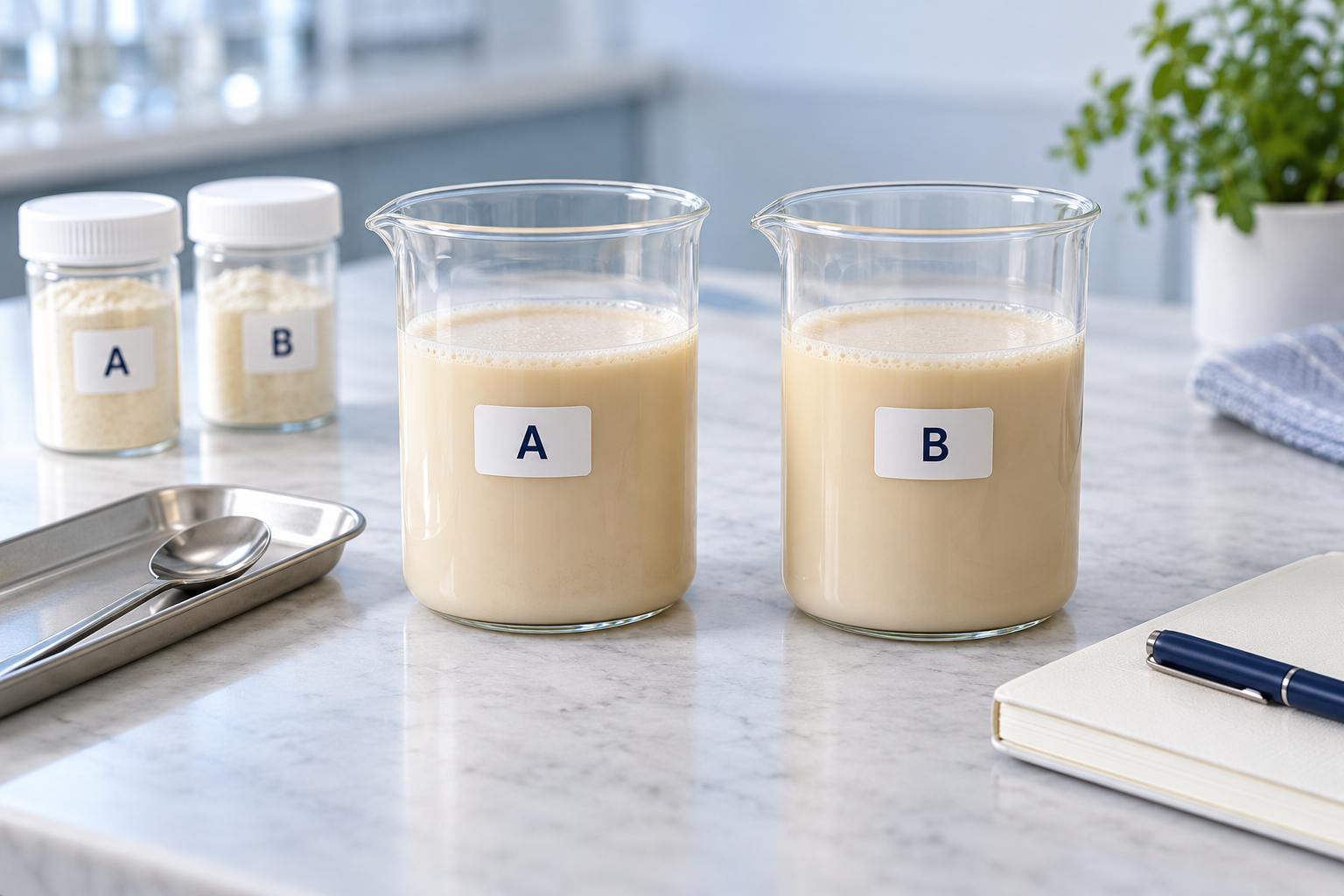
Use the approved material as a reference. For the initial comparison, hold the formula, water source, addition order, hydration time, temperature and mixing conditions steady. Code samples where practical and agree which differences are acceptable before seeing the results.
Record the properties relevant to the product: taste, mouthfeel, dispersion, viscosity, sediment or bar texture, as appropriate. Compare after the relevant processing and storage steps, not only immediately after mixing.
If the new material needs a revised formula, run that as a separate development step and document the changes. Then compare the finished result and actual costs. The cheaper ingredient may still win; it simply needs to win in the product too.
5 Let Quality Join Before the First Delivery

Review the proposed specification, representative COA, traceability and required safety or market documentation with the responsible team. Confirm which documents and checks apply to the commercial lot, and how a change will be approved by your manufacturer.
Keep the approved grade and trial conditions identifiable when ordering. Passing one sample does not settle every question about future supply.
6 Give SRS a Brief, Not a Guessing Game
Send SRS Nutrition Express your current pea-protein specification, intended application, use level, process, destination market and expected quantity. Tell us what needs to stay the same and what you want to improve, including the problem that prompted the search.
We can review available pea-protein options and discuss the specifications, supporting documents and samples available for comparison. Sample arrangements, commercial terms and any additional testing need project-specific confirmation. Your manufacturer and quality team should approve the replacement against the finished-product requirements.
Your spreadsheet can keep its favourite. Give your formula a vote before you place the order.
Evidence Boundaries
- The opening purchasing scene is illustrative, not a verified SRS customer case.
- The 80% dry-basis, 6% moisture and 25 g calculation is hypothetical; it is not a batch specification, lab result or finished-product declaration.
- Published studies concern their own materials and conditions. They do not establish equivalence, superiority or finished-product performance for an SRS grade.
- No guaranteed cost saving, direct substitution, sample quantity, test capability or commercial availability is promised. The proposed grade and finished product require project-specific review.
Recommended Reading
- Does a Smaller Peptide Always Make Pea Protein Hydrolysate Better?
- Does Extrusion Improve Pea Protein Nutrition? What a New 2026 Human Study Found
References
1. Hansen L, Bu F, Ismail BP. Structure-Function Guided Extraction and Scale-Up of Pea Protein Isolate Production. Foods. 2022;11(23):3773. DOI 10.3390/foods11233773.
2. Taherian AR, Mondor M, Labranche J, et al. Comparative study of functional properties of commercial and membrane processed yellow pea protein isolates. Food Research International. 2011;44(8):2505–2514. DOI 10.1016/j.foodres.2011.01.030.
Post time: Oct-23-2026


