

A supplier offers a tart cherry powder with a high extraction ratio. Another quotes an anthocyanin percentage. A third points to a study using juice concentrate.
All three may sound relevant to a recovery product. They do not give a buyer the same information.
Before comparing price per kilogram, establish what the proposed ingredient contains, which evidence applies to it and how much of it belongs in the intended serving. That is the starting point for evaluating tart cherry in a drink powder, capsule or other recovery format.
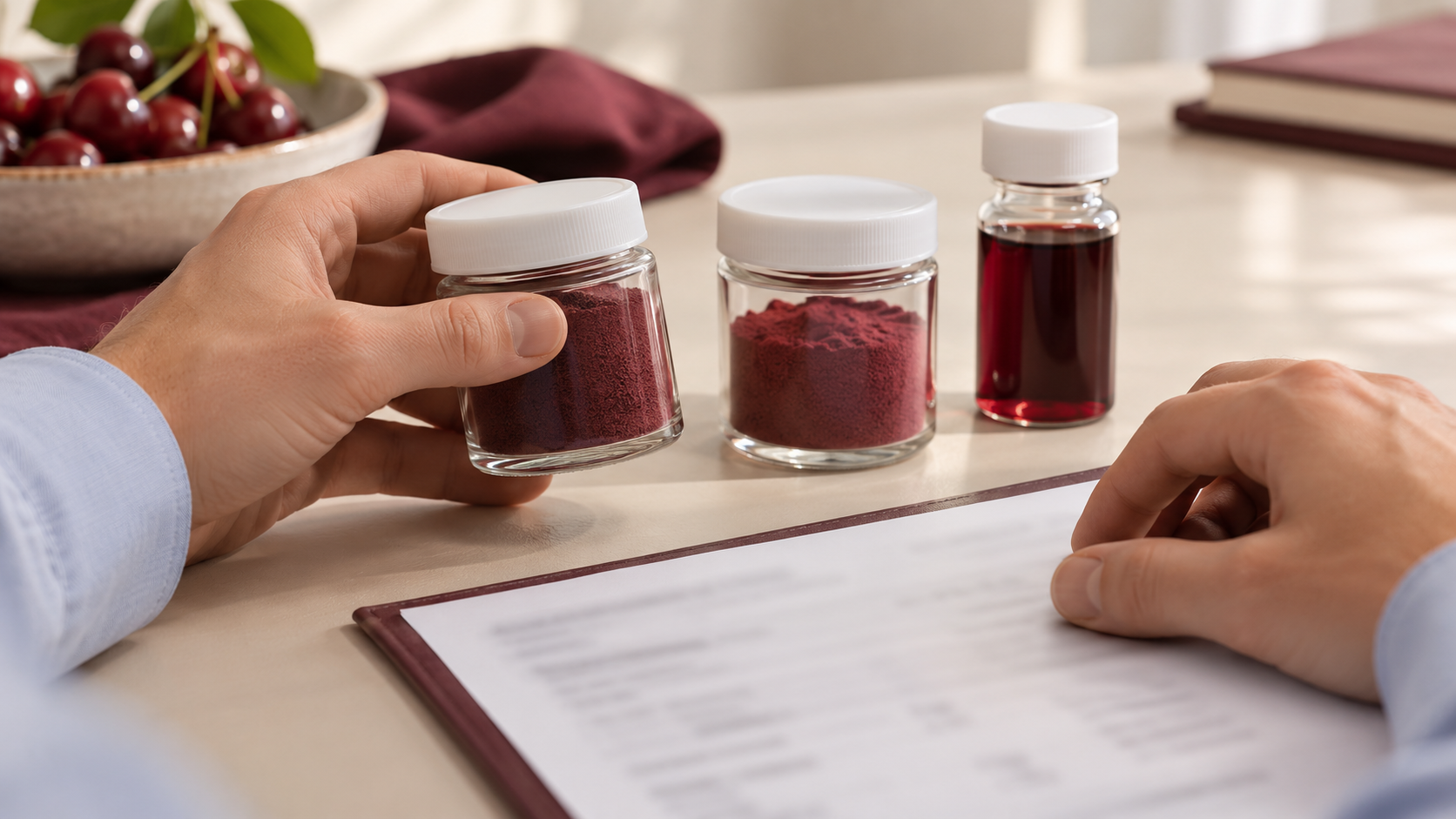
Juice, Concentrate and Extract Powder Are Different Materials
“Tart cherry” identifies the ingredient family. It does not fully describe a commercial grade.
Ask for the botanical identity, cultivar where specified, plant part and manufacturing description. Confirm whether the material is a juice powder, whole-fruit powder, skin-derived powder or selectively extracted ingredient.
For powders, request the complete composition, including carriers and other added ingredients. For liquids, obtain the composition and concentration information relevant to the project.
A 10:1 extraction ratio describes a stated relationship between starting material and extract. It does not by itself establish anthocyanin content or clinical equivalence. Likewise, an estimated number of cherries per serving cannot replace a compositional specification.
These distinctions matter when comparing a powder quotation with evidence generated using a measured volume of concentrate.
Human Recovery Research Is Promising but Not Uniform
In a 2016 trial, 16 male semi-professional soccer players consumed Montmorency tart cherry concentrate or placebo for eight days. The concentrate protocol used 30 mL twice daily, with the exercise test on day five.
Selected performance measures recovered faster and soreness ratings were lower in the concentrate group. Creatine kinase and the measured lipid-peroxidation marker did not differ.[1]
A separate 2019 randomized trial in 36 men without resistance-training experience found no significant recovery advantage from tart cherry juice after damaging elbow-flexor exercise.[2]
Powders have also been studied. A 2015 trial in resistance-trained men reported lower soreness at a specific quadriceps measurement site, while oxidative-damage and inflammatory findings remained inconclusive.[3] These findings support careful evaluation. They do not establish that every tart cherry extract improves every measure of recovery.
Match the Schedule as Well as the Serving
The concentrate study involved supplementation before and after the exercise challenge. The powder study also included several days of intake before exercise.[1,3]
That distinction matters for a product positioned as an occasional post-workout drink. A multi-day research protocol does not directly establish what happens after a single serving taken only when training ends.
When reviewing evidence, record the exact preparation, daily amount, supplementation period, exercise model and outcome. Separate perceived soreness, strength recovery and blood biomarkers; they answer different questions.
Then compare the proposed commercial usage instructions with the protocol. Any remaining gap should stay visible in the development assessment.
Ask What the Assay Actually Measures
If a supplier quotes anthocyanins or total polyphenols, request the analytical method, reporting units, reference standard or calculation basis, and whether the value is a guaranteed limit or a typical result.
Total polyphenols and anthocyanins describe different measurements. Do not treat their percentages as interchangeable.
Calculate the stated marker contribution at the intended daily ingredient intake. For illustration, 500 mg of a powder standardized to 1% anthocyanins corresponds to 5 mg of stated anthocyanins.
This is arithmetic, not an effective-dose recommendation or an SRS specification. Matching a marker quantity alone also does not prove that two preparations reproduce the same clinical effect.
Choose the Format Before Finalizing the Ingredient
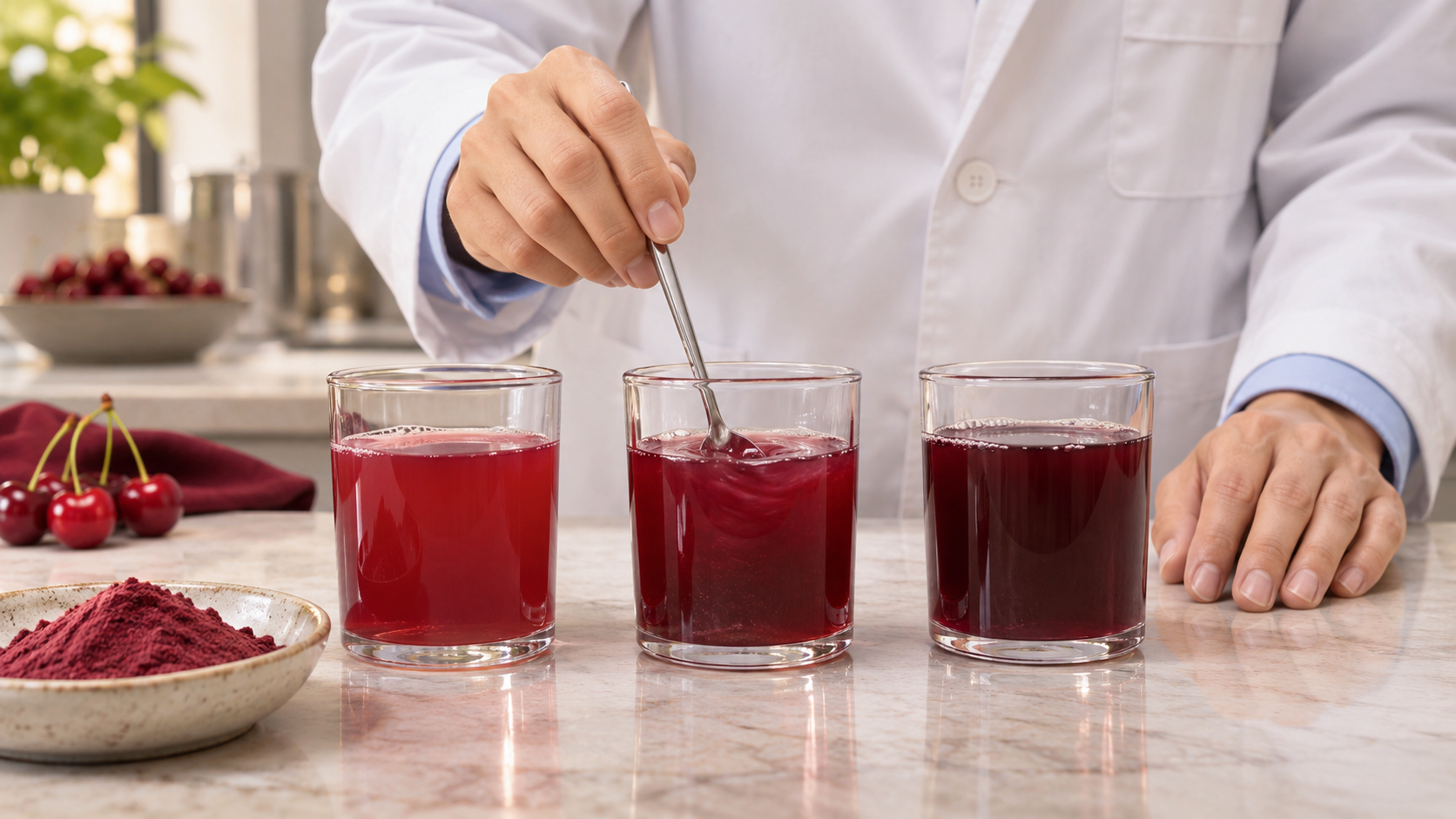
For a drink powder, evaluate taste, colour, dispersion and sediment at the actual inclusion level in the complete recipe. Repeat the assessment with the intended protein, minerals, sweeteners and flavour system.
For capsules, calculate whether the proposed daily amount fits the intended capsule count. A compact format should follow the ingredient rationale rather than dictate an unsupported dose.
A gummy or ready-to-drink concept needs assessment after processing and during storage. Initial powder results cannot establish finished-product stability.
Also define what tart cherry contributes to the product. It does not replace the protein, carbohydrate or electrolyte requirements of a broader recovery strategy.
Request a Quote You Can Evaluate
Send the supplier your destination market, product format, target user, proposed daily serving and intended positioning. Include trial quantity, expected commercial demand and any relevant certification requirements.
Request the proposed grade’s specification, representative COA, composition, analytical information and supporting studies. Ask whether those studies used the offered material or a different preparation.
Agree sample criteria with the manufacturer before purchasing. Evaluate cost per intended daily serving alongside taste, processing requirements and the strength of the evidence match.
Developing a tart cherry recovery product? Contact SRS Nutrition Express with your format, target market and formulation brief to discuss ingredient options, documentation and samples. Confirm the proposed grade and its suitability for your project before ordering.
Evidence Boundaries
- • The cited trials used particular preparations, populations and exercise protocols; their findings cannot be transferred automatically to another grade or finished blend.
- • The research examples concern recovery outcomes. They do not substantiate sleep claims or imply that tart cherry supplies a clinically relevant melatonin dose.
- • The 500 mg and 1% calculation is hypothetical. It is not an SRS batch result, product specification or recommended intake.
- • The purchasing suggestions are practical interpretation. Final suitability, stability and claims require assessment for the intended product and market.
Recommended Reading
Can One Raw Material Specification Work for Every Finished Product?
References
- Bell PG, et al. (2016). The Effects of Montmorency Tart Cherry Concentrate Supplementation on Recovery Following Prolonged, Intermittent Exercise. Nutrients, 8:441.
- Lamb KL, et al. (2019). No Effect of Tart Cherry Juice or Pomegranate Juice on Recovery from Exercise-Induced Muscle Damage in Non-Resistance Trained Men. Nutrients, 11:1593.
- Levers K, et al. (2015). Effects of powdered Montmorency tart cherry supplementation on an acute bout of intense lower body strength exercise in resistance trained males. Journal of the International Society of Sports Nutrition, 12:41.
Post time: Nov-23-2026


