A raw material may pass its identity, assay, purity and contaminant tests yet still be unsuitable for the finished product being manufactured. This is not a contradiction. Chemical specifications establish what an ingredient is and whether it meets defined quality limits. They do not fully predict how it will flow into a capsule, compact into a tablet, disperse in water or remain stable in a gummy or ready-to-drink beverage. The same ingredient may therefore require different physical and performance criteria for different product formats.
Core Quality Specifications Are Only the Starting Point
Identity, assay, relevant impurities, elemental contaminants, microbiological limits and moisture are fundamental controls. They help determine whether a material is authentic, safe and compositionally acceptable. They do not necessarily establish whether it will perform consistently during manufacturing.
ⓘ
Under U.S. dietary supplement GMP requirements, 21 CFR §111.70 requires manufacturers to establish specifications for components, in-process production and finished batches. A supplier specification is therefore an important starting point, but it does not replace application-specific qualification.
Developers need to answer two separate questions:
1 Does the ingredient meet its chemical, microbiological and safety requirements?
2 Can it be processed consistently in the intended dosage form?
A standard Certificate of Analysis may help answer the first question. The second usually requires physical data, pilot production and finished-product testing.
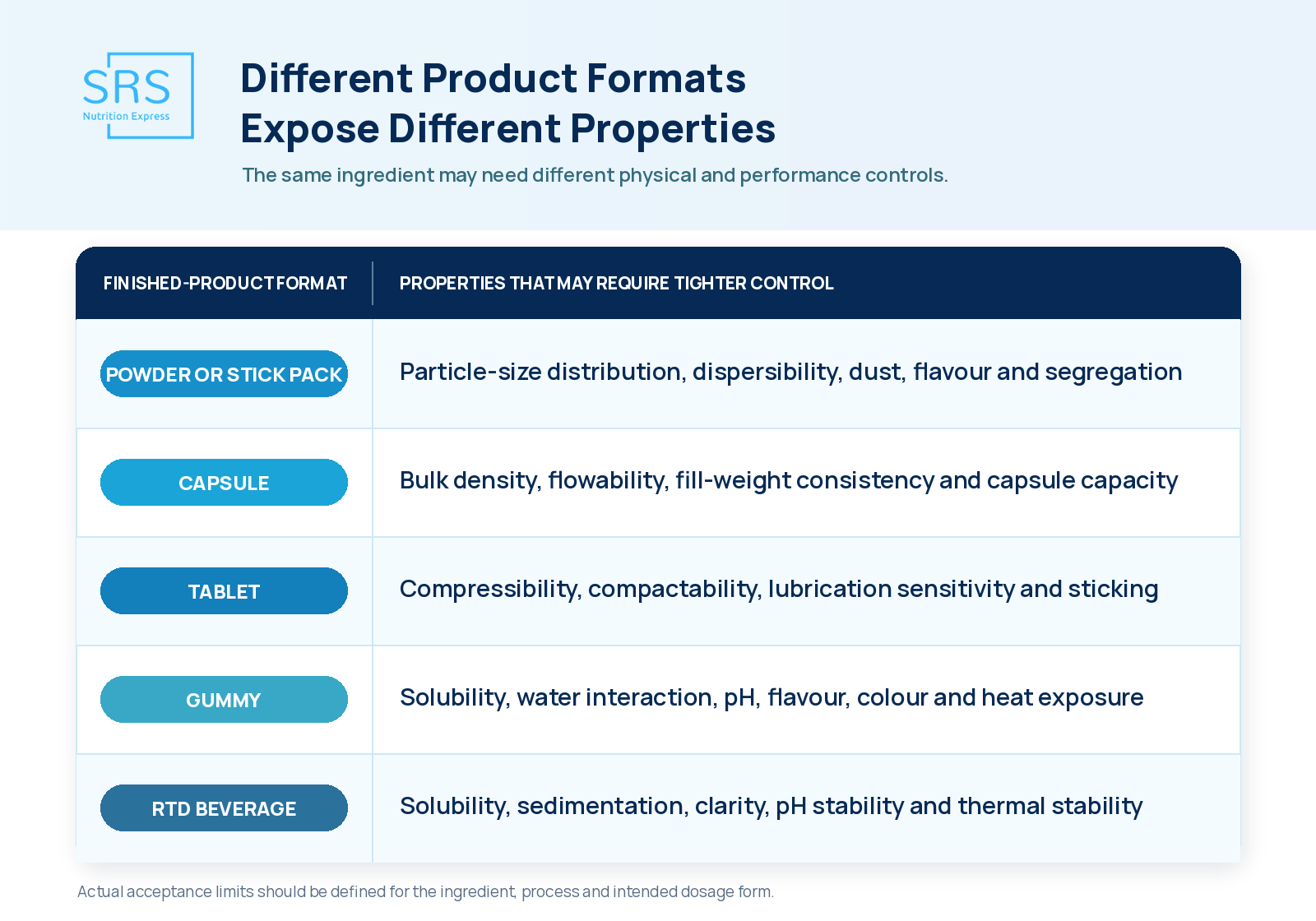
Different Product Formats Expose Different Properties
These properties are not interchangeable. A grade that performs well in a capsule may create dust or segregation in a drink powder. A dry ingredient that passes assay testing may become unstable after exposure to water, low pH or heat.
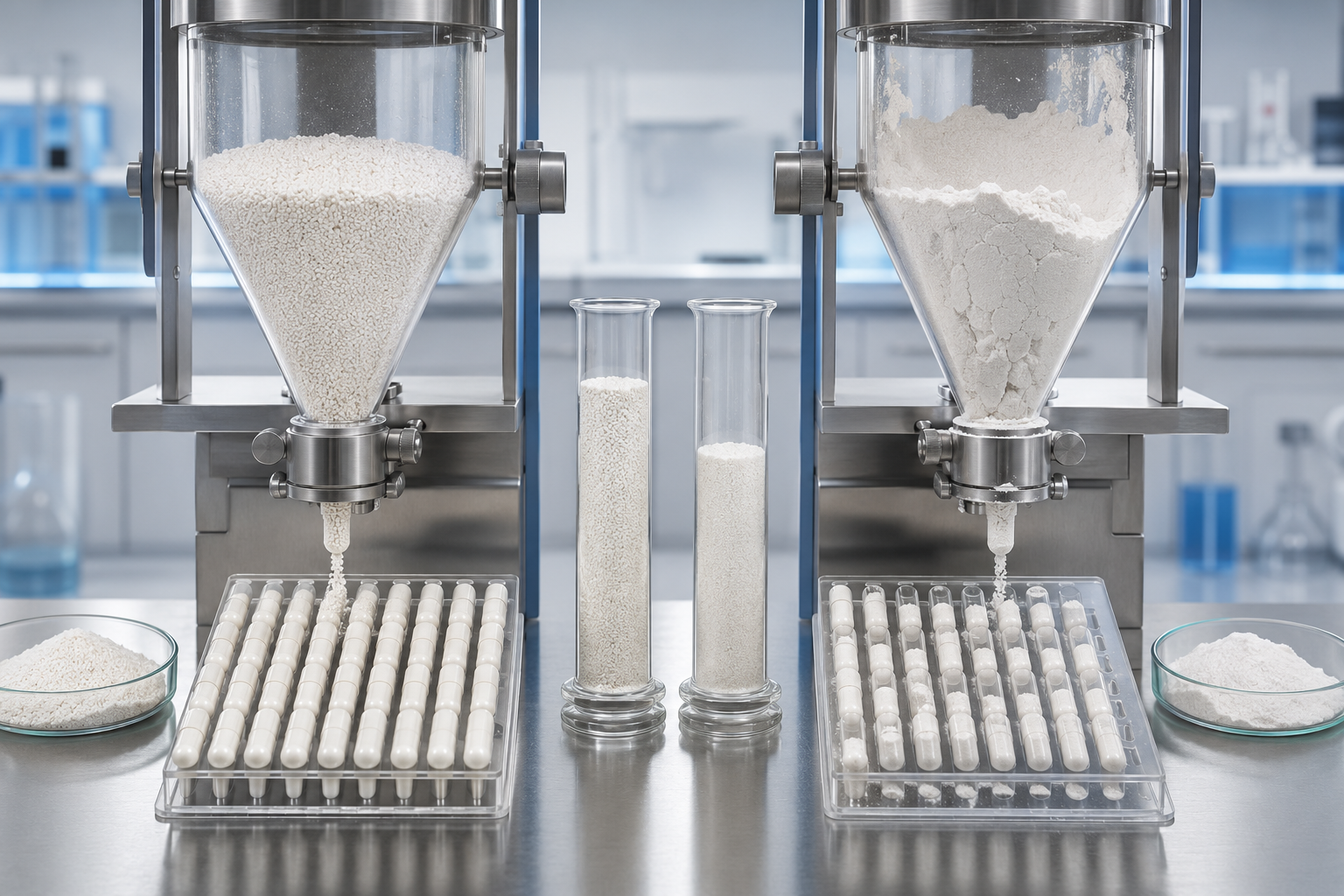
Bulk Density Can Change Capsule Fill Weight
Capsule filling is volumetric, so density and packing behaviour affect how much material can fit into each capsule. In an 18-run experimental study, pellets with apparent densities of 1.45, 2.53 and 3.61 g/cm³ produced capsule fill weights of:
- · 407.9–490.4 mg for low-density pellets
- · 596.9–685.8 mg for intermediate-density pellets
- · 770.6–829.4 mg for high-density pellets
Bulk density and capsule fill weight showed a strong relationship, with an R² of 0.975. Surface treatment also influenced consistency: coated pellets produced fill-weight variation of 0.90–2.10%, compared with 1.73–3.61% for uncoated pellets. The study used pharmaceutical pellets rather than creatine, mineral or botanical powders. Its numerical results should not be transferred directly to supplement ingredients. It nevertheless demonstrates why two batches with the same assay can create very different capsule-capacity and weight-control outcomes.
Finer Particles Are Not Automatically Better
Particle size can influence flow, blending, dissolution and tablet strength, but the effects do not always move in the same direction. In a study comparing two crystalline forms of ranitidine hydrochloride, reducing particle size increased tablet tensile strength by approximately 135% in one crystal form and 175% in the other at a compaction pressure of 200 MPa.
Flow performance moved in the opposite direction. For one form, the Carr Index increased from 15.6 to 27.1 as particle size decreased, indicating a change from relatively good to poor flow. The study also found that crystal form affected tablet performance independently of particle size. A smaller-particle fraction of one form could still produce weaker tablets than a larger-particle fraction of the other. These pharmaceutical data do not establish universal acceptance limits for supplement ingredients. They show why a tableting grade should not be approved using mesh size alone. Particle-size distribution, morphology, bulk density, flow and compression behaviour may all need evaluation.
Water Changes the Specification Problem
A dry-powder specification cannot establish stability after an ingredient enters a gummy, gel or beverage. Creatine provides a useful example. In controlled water–glycerol model systems with water activity values ranging from 0.31 to 0.983, estimated creatine half-life decreased as water activity and temperature increased:
- At 4°C: 2,529 to 368 days
- At 23°C: 182 to 43 days
- At 35°C: 29 to 12 days
These were laboratory model systems, not finished commercial gummies or RTD beverages. They cannot predict a labelled shelf life. However, they demonstrate why dry-material assay and moisture results cannot replace stability studies covering water activity, pH, temperature, packaging and storage time. Similar application-specific risks include protein aggregation, mineral sedimentation, gummy texture changes and flavour instability.
What Product Developers Should Define
✓ Intended dosage form and target dose
✓ Serving size and maximum volume
✓ Manufacturing equipment sequence
✓ Flow, compression or dispersion
✓ Processing temperature and pH
✓ Sensory and appearance limits
✓ Packaging and expected shelf life
✓ Finished-product testing requirements
Additional controls might include a bulk-density range for capsules, compression data for tablets, dispersibility testing for powders or defined stability data for moisture-containing products.
The Right Specification Begins With the Finished Product
One raw material specification can establish a common quality foundation, but it may not be sufficient for every product format. Capsules, tablets, powders, gummies and beverages expose different material properties and processing risks.
At SRS Nutrition Express, available grades, supplier documentation and batch data can be reviewed alongside the intended application. Samples can also support formulation and pilot-line assessment. Final performance limits should be agreed with the finished-product manufacturer and verified under the actual processing, packaging and storage conditions.
References
- 1. U.S. FDA. 21 CFR §111.70—What Specifications Must You Establish?
- 2. Nechrebeki J, et al. The Effect of Particle Properties on the Filling of Capsules with Pellets. 2020.
- 3. Khomane KS, et al. Molecular Understanding of the Compaction Behavior and Mechanical Properties of Ranitidine Hydrochloride Polymorphs. 2013.
- 4. Uzzan M, et al. The Effect of Water Activity and Temperature on the Stability of Creatine during Storage. 2009.