

“Premium creatine” is widely used in product descriptions, but it is not a complete technical specification. A high assay matters, yet it cannot show whether process-related impurities are controlled, whether the powder will run well on a filling line or whether the next shipment will perform like the first.
For buyers, premium should mean a set of measurable requirements that can be verified before purchase and monitored from batch to batch.
Start With Identity, Assay and the Test Method
The first gate is correct chemical identity. The document set should state the exact form—such as creatine monohydrate—and include an appropriate identity test rather than relying on appearance alone.
Assay results also need context. Buyers should check whether the value is reported as creatine monohydrate, creatine, on an as-is basis or on a dry basis. Moisture and water of crystallisation can make two apparently similar percentages mean different things. The analytical method matters as well: a result without the method, calculation basis and acceptance range is difficult to compare.
This is why a headline such as “99.9% pure” is not enough. Assay measures the principal material; it does not replace separate limits for relevant impurities.
Control Creatinine, DCD and DHT Separately
Industrial creatine production can generate or retain compounds including creatinine, dicyandiamide (DCD) and dihydrotriazine (DHT).[1] They should therefore appear as individual specification items with suitable analytical methods.
One useful public reference is FDA GRAS Notice 931 for a specific proprietary creatine monohydrate. Its submitted specification includes assay of at least 99.9%, creatinine no more than 100 mg/kg, DCD no more than 50 mg/kg and DHT no more than 3 mg/kg, using HPLC.[2] These figures describe that notified ingredient; they are not a universal legal definition of premium creatine or automatic evidence for another supplier’s material.
“Not detected” also needs interpretation. The laboratory’s limit of detection or quantification must be low enough to support the agreed specification. Otherwise, two reports using the same wording may provide very different levels of assurance.
Add Safety and Manufacturing Performance
Lead, cadmium, arsenic and mercury limits should reflect the target market, intended daily serving and finished-product category. Microbiological criteria, foreign-material controls and any process-specific risks must also be included where relevant. A generic “heavy metals compliant” statement is weaker than named elements, numerical limits, methods and batch results.
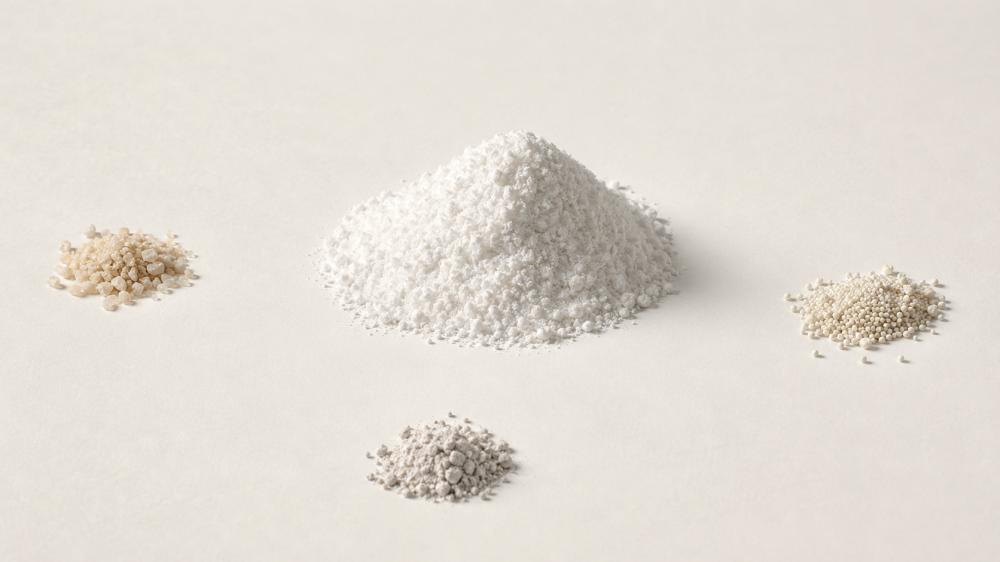
Physical properties form a separate quality layer. Particle-size distribution, bulk and tapped density, flow, dusting, dispersibility, colour and odour can affect blending, capsule filling, tablet compression and powder reconstitution. Finer powder is not automatically better: it may disperse differently but can also create more dust, poorer flow or agglomeration.
The appropriate grade is therefore application-specific. A powder intended for a tub, capsule or tablet should be tested in that process rather than selected from mesh size alone.
Use a Four-Gate Purchasing Framework
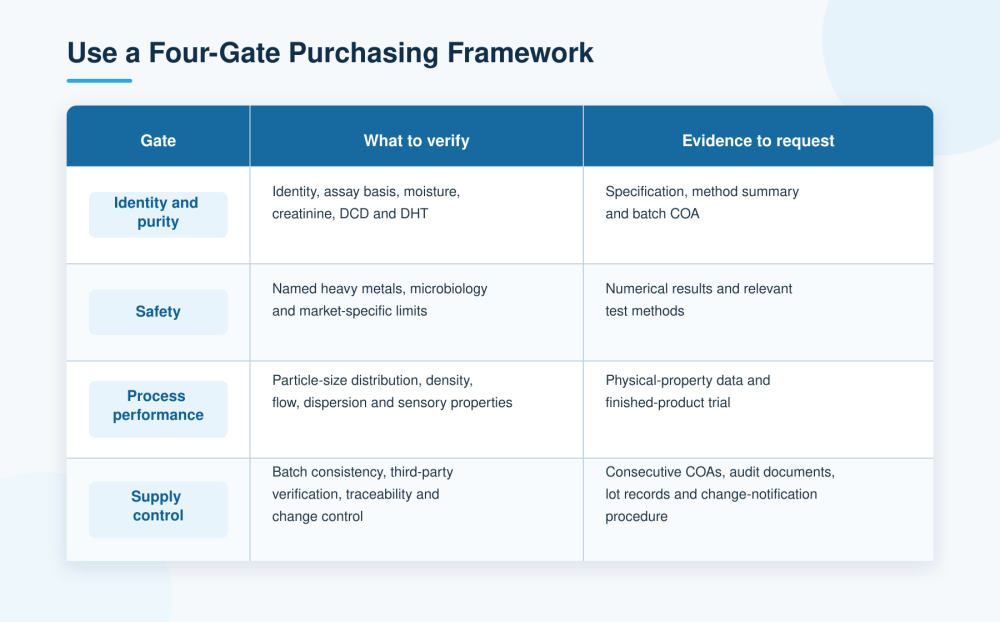
The final gate is consistency. Review several consecutive COAs with actual results, not only “pass” statements. Trends in assay, impurities, density, particle size or colour can reveal variation that one compliant batch will not show.
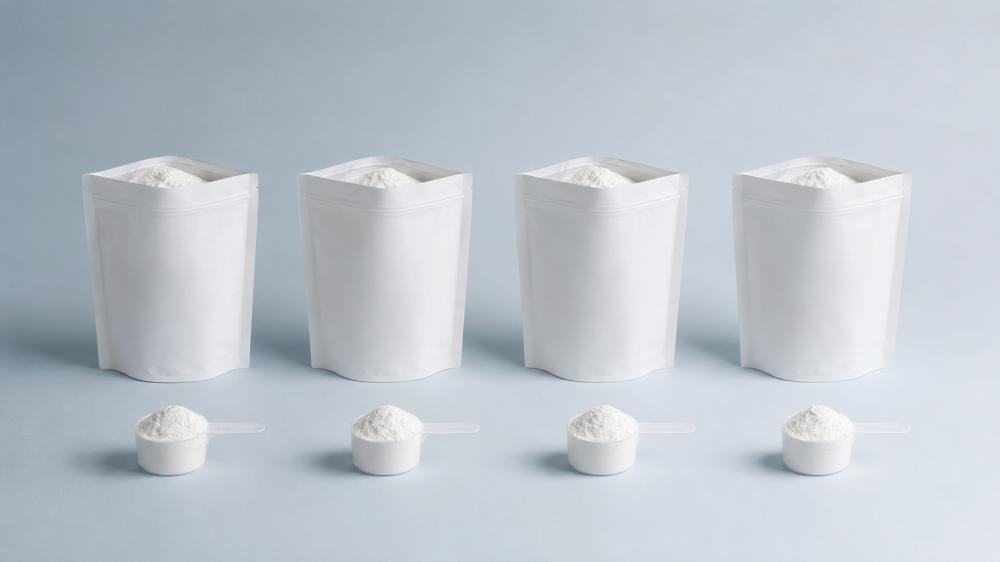
Independent testing is valuable when it uses appropriate, scientifically valid methods, but it does not replace supplier qualification. Under US dietary-supplement GMP rules, manufacturers must establish component specifications and conduct at least one appropriate identity test or examination for each dietary ingredient, unless FDA has granted an exemption. For other applicable component specifications, a supplier’s COA may be relied upon only after its reliability has been established, documented and periodically reconfirmed.[3–5]
Premium creatine is therefore not one number or one mesh grade. It is a reproducible combination of chemical purity, safety, manufacturing performance and documented control.
SRS Nutrition Express supplies creatine monohydrate in specifications designed for different formulation needs. Buyers can request the current specification and batch documentation, then align particle size, density and analytical requirements with the intended product and target market.
References
1. Benzi G, Ceci A. Creatine as nutritional supplementation and medicinal product. Journal of Sports Medicine and Physical Fitness. 2001;41(1):1–10.
2. US Food and Drug Administration. GRAS Notice No. 931: Creatine Monohydrate. 2020.
3. Electronic Code of Federal Regulations. 21 CFR §111.70: Specifications.
4. Electronic Code of Federal Regulations. 21 CFR §111.75: Determining Whether Specifications Are Met.
5. Electronic Code of Federal Regulations. 21 CFR §111.320: Laboratory Methods
Post time: Aug-03-2026


