

An ingredient may have credible human evidence behind it, yet the studied dose may not fit the capsule, gummy, tablet or beverage selected for the product.
This conflict is often discovered after the serving format has already been chosen. The required ingredient mass may exceed the available volume, a mineral compound may provide less elemental content than expected, or an active may change the texture or stability of the finished product.
The correct response is to redesign the formulation—not quietly reduce the dose while preserving the same product promise.
An Evidence-Based Dose Is Specific to the Intended Outcome
An evidence-based dose is not simply the largest number found in a paper. It must be connected to the studied population, intake schedule, duration and outcome.Creatine guidance commonly describes 3–5 g/day for maintaining elevated muscle creatine stores, while rapid loading protocols use approximately 0.3 g/kg/day for 5–7 days.[1]β-Alanine follows a different model. Research covering daily intakes of 1.6–6.4 g for at least four weeks reported muscle-carnosine increases of approximately 40–65%. Across eight studies, the response was associated with total β-alanine consumed rather than body weight alone.[2]These figures illustrate why developers must define the intended benefit before selecting the serving format.
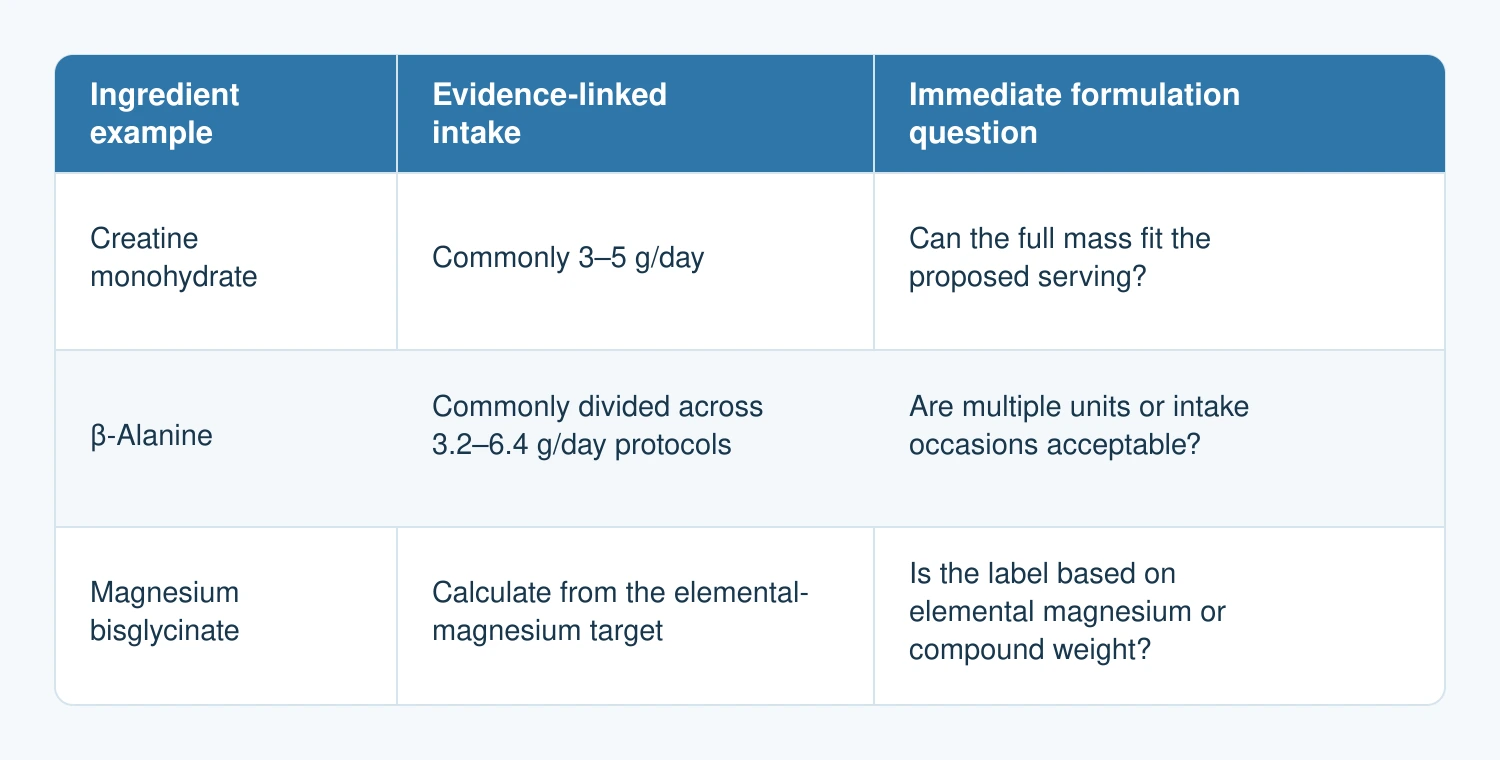
The table does not establish universal recommended doses. Each claim must be evaluated against the relevant evidence and local regulations.
Capsule Volume Creates a Mathematical Limit
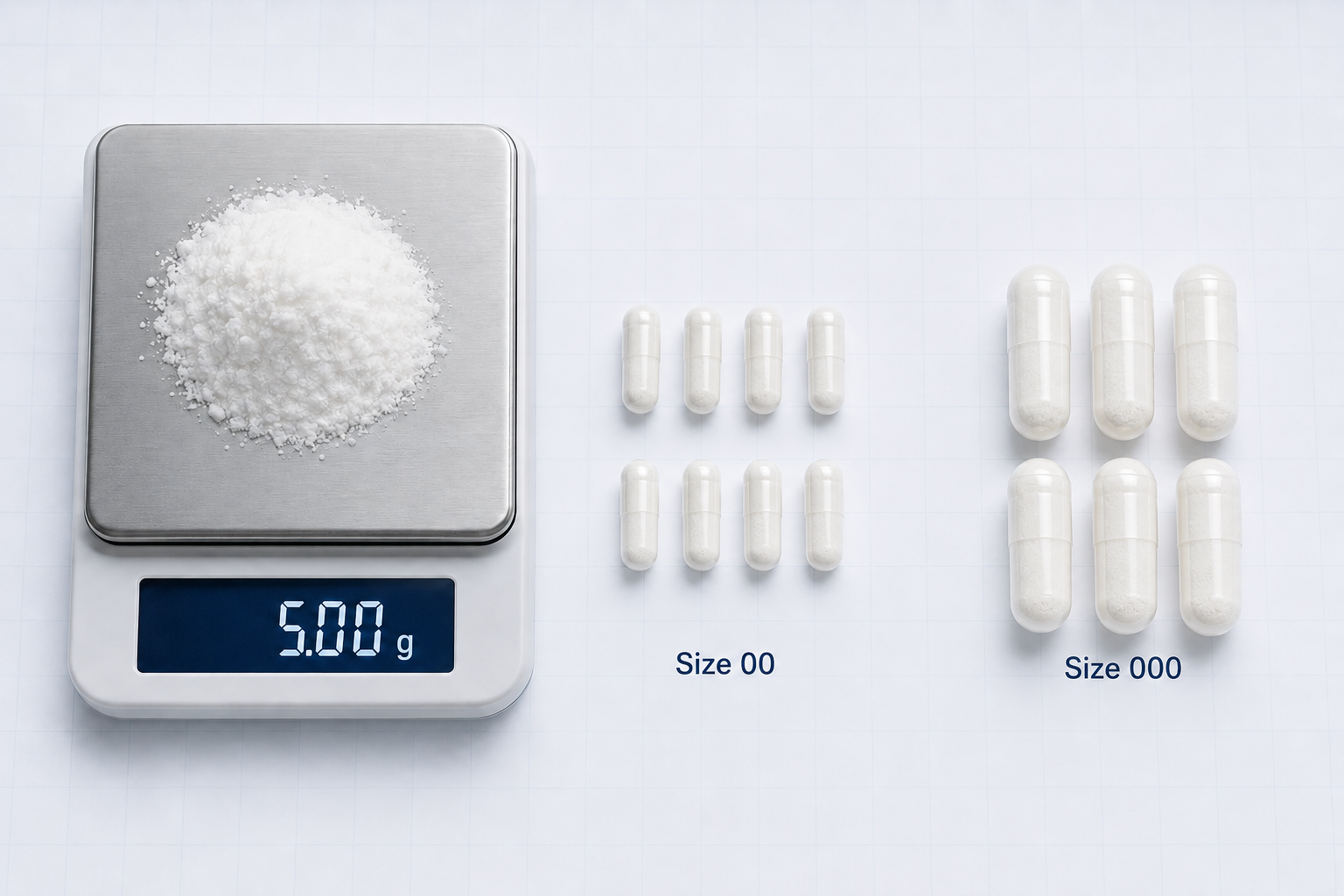
Hard capsules are volumetric systems. According to ACG technical specifications, a size 00 capsule has a body volume of approximately 0.95 mL, while size 000 holds approximately 1.37 mL.[3] If a powder has a measured bulk density of 0.70 g/mL, the theoretical gross capacities would be: Size 00: approximately 665 mg Size 000: approximately 959 mg A 5 g dose: approximately eight size 00 or six size 000 capsules These are volume calculations, not guaranteed production fill weights. They exclude space needed for excipients and do not account for aeration, consolidation, flow or equipment settings. This distinction is supported by filling research. In an 18-run capsule study, pellets with three apparent-density levels produced actual fill weights ranging from 407.9–490.4 mg, 596.9–685.8 mg and 770.6–829.4 mg. Capsule fill weight correlated strongly with bulk density, with an R2R^2R2 of 0.975.[4] Coating also changed fill consistency: coated pellets showed fill-weight variation of 0.90–2.10%, compared with 1.73–3.61% for plain pellets. These were pharmaceutical pellets, not supplement powders, so the values cannot be transferred directly to creatine. They demonstrate that nominal capsule volume alone is insufficient.
Compound Weight Is Not the Same as Active Content
Mineral formulations create another common mismatch.A 2025 randomized trial investigating sleep outcomes used magnesium bisglycinate providing 250 mg/day of elemental magnesium for four weeks.[5] This was one defined intervention—not a universal efficacy standard.
Pure anhydrous magnesium bisglycinate has a molecular weight of 172.42 g/mol and a theoretical elemental-magnesium content of approximately 14.1%.[6] On that basis, 250 mg of elemental magnesium would require approximately:
That is about 1.77 g of pure anhydrous compound before excipients are added.
Commercial materials may be hydrated, buffered or supplied on a different assay basis. Developers must therefore use the supplier’s verified elemental-magnesium result rather than relying on a generic percentage.
Gummies Must Carry the Active Without Losing the Product
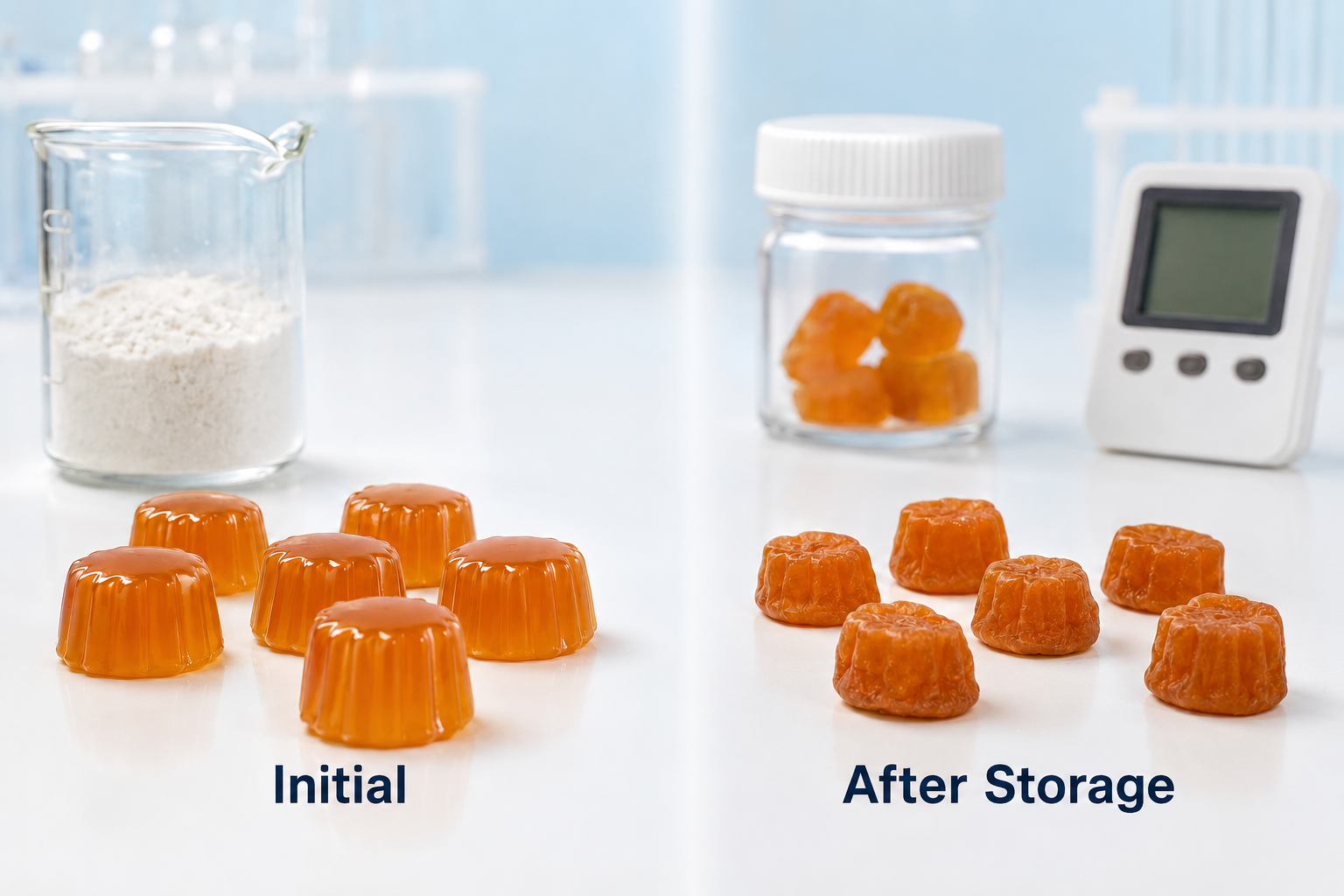
The full gummy weight is not available for the active. The matrix must also contain water, gelling materials, sweeteners, acids, flavours and processing aids.In a controlled gummy study, adding calcium carbonate and a vitamin D₃ solution reduced firmness by 59.59 ± 1.45%, strength by 50.67 ± 5.53% and hardness by 23.59 ± 3.37%.[7] Calcium also reduced the sensory taste score by 25.69 ± 1.8% versus the control.Storage created another problem. Average gummy mass decreased by 20.7 ± 1.3% after seven days and 43.76 ± 2.1%.after 14 days at room temperature, largely because of water loss. This model formulation does not define commercial gummy performance, but it shows that fitting an active into the initial batch does not prove acceptable texture or shelf life.
Moisture Can Change the Active Itself
Creatine illustrates why dry-powder specifications cannot predict performance in gummies or beverages.In water–glycerol model systems covering water activity values from 0.31 to 0.983, creatine half-life at 23°C decreased from 182 to 43 days. At 35°C, no tested composition had a half-life longer than one month.[8] The formulations were prepared with a pH 4 buffer, but measured pH varied from approximately 4.05 to 5.00 as glycerol concentration changed. Water activity, pH and temperature therefore changed together, so these results cannot predict the shelf life of a commercial creatine gummy or RTD beverage.They do demonstrate why pH, water activity, processing temperature, packaging and real-time storage must be tested in the finished product.
What Developers Can Change
When the dose does not fit, practical options include:
- Increasing the number of units per daily serving Dividing intake across the day
- Moving from capsules or gummies to powder or stick packs
- Simplifying a multi-ingredient formula
- Selecting a more concentrated, properly verified ingredient grade
- Changing the intended claim or benefit
- Developing separate convenience-dose and full-dose products
The format should follow the evidence, material properties and manufacturing data. At SRS Nutrition Express, active or elemental content, particle size, bulk density and intended processing conditionscan be reviewed before the serving format is finalised. Samples and batch documentation can support formulation trials, but final dose selection, product claims and shelf life must be confirmed through finished-product validation.
References
- Kreider RB, et al. International Society of Sports Nutrition Position Stand: Safety and Efficacy of Creatine Supplementation. Journal of the International Society of Sports Nutrition. 2017.
- Stellingwerff T, et al. Optimizing Human In Vivo Dosing and Delivery of β-Alanine Supplements for Muscle Carnosine Synthesis. Amino Acids. 2012;43:57–65.
- ACG Capsules. Technical Specifications for Pharmaceutical Capsules.
- Nechrebeki J, et al. Application of Multiple Linear Regression and Artificial Neural Networks for Prediction of Capsule Filling Performance. Pharmaceutics. 2020;12(3):244.
- Schuster J, et al. Magnesium Bisglycinate Supplementation in Healthy Adults Reporting Poor Sleep. 2025.
- NIH PubChem. Magnesium Glycinate: Molecular Formula and Molecular Weight.
- Čižauskaitė U, et al. Natural Ingredients-Based Gummy Bear Composition Designed According to Texture Analysis and Sensory Evaluation. Molecules. 2019;24(7):1442.
- Uzzan M, et al. Effect of Water Activity and Temperature on the Stability of Creatine During Storage. Drug Development and Industrial Pharmacy. 2009;35(8):1003–1008.
Post time: Jul-24-2026


