

Whey protein concentrate and whey protein isolate are often presented as a simple good-better comparison. Because isolate contains more protein, it is frequently assumed to be the premium choice.
For product developers, the decision is more complex. The right ingredient depends on protein targets, serving size, sensory profile, processing conditions, label requirements and total formulation cost. WPI may be ideal for one application, while WPC80 may provide better flavor, body and commercial efficiency in another.
The Difference Begins With Composition
Under the U.S. definition, whey protein concentrate is produced by removing sufficient non-protein constituents from whey so that the finished dry product contains at least 25% protein. Commercial grades include WPC34 and WPC80, with WPC80 commonly used in sports-nutrition products.
Whey protein isolate undergoes further separation to reduce lactose, minerals and fat. In commercial dairy-protein terminology, WPI typically contains at least 90% protein on a dry-matter basis.
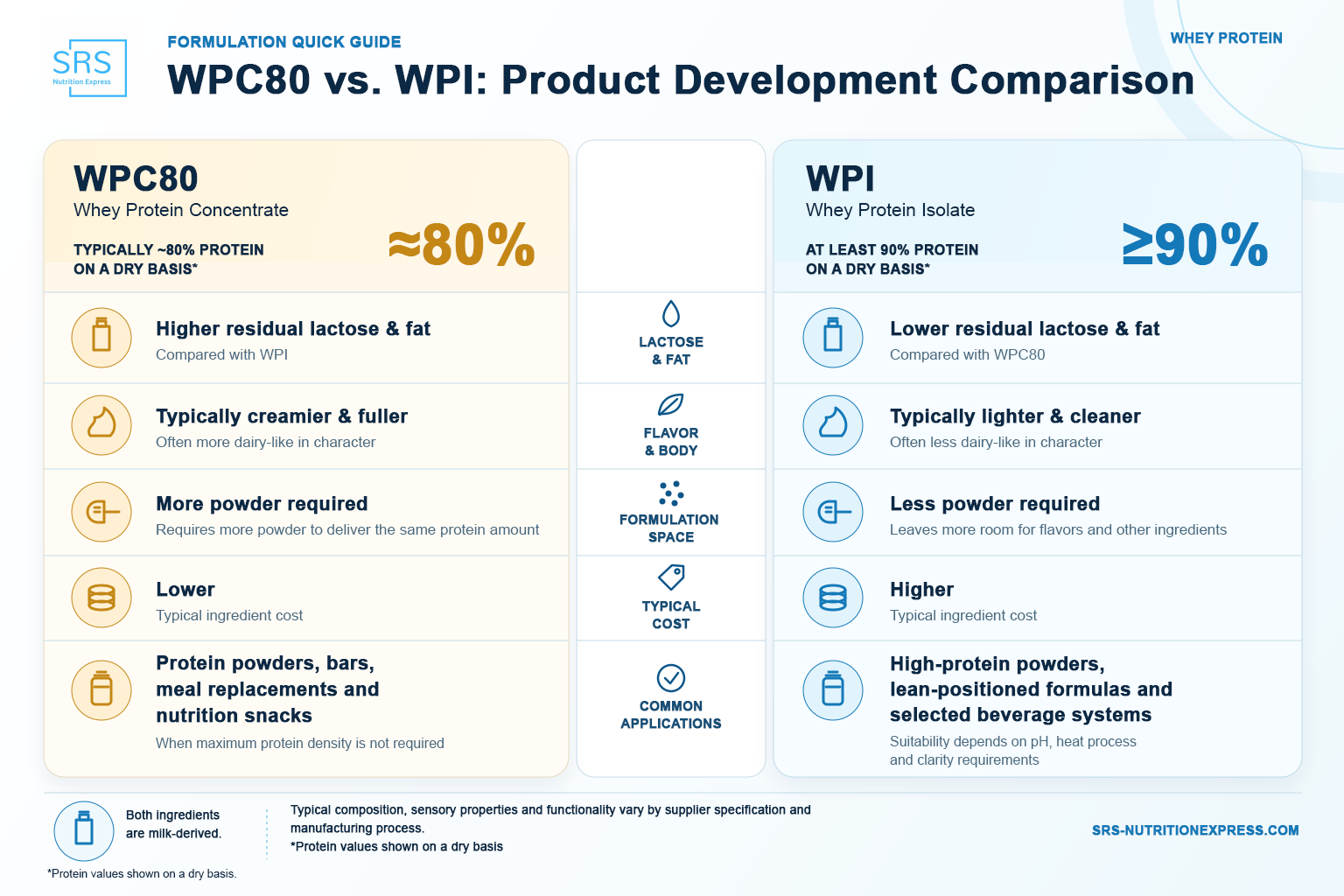
[Insert the completed WPC80 vs. WPI90 comparison table here]
This WPC80 vs. WPI90 comparison represents typical category-level differences. Actual composition and functionality must be confirmed from the supplier specification, including the analytical method and whether protein is reported on an as-is or dry-matter basis.
When WPI Makes More Formulation Sense
WPI is useful when a product must deliver more protein within a restricted serving size. At nominal protein levels, 30 g of WPC80 supplies approximately 24 g of protein, while 30 g of WPI90 supplies approximately 27 g—before flavors, sweeteners or other ingredients are added.
WPI may be preferred when the product requires:
Lower lactose does not mean lactose-free. Both WPC and WPI are milk-derived and require the applicable allergen declaration. For instantized products, the lecithin source should also be confirmed.
When WPC80 May Be the Better Choice
WPC80 can be commercially attractive for conventional protein powders, meal products and nutrition snacks where maximum protein density is unnecessary.
Its remaining lactose, fat and minerals may contribute to a fuller dairy profile and greater body, although sensory performance varies by source and manufacturing process.
WPC80 also generally costs less per kilogram. However, developers should compare cost per delivered gram of protein within the complete formulation. A cheaper ingredient may become less economical if it requires a larger serving or additional flavor correction. Conversely, WPI may not justify its premium when WPC80 already meets the product brief.
Whey Protein Solubility and Heat Stability
Solubility, dispersibility and processing stability are different properties. A powder may eventually dissolve but still wet or disperse poorly. Agglomeration and lecithination can improve wetting, but instantization does not guarantee stability in every formulation.
Developers should ask:
- Does the powder wet and disperse easily?
- Does it dissolve under the intended pH and temperature?
- Does it remain stable during processing and storage?
WPI is not automatically more heat-stable because it contains more protein. Whey protein heat stability is influenced by pH, mineral balance, protein concentration, residual lipids, previous heat exposure and manufacturing history.
A 2024 study demonstrated that experimental WPI produced using acidification, demineralization and clarification could achieve heat stability comparable with commercially microfiltered WPI. For RTD products, testing under the intended pH, protein concentration, pasteurization or UHT process and storage conditions remains essential.
Protein Bars Require a Different Evaluation
Neither WPC nor WPI automatically prevents bar hardening. Texture is affected by water migration, protein aggregation, oxidation, sweetener selection, lipid composition and storage conditions.
In a six-week model study, hardness increased substantially in pea-, whey- and rice-protein bars, but the extent depended on the protein and lipid system. The findings are not a universal shelf-life prediction; they show why proteins must be evaluated inside the complete formulation.
What Product Developers Should Request
A whey protein quality review should cover:
- ✔ Protein content, test method and reporting basis
- ✔ Moisture, lactose, fat and ash
- ✔ Microbiological and elemental-contaminant limits
- ✔ Allergen and lecithin declarations
- ✔ Particle size and bulk density
- ✔ Dispersibility and solubility test conditions
- ✔ Sensory characteristics
- ✔ Defined heat-stability data where relevant
- ✔ Batch traceability and consistency
Application trials should reproduce the intended water quality, pH, mixing sequence, thermal process, packaging and storage conditions.
The Better Ingredient Fits the Product Brief
WPI is not automatically superior, and WPC80 is not simply a lower-grade alternative. WPI provides greater protein density and generally less lactose and fat. WPC80 may offer better commercial efficiency, dairy character and body.
At SRS Nutrition Express, ingredient category, supplier specifications and batch qualification are evaluated separately. Verified composition, documented test methods, batch consistency and application testing—not the perceived prestige of the ingredient name—determine whether a particular grade is suitable for the finished product.
References
1. U.S. FDA. 21 CFR §184.1979c—Whey Protein Concentrate.
2. U.S. Dairy Export Council. Reference Manual for U.S. Whey and Lactose Products.
3. Prabhakaran GYS, et al. Journal of Dairy Science. 2024;107(9):6629–6642.
4. Dietrich RB, et al. Journal of Food Science. 2025;90(1):e17657.
Post time: Jul-28-2026


