Imagine opening two bars from the same pilot batch. The first, unwrapped the morning after production, bends before it breaks. The second has spent several weeks on the shelf. The wrapper looks fine, the chocolate still smells good, but it takes real effort to bite through the centre.
The tasting panel approved the first bar. A customer buying a box may get the second.
For a brand developing a high-protein snack, that gap matters. A fresh tasting tells you whether people like the recipe. A tasting several weeks later can help you decide which protein to order for the next production run.
? What changes inside a sealed bar?
A protein bar can feel dry for more than one reason. Some moisture may have escaped through the packaging. Water can also redistribute among the ingredients inside the bar. Meanwhile, the proteins themselves can change during storage. A firmer bite alone tells you little about which change mattered most in your recipe.
A 2025 Journal of Food Science study puts that distinction into perspective. Researchers made model bars with whey, pea or rice protein and stored them at 37°C for 42 days to accelerate ageing. In the recipes without added oil, the force needed to puncture the whey bars rose to 5.4 times its initial value. For the pea bars, it rose to 7.2 times. The team also measured changes in moisture and found evidence of protein oxidation in both the whey and pea bars.
There is a useful detail behind those numbers. Each increase was measured against that recipe’s own starting point. You cannot use the two figures to tell a customer which finished bar was easier to bite. And six weeks at 37°C does not predict exactly when a bar on a shop shelf will turn hard. For a product developer, the better question is how long each prototype keeps the texture customers liked in the first place.
! Before changing the protein, cut the bar open
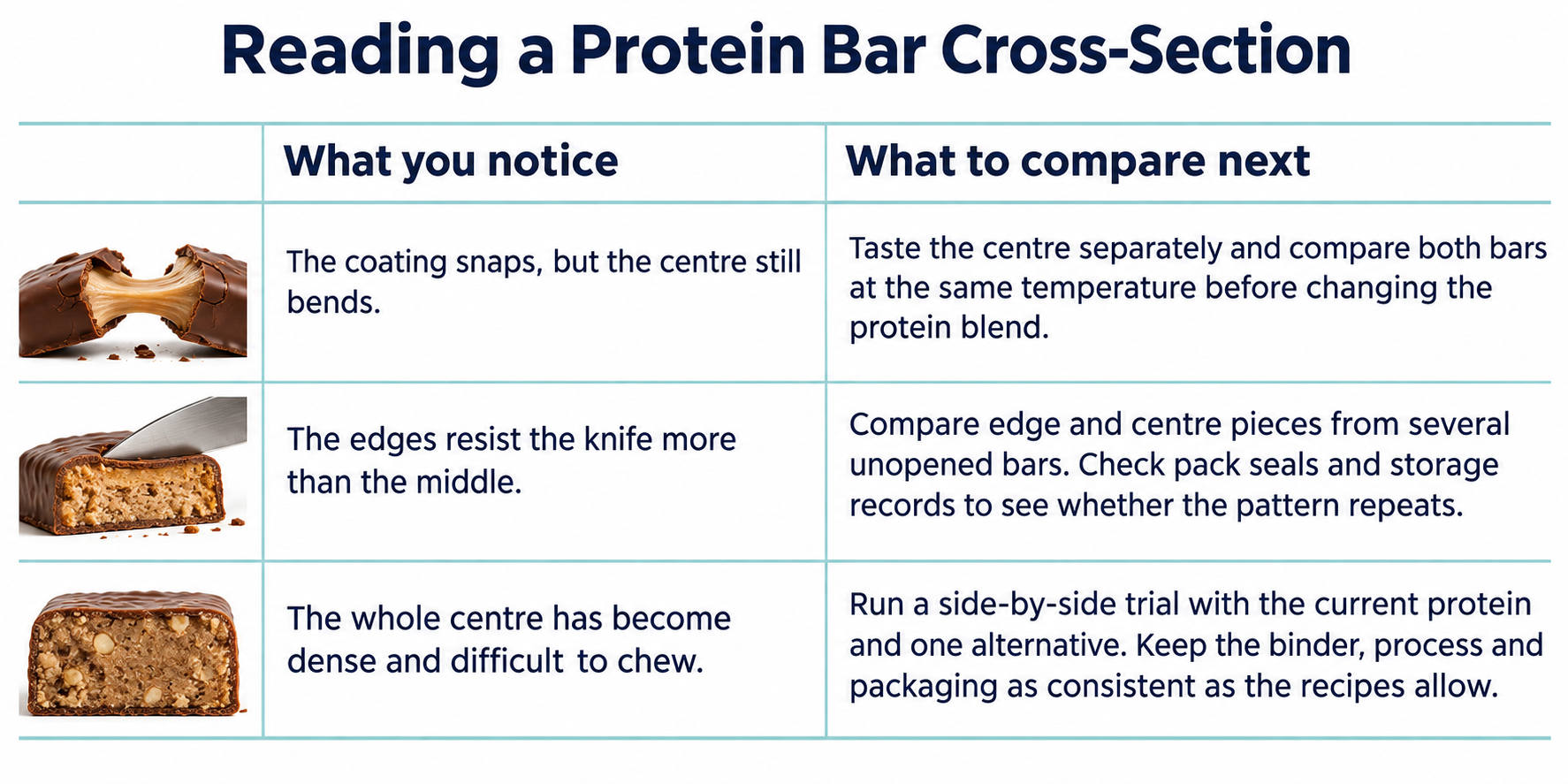
“Too hard” is an understandable customer complaint. As a reformulation brief, it leaves several decisions unresolved. Open a retained sample, bring it to the same temperature as your comparison bar, then cut through the centre. Three observations can make the next trial more informative.
Save the tasting panel’s actual words. “It crumbles on the first bite” and “I’m still chewing after ten seconds” may earn the same low texture score, yet they give the formulator very different products to work on.
A WPC80-to-WPI90 switch changes more than the protein source
Consider a 60 g bar designed to deliver 20 g of protein. If a single whey ingredient supplies all 20 g, a powder containing 80% protein would contribute 25 g to the recipe. At 90%, the equivalent amount is approximately 22.2 g. This simplified calculation assumes both percentages are measured on the same basis. SRS offers both WPC80 and WPI90 for formulation work.
The Calculation Gap
That leaves 2.8 g per bar for the developer to account for. Fill the space with syrup and you have also changed the binder level. Fill it with crisp inclusions and you have changed the bite deliberately. Either choice may make a better snack, but it changes what you can learn from the tasting.
Write down where those 2.8 g went. That one line helps the buyer understand why a promising WPI sample performed differently and gives the manufacturer enough information to reproduce the preferred version. The same discipline applies when trialling pea protein for a plant-based bar. Compare at the intended protein content and record any recipe adjustment needed to make a workable centre.
Give the second tasting a date
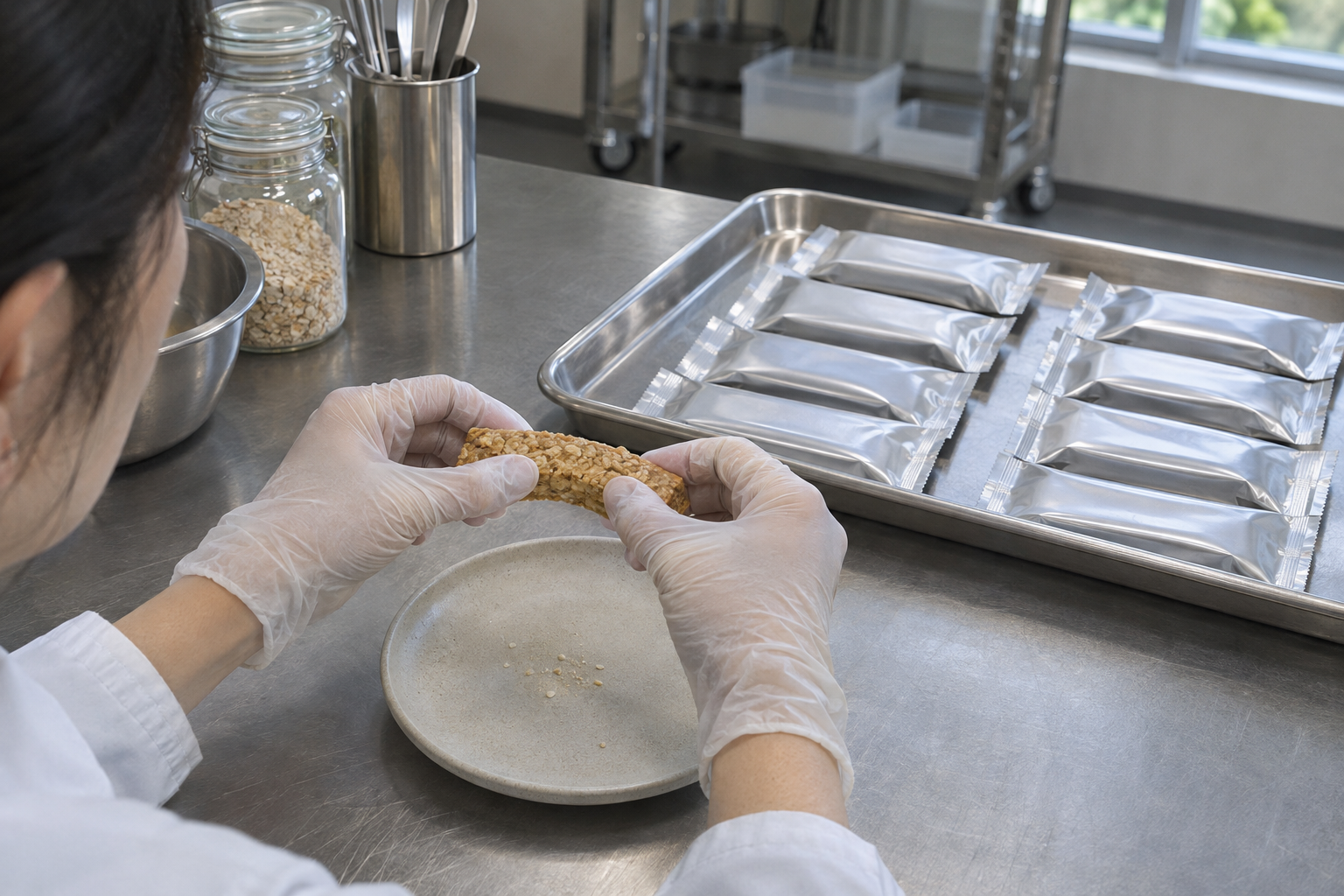
For a first screening trial, keep the current bar as a control and make one candidate alongside it. Wrap both as you intend to sell them. Set aside unopened samples and, as an example, schedule tastings for day one, week two and week six. Use the intended storage conditions and give samples enough time to reach the same tasting temperature. A commercial shelf-life decision needs evidence covering the actual product, pack and intended shelf life.
At each tasting, ask the same three questions. How much effort does the first bite take? Does the centre bend, crumble or pull apart? Would you finish the whole bar? The last question gives the team a reason to care about the first two. A firmer bar can still be a good bar. The point worth catching is when a satisfying chew becomes a reason to put it down.
Which protein should you trial in your next bar?
Tell SRS Nutrition Express your target grams of protein per bar, the protein you use today and when the bite starts to change. We can help you shortlist whey or pea protein options and discuss samples for a side-by-side trial in your own recipe.
Evidence Boundaries
- Dietrich et al. Role of protein and lipid oxidation in hardening of high-protein bars during storage. Journal of Food Science, 2025.
- Hardening of high-protein nutrition bars and sugar/polyol-protein phase separation.
Recommended Reading
References
- Dietrich RB, Lincoln L, Momen S, Minkoff BB, Sussman MR, Girard AL. Role of protein and lipid oxidation in hardening of high-protein bars during storage. Journal of Food Science. 2025, 90(1), e17663. Read the full study.
- 2. McMahon DJ, Adams SL, McManus WR. Hardening of high-protein nutrition bars and sugar/polyol-protein phase separation. Journal of Food Science. 2009, 74(6), E312–E321. View on PubMed.