

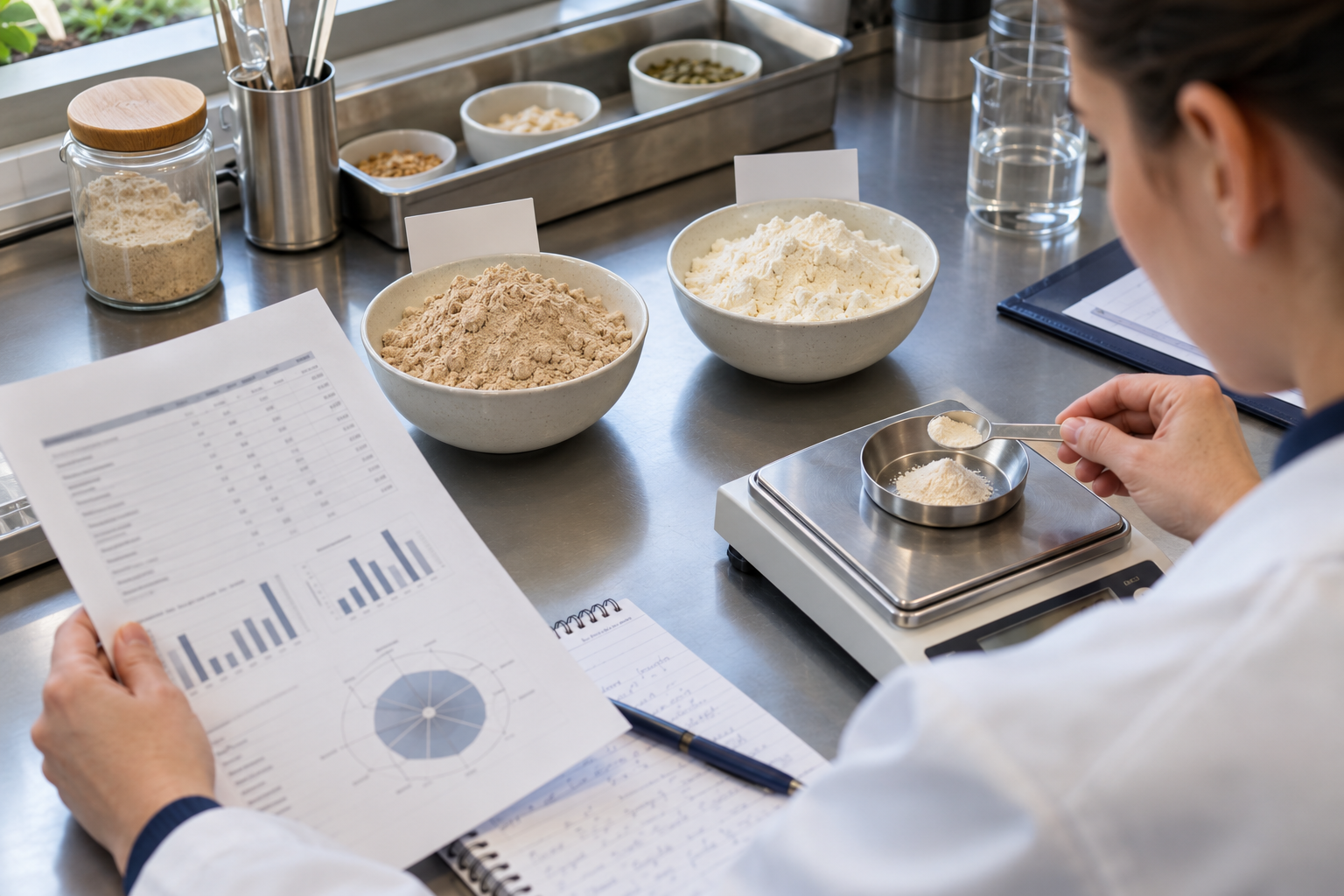
Eighty percent protein sounds like a convenient basis for substitution. Replace one 80% powder with another, keep the serving weight unchanged and move on.
Formulation rarely behaves that politely.
A protein result describes concentration under a defined method and reporting basis. It does not establish the amino-acid profile, digestibility, flavour, colour, hydration or processing behaviour of the ingredient. Yeast protein 80 and WPC80 can therefore share a headline number while producing very different finished products.
1 First Confirm What “80% Protein” Means
Before comparing ingredients, check whether protein is reported:
- ✔ as-is or on a dry-matter basis;
- ✔ by Kjeldahl, Dumas or another agreed method;
- ✔ using which nitrogen-to-protein conversion factor;
- ✔ as a minimum specification or typical result.
Moisture and the selected calculation factor can affect the reported percentage. A buyer should not assume that two COAs showing 80% were calculated on the same basis.
The remaining 20% matters too. Depending on the ingredient and process, it may include moisture, ash, carbohydrate, fibre, fat or other constituents that influence flavour, colour and performance.
Protein Percentage Does Not Describe Protein Quality
Protein quality depends on both indispensable amino-acid composition and digestibility.
A 2025 comparative study reported an amino-acid score of 1.37, PDCAAS of 100% and DIAAS of 82.42% for the yeast protein tested for individuals over three years of age. Its DIAAS exceeded the plant proteins included in that study but remained below the animal proteins, primarily because digestibility was lower. The work used growing rats and an in-vitro digestion model, not a human clinical trial.
Another 2025 rat study found that combining its yeast protein with whey or soy improved true digestibility and produced more balanced amino-acid scores than the individual materials in some comparisons. This supports investigating protein blends, but it does not establish a universal replacement ratio for every commercial yeast protein.
Why Do Yeast-Protein Studies Report Different Digestibility?
Not every “yeast protein” is the same material.
A separate 2025 study using an advanced in-vitro gastrointestinal model reported comparable digestibility for its yeast-based protein, whey and casein. Most of the study authors were employees of companies involved with the tested yeast ingredients, and the experiment did not measure long-term human outcomes.
The difference between studies is commercially important. Results can vary with:
Published results for one processed yeast protein should not automatically be used as proof for another supplier’s grade.
WPC80 and Yeast Protein Behave Differently in a Formula
WPC80 contributes dairy flavour, body and characteristic whey-protein functionality. Yeast protein may bring a beige colour, savoury or fermented notes and a different hydration profile.
Research on yeast protein has reported low solubility as a recurring application limitation. A 2024 study found useful foaming, emulsifying and thermal properties in its material but also low solubility. More recent experimental processing studies substantially increased solubility, demonstrating that performance depends on how the protein was produced—not simply on the words “yeast protein.”
A direct substitution may therefore change:
- dispersibility and sediment
- viscosity and mouthfeel
- foam formation
- flavour intensity
- beverage colour
- heat response
- protein delivered per serving
A Blend May Be More Useful Than a Complete Replacement
Yeast protein does not have to imitate whey to create commercial value.
A partial blend may help brands develop a fermentation-based protein story, diversify protein sourcing or adjust amino-acid composition while retaining some of the familiar sensory and functional properties of whey or another protein.
The correct ratio cannot be selected from protein percentages alone. It should be established through bench trials using the complete formula, processing conditions and target serving.

Check Market Status Before Finalising the Label
Regulatory status depends on the precise yeast, manufacturing process, composition, intended use and destination market.
For the European Union, the Novel Food Catalogue is a non-binding orientation tool rather than a universal approval list. Food business operators must be able to support the regulatory status of the specific ingredient they place on the market.
Buyers should request the organism identification, manufacturing description, compositional specification, allergen statement and applicable market documentation before approving claims such as fermentation-derived or alternative protein.
Evaluating Yeast Protein 80?
SRS Nutrition Express can provide available Yeast Protein 80 specifications, representative COAs and samples for technical evaluation.
Share your target protein per serving, intended product format, other protein sources, processing conditions, flavour direction, destination market and estimated volume.
Evidence Boundaries
- An 80% protein result does not establish nutritional or functional equivalence.
- Published findings apply to the specific yeast materials and methods studied.
- In-vitro and animal results are not equivalent to human clinical outcomes.
- Yeast protein is not automatically more sustainable without product-specific lifecycle evidence.
- Raw-material data cannot replace finished-formula sensory and stability trials.
- Regulatory status must be confirmed for the precise ingredient, use and destination market.
Recommended Reading
References
- • Cao X, Liu H, Yang M, et al. Evaluation of the nutritional quality of yeast protein in comparison to animal and plant proteins using growing rats and INFOGEST model. Food Chemistry. 2025;463:141178. DOI: 10.1016/j.foodchem.2024.141178
- • Qiao K, Zhou X, Sun B, et al. The evaluation of yeast protein quality as a new and sustainable source of dietary protein. Journal of Agricultural and Food Chemistry. 2025;73(38):24127–24138. DOI: 10.1021/acs.jafc.5c06807
- • Caron J, Martinez Tuppia C, Machuron F, et al. In-vitro human gastrointestinal digestibility and colonic fermentation of edible yeast-based protein. Food Research International. 2025;208:116098. DOI: 10.1016/j.foodres.2025.116098
- • FAO. Dietary Protein Quality Evaluation in Human Nutrition. FAO Food and Nutrition Paper 92. 2013.
- • European Commission. Novel Food Status Catalogue and Union List of Novel Foods.
Post time: Oct-30-2026


