

Two whey protein powders can report similar protein content and still behave very differently in water. One sinks and disperses after gentle shaking; another floats, forms dry-centred lumps or leaves a head of foam.
These symptoms are not the same failure. Foaming starts at an air–water interface. Wet clumps begin with slow water penetration. Poor dispersion concerns later particle breakup, while lumps already in the bag usually point to storage.
Foaming Is a Functional Property, Not Automatically a Defect
Whey proteins are surface-active. Mixing introduces air, and proteins form films at bubble surfaces that slow collapse. More shear may remove lumps faster while creating more bubbles.
Protein concentration and pH also matter. In a controlled β-lactoglobulin study conducted from pH 3 to 7, researchers identified concentration thresholds below which the target foam volume was not reached. Foamability increased across that pH range, while foam stability rose with protein concentration and was highest at pH 7 under the tested conditions.[1] This does not mean every finished whey drink foams most at pH 7: β-lactoglobulin was studied as a model protein, not as a flavoured WPC or WPI formula containing fat, lecithin, gums, minerals and sweeteners.
Investigate persistent foam with fixed protein concentration, liquid volume, vessel, mixer speed and time. Without a controlled method, “foams too much” is not a reproducible specification.
Why Whey Powder Floats and Forms Dry-Centred Lumps
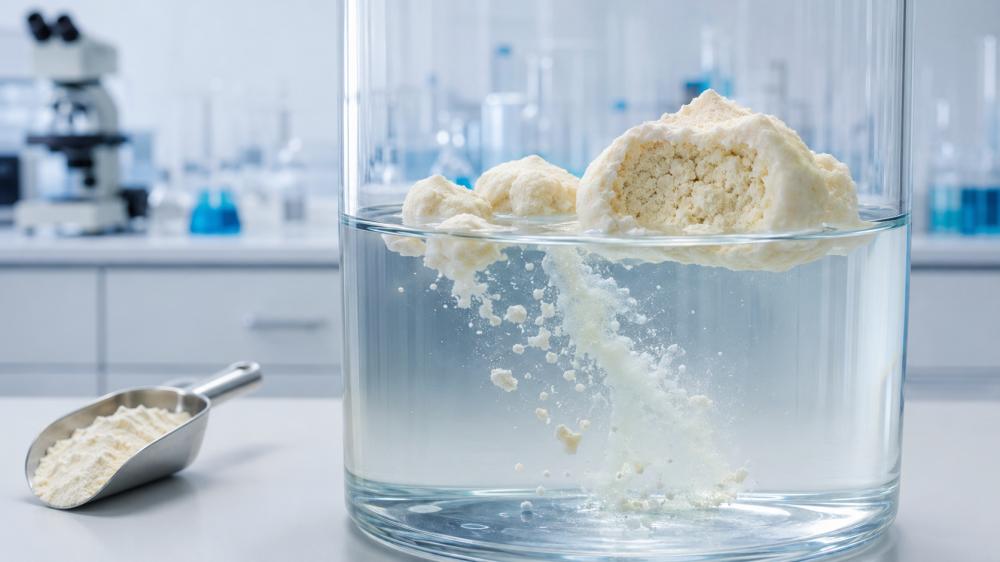
Before protein can dissolve, water must first spread across the particle surface and enter the pores. If the outer surface of a powder cluster hydrates first, it can create a protein-rich layer around dry material—the familiar “fish-eye” lump.
A study of five high-protein dairy powders measured wetting, dispersion and sediment. WPI and caseinate showed especially poor initial wetting; most samples required more than 20 minutes to sink. Yet once wet, WPI dispersed quickly enough that particle sizing tracked agglomerated WPI for only the first four minutes.[2] A powder may therefore be difficult to wet but disperse rapidly after entering the liquid.
What Agglomeration and Lecithination Actually Change
Instantisation is not one property. Agglomeration builds larger, porous particles; lecithination changes the surface. Neither term guarantees performance in a finished formula.
The scale of the structural effect is visible in a fluid-bed WPI experiment. Agglomeration increased median particle size from 58.5 μm to 122.3–154.3 μm and raised porosity from 52.9% to 67.2–72.2%. The contact angle of the original WPI fell only from about 130° to 120° during the first 10 seconds, indicating poor wetting. For the agglomerated powders, the angle dropped to zero in less than 10 seconds as water entered the larger voids.[3]
A separate WPI study applied 0.5%, 2% and 5% lecithin solutions by fluid-bed agglomeration or coating. Coating reduced the initial contact angle and weakened the surface protein film, while agglomeration improved capillary penetration through particle size and porosity.[4] These were controlled treatments on specific WPI powders; the percentages are experimental conditions, not universal lecithin recommendations.
Dispersion, Solubility and Storage Caking Need Different Tests
Wettability asks how readily powder enters water. Dispersibility asks how wetted particles break apart and distribute. Solubility asks how much remains dissolved under defined conditions. ISO/TS 17758 formalises methods for instant dried milk, but sports nutrition still needs application-specific testing at the intended dose, temperature and mixing method.[5]
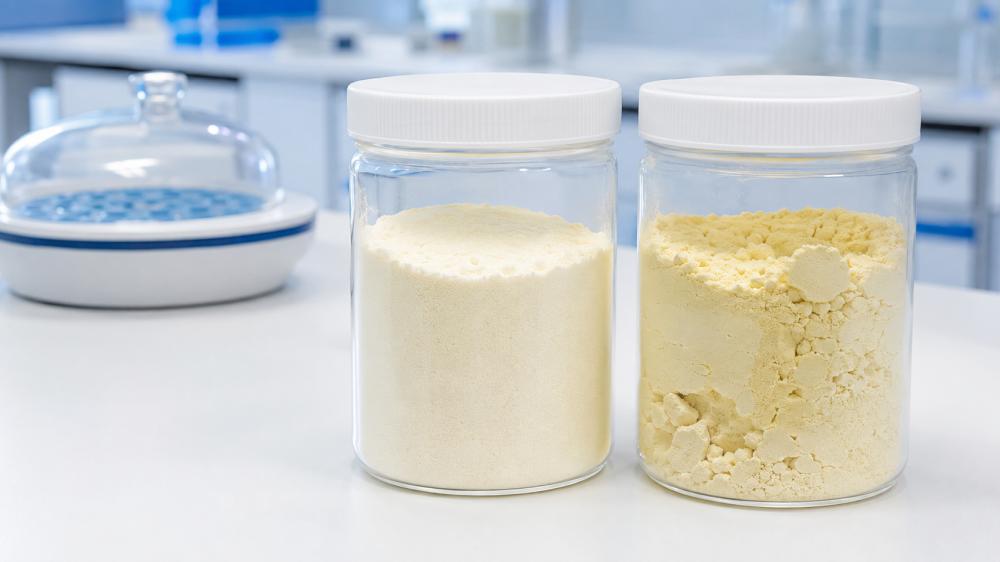
Clumps already in a sealed bag require another investigation. In an 18-month study, WPC34 containing 34.9% protein and WPC80 containing 76.8% protein were stored under ambient and elevated conditions. Samples held at 35°C became unacceptably yellow and were removed by 12 months; the researchers also observed increased water activity, caking, volatile formation and lysine loss in many samples. Their sealed-bag conclusion was a nine-month shelf life at 35°C and at least 18 months at lower temperatures.[6] Those values describe the tested materials and bags—not every commercial WPC, climate or repacking operation.
What Product Developers Should Specify
Do not approve whey protein on protein assay and a quick spoon test alone. Record wetting time, surface residue, visible dry cores, dispersion after a fixed mixing period, sediment after standing, foam height and collapse time. Also compare particle-size distribution, bulk density, moisture, water activity and performance after the intended heat process and storage period.
The test method should lock the powder mass, liquid composition and temperature, addition order, vessel, mixer, speed and time. The complete formula matters: minerals, cocoa, flavours, gums, fat and lecithin can all change the result.
SRS Nutrition Express can support WPC and WPI selection with specifications, batch documentation and samples for application trials. The final choice should be confirmed in the customer’s own formula, process and packaging rather than inferred from protein percentage alone.
References
1.Lech FJ, Delahaije RJBM, Meinders MBJ, et al. Identification of Critical Concentrations Determining Foam Ability and Stability of β-Lactoglobulin. Food Hydrocolloids. 2016;57:46–54.
2.Ji J, Fitzpatrick J, Cronin K, et al. Rehydration Behaviours of High Protein Dairy Powders: The Influence of Agglomeration on Wettability, Dispersibility and Solubility. Food Hydrocolloids. 2016;58:194–203.
3.Fitzpatrick JJ, Lauwe A, Coursol M, et al. Self-Agglomeration in Fluidised Beds after Spray Drying. ChemEngineering. 2020;4(2):35.
4.Ji J, Cronin K, Fitzpatrick J, Miao S. Enhanced Wetting Behaviours of Whey Protein Isolate Powder: The Different Effects of Lecithin Addition by Fluidised Bed Agglomeration and Coating Processes. Food Hydrocolloids. 2017;71:94–101.
5.ISO. ISO/TS 17758:2014—Instant Dried Milk: Determination of the Dispersibility and Wettability. 2014.
6.Tunick MH, Thomas-Gahring AE, Van Hekken DL, et al. Physical and Chemical Changes in Whey Protein Concentrate Stored at Elevated Temperature and Humidity. Journal of Dairy Science. 2016;99(3):2372–2383
Post time: Aug-06-2026


