

For years, adding another ingredient made a supplement look more advanced.
One form of magnesium became three. A protein powder gained collagen, adaptogens, vitamins and digestive enzymes. A sleep product began to resemble an inventory list.
But consumers now have more ways to question what they are buying. They can compare doses, search clinical studies and ask whether every ingredient is present in a meaningful amount.
The next competitive formula may therefore contain fewer ingredients—not because minimalism is automatically healthier, but because every ingredient has to earn its place.
Familiar Ingredients Are Not Disappearing
Holland & Barrett’s 2027 trend report does not suggest that consumers are abandoning established ingredients. Its 2026 bestselling products included magnesium bisglycinate, turmeric, fish oil and ashwagandha. The retailer reported selling almost 45 million magnesium bisglycinate capsules during the year.
Interest also remains strong in protein, creatine, omega-3 and electrolytes. The opportunity is not necessarily to discover another ingredient consumers cannot pronounce.
It may be to give a familiar ingredient a clearer purpose:
- ■ magnesium bisglycinate for a straightforward evening routine;
- ■ creatine monohydrate for daily strength and active aging;
- ■ protein for convenient nutrition and muscle maintenance;
- ■ omega-3 with clearly stated EPA and DHA;
- ■ electrolytes designed around a specific use occasion.
These ingredients are familiar, but the product experience around them can still change.
More Ingredients Can Create Less Clarity
A long formula can appear valuable until the customer asks how much of each ingredient it contains.
A product may feature ten attractive ingredients on the front of the pack while providing only a small combined blend on the back. Even when every ingredient is disclosed, a crowded formula creates practical questions:
- Does each ingredient reach a relevant dose?
- Can the serving size physically hold the formula?
- Do the ingredients remain stable together?
- Will the combination affect flavour or solubility?
- Can the finished product be tested accurately?
- Is there evidence for the combination—or only for its individual parts?
More ingredients also mean more specifications, suppliers, allergens, interactions, analytical methods and potential supply interruptions.
A simpler formula is not automatically better. It is simply easier to understand when its dose and purpose are well defined.

Consumers Are Asking for Proof, Not Just Novelty
McKinsey’s 2027 wellness research found that effectiveness now ties with price as consumers’ leading buying consideration. Quality follows closely, while clear ingredient labelling has become an important purchasing factor for highly engaged wellness consumers.
These findings do not prove that consumers will reject every multi-ingredient product. They suggest that complexity needs a reason.
“Contains 12 active ingredients” is no longer a complete value proposition. The brand must explain why those ingredients belong together, whether the doses are meaningful and how quality is controlled.
Simpler Does Not Have to Mean Boring
A single-ingredient product can still be differentiated through:
- raw-material source and traceability;
- particle size, density or dispersibility;
- flavour and sensory performance;
- capsule, gummy, powder or stick-pack format;
- transparent batch testing;
- packaging suited to the serving and powder volume;
- evidence appropriate to the intended consumer.
A creatine product does not require a novel creatine form to feel new. A finer grade, portable sachet, better flavour or thoughtfully designed women’s product may create a more relevant experience.
Likewise, magnesium bisglycinate can be positioned through elemental magnesium content, chelation evidence, tolerability, format and transparent dosing—not by placing it beside several cheaper magnesium forms and calling the mixture “advanced.”
Fewer Ingredients Can Demand Better Ingredients
Removing supporting ingredients can make the remaining raw material more visible.
Colour, flavour, odour, dispersibility and batch variation become harder to hide in a short formula. The supplier’s specification therefore matters more, not less.
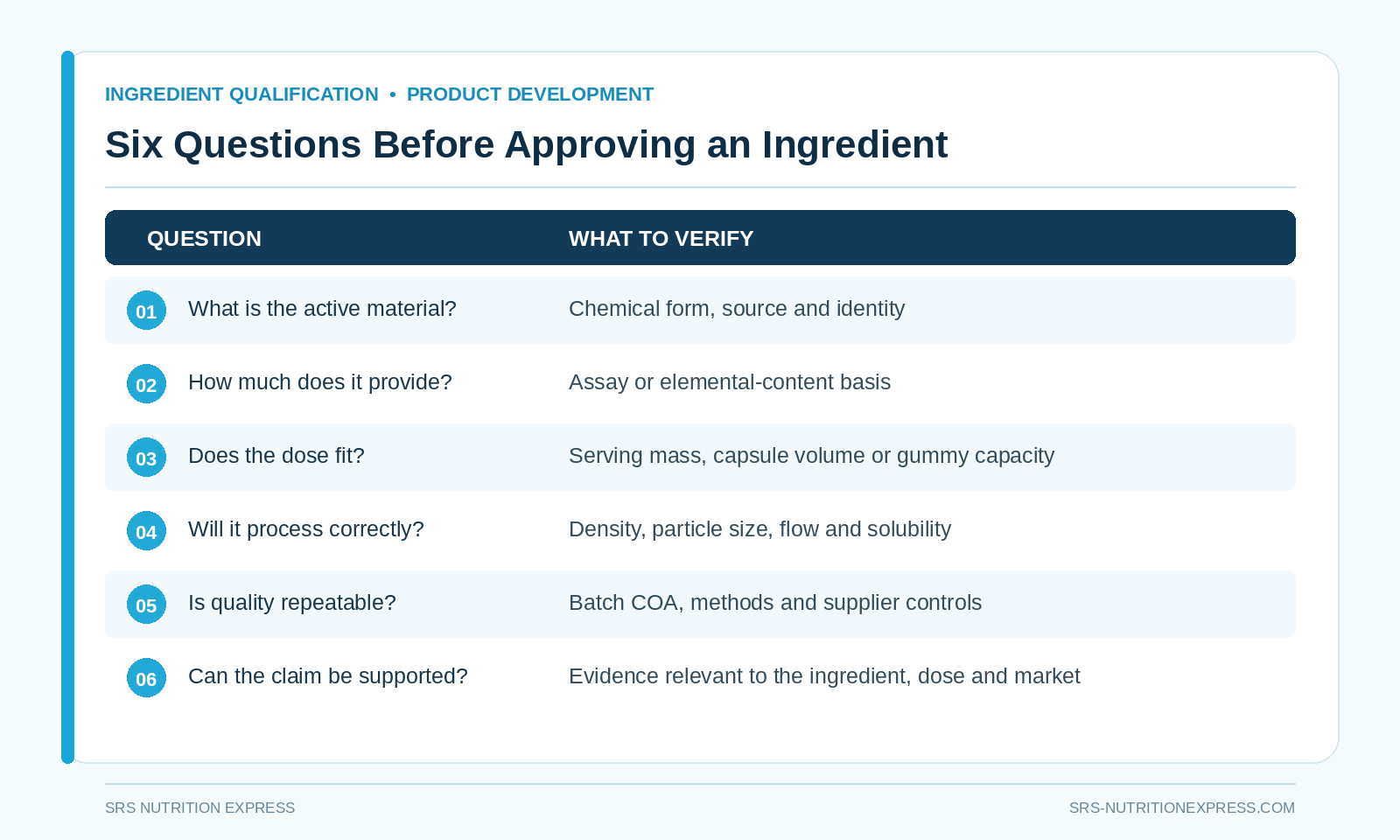
Before approving a simplified product, brands should still confirm:
When Does a Multi-Ingredient Formula Still Make Sense?
Some products genuinely need several components.
An electrolyte formula requires more than one mineral. A meal-replacement powder needs a broader nutritional profile. A formulation may combine ingredients because they perform complementary technical or nutritional roles.
The question is not whether every product should become a single-ingredient supplement.
If an ingredient were removed, would the product become less useful—or only less impressive on the label?
That question can expose unnecessary complexity without turning simplicity into another marketing gimmick.
Planning a Clearer Supplement Formula for 2027?
SRS Nutrition Express can help translate a product concept into an ingredient and format brief that your purchasing, formulation and quality teams can evaluate.
Share the intended benefit, target consumer, dosage form, serving size, destination market and preferred ingredients. We can help compare applicable grades, realistic dose requirements, specifications, samples and available packaging or private-label options before the formula becomes unnecessarily complicated.
Evidence Boundaries
- Market forecasts describe emerging patterns, not guaranteed consumer behaviour.
- Fewer ingredients do not automatically make a product safer, more effective or higher quality.
- Multi-ingredient formulations may be appropriate when every component has a justified role.
- Evidence for individual ingredients does not automatically establish the efficacy of a finished combination.
- Product suitability depends on dose, raw-material quality, formulation, processing, packaging and target-market requirements.
Recommended Reading
References
- Holland & Barrett. Wellness Trends Report 2027.
- McKinsey & Company. Future of Wellness 2027: Inside the $2.7 Trillion Takeover. November 3, 2026.
- Council for Responsible Nutrition. What Americans Think About Supplements: 2026 Consumer Survey. October 7, 2026.
- The Vitamin Shoppe. Five Defining Trends Shaping the Next Era of Health and Wellness. June 29, 2026.
Post time: Nov-16-2026


