

A Certificate of Analysis is often the first document requested when a supplement brand evaluates a new ingredient. It is useful, but it answers a limited question: what results did the supplier report for this batch?
It does not, on its own, establish that the sample represented the shipment, that the analytical method was suitable, that the supplier remains consistent, or that the material will perform in the intended formulation.
A stronger approval process connects the COA to a defined specification, verified supplier controls, representative sampling, traceability and application testing.
What a Certificate of Analysis Actually Proves
A useful COA should identify the material and batch, specification limits, analytical methods and actual results. A numerical result with a method and reporting basis is more informative than a simple statement such as “complies.”
For U.S. dietary supplements, 21 CFR Part 111 requires at least one appropriate identity test or examination for every component that is a dietary ingredient, unless FDA grants an exemption.
A manufacturer may rely on a supplier COA for other applicable component specifications only after establishing its reliability through confirmation testing. The COA must describe the methods, test limits and actual results. Supplier qualification must also be documented, periodically reconfirmed and approved by quality-control personnel.
A professionally formatted PDF is therefore not the same as completed supplement ingredient qualification.
The Specification Must Match the Intended Product
The specification comes before the COA. It defines what the ingredient must meet for the intended dosage form, product positioning and target market.
A generic specification may be valid but still inadequate for a specific application.
Creatine monohydrate qualification may include assay, creatinine, DCD, DHT, heavy metals, microbiological limits and particle size. WPI90 intended for an RTD beverage may also require mineral composition, turbidity and process-specific heat-stability data. Fish oil qualification normally extends beyond EPA and DHA content to oxidation indicators and contaminant controls.
The reporting basis also matters. Protein measured on a dry-matter basis cannot be compared directly with an as-is result. A result reported as “not detected” is meaningful only when the analytical method and detection limit are known.
Supplier Qualification Tests Whether the COA Can Be Trusted
Supplier approval should examine the quality system behind the document, not only the document itself.
Relevant evidence may include:
● manufacturing-site information;
● GMP or food-safety certification;
● internal and external testing capabilities;
● comparison with independent laboratory results;
● deviation and complaint handling;
● change-notification procedures;
● previous batch performance.
Qualification is not permanent. A change in manufacturing site, raw-material source, analytical method or process conditions may alter risk even when the commercial product name remains unchanged.
Periodic review should therefore consider both documentation and actual supply history.
Sampling and Traceability Affect Every Test Result
A technically correct laboratory result can still be misleading when the sample does not represent the full lot.
U.S. dietary-supplement CGMP rules require representative samples to determine whether applicable specifications are met. Components must also receive unique identifiers that allow each lot to be traced to the supplier, receipt date, material status and the dietary supplements in which it was used.
EU food law uses a similar supply-chain approach. Article 18 of Regulation (EC) No 178/2002 requires food businesses to identify the businesses that supplied them and the businesses to which their products were supplied. Traceability information must be available to competent authorities when requested.
A batch number printed on a COA has limited value unless it connects to actual manufacturing, testing, shipment and customer records.
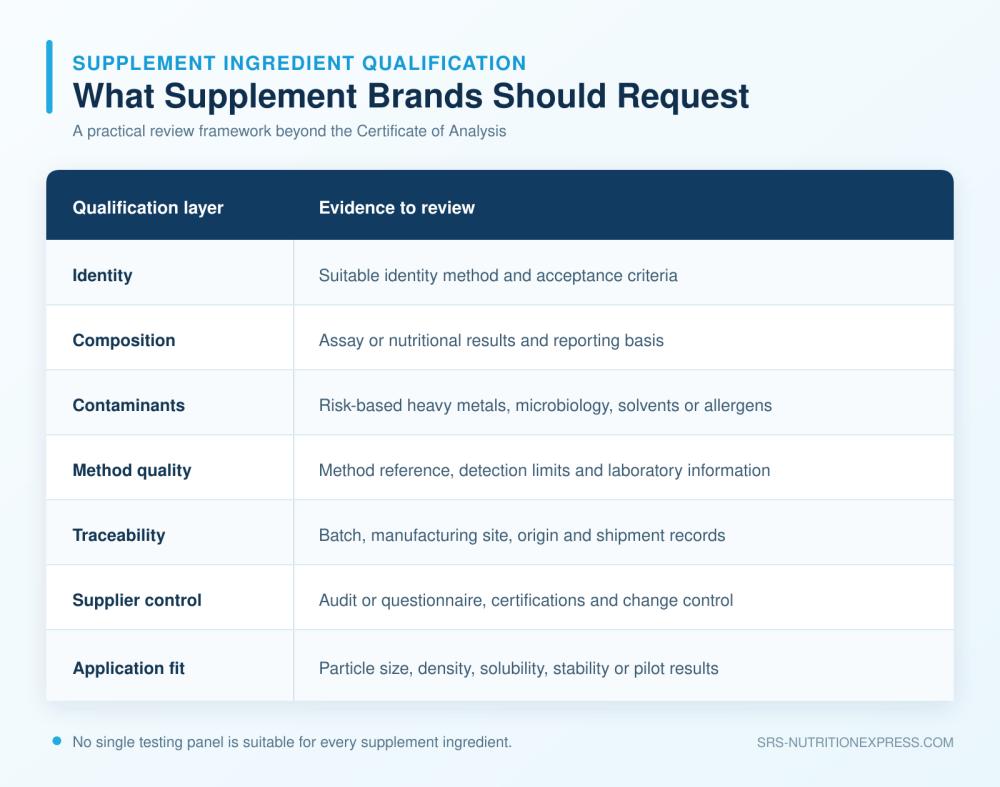
The qualification plan should reflect the ingredient’s manufacturing process, intended dose, target market, finished-product format and known sources of variability.
A Compliant Batch Can Still Fail in the Application
A qualified supplier and compliant COA reduce risk. They do not guarantee success in every formulation.
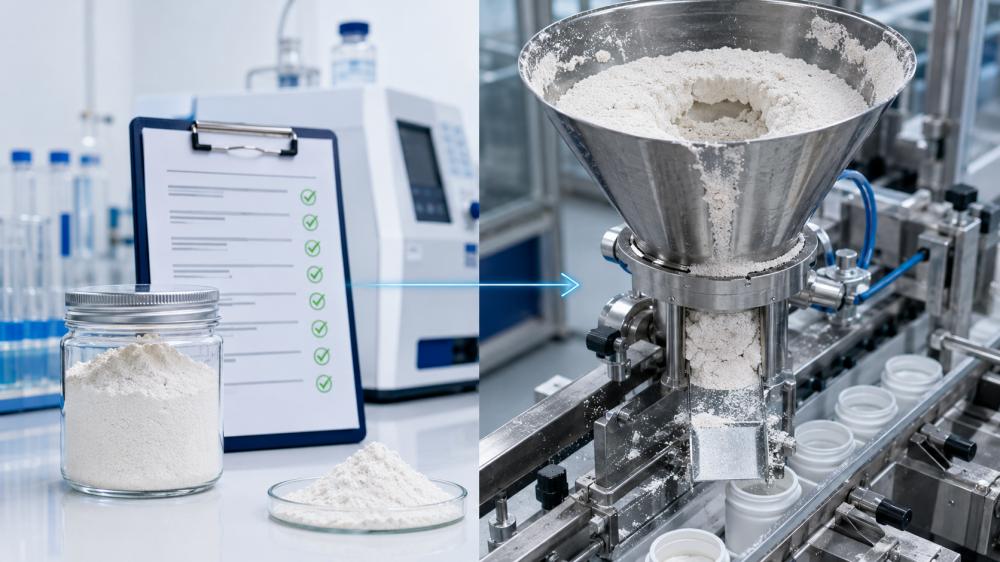
A whey protein can meet compositional specifications and still aggregate during UHT processing. A fine creatine grade can meet its assay requirement but create flow, dust or filling problems on a packaging line. A fish oil can meet EPA and DHA targets while requiring separate evaluation of oxidation and sensory quality.
Regulatory limits also require context. EU Regulation 2023/915 establishes maximum levels for specified contaminants in defined
food categories, including certain food supplements. It should not be treated as one universal raw-material specification for every ingredient or market.
Specification compliance and application suitability are related, but they are not the same decision.
Review the Documentation Before Batch Approval
A Certificate of Analysis is necessary evidence. Full ingredient qualification asks a broader question:
Can this material, supplier and individual batch consistently support the intended commercial product?
At SRS Nutrition Express, supplier documentation, raw-material specifications, batch results and application requirements are treated as separate layers of evaluation.
Brands can request the relevant specification, batch COA, available supporting test documents and a representative sample before approving an ingredient for commercial production.
References
1. U.S. Food and Drug Administration. 21 CFR Part 111—Current Good Manufacturing Practice in Manufacturing, Packaging, Labeling, or Holding Operations for Dietary Supplements, particularly §§111.70, 111.75, 111.80, 111.95 and 111.155.
2. U.S. Food and Drug Administration. Small Entity Compliance Guide: Current Good Manufacturing Practice in Manufacturing, Packaging, Labeling, or Holding Operations for Dietary Supplements.
3. European Parliament and Council. Regulation (EC) No 178/2002, Article 18 on traceability.
4. European Commission. Regulation (EU) 2023/915 on Maximum Levels for Certain Contaminants in Food.
Post time: Jul-30-2026


