

A lower price is not a successful supplier change if the new creatine behaves differently in production, arrives with incomplete documentation or falls outside your market requirements. Qualification should therefore begin with your finished product and quality system—not with a catalogue grade name alone.
Define the specification before comparing suppliers
Start with the attributes that affect your formula, process and target market:
- Assay basis and method: clarify whether results are calculated as creatine monohydrate or anhydrous creatine, and whether they are reported as-is or on a dried basis.
- Water or loss on drying: record the method because creatine monohydrate contains approximately 12.1% water of crystallisation.
- Key related substances: creatinine, dicyandiamide (DCD) and dihydro-1,3,5-triazine (DHT), with methods, limits and reporting thresholds.
- Individual limits for lead, cadmium, arsenic and mercury, plus microbiological criteria appropriate to the destination market and finished product.
- Particle-size distribution, bulk and tapped density, flow and application-specific performance where these affect processing.
Published dossiers can provide reference points, but they do not create universal legal limits for every creatine source.
Read the COA as a lot-specific technical record
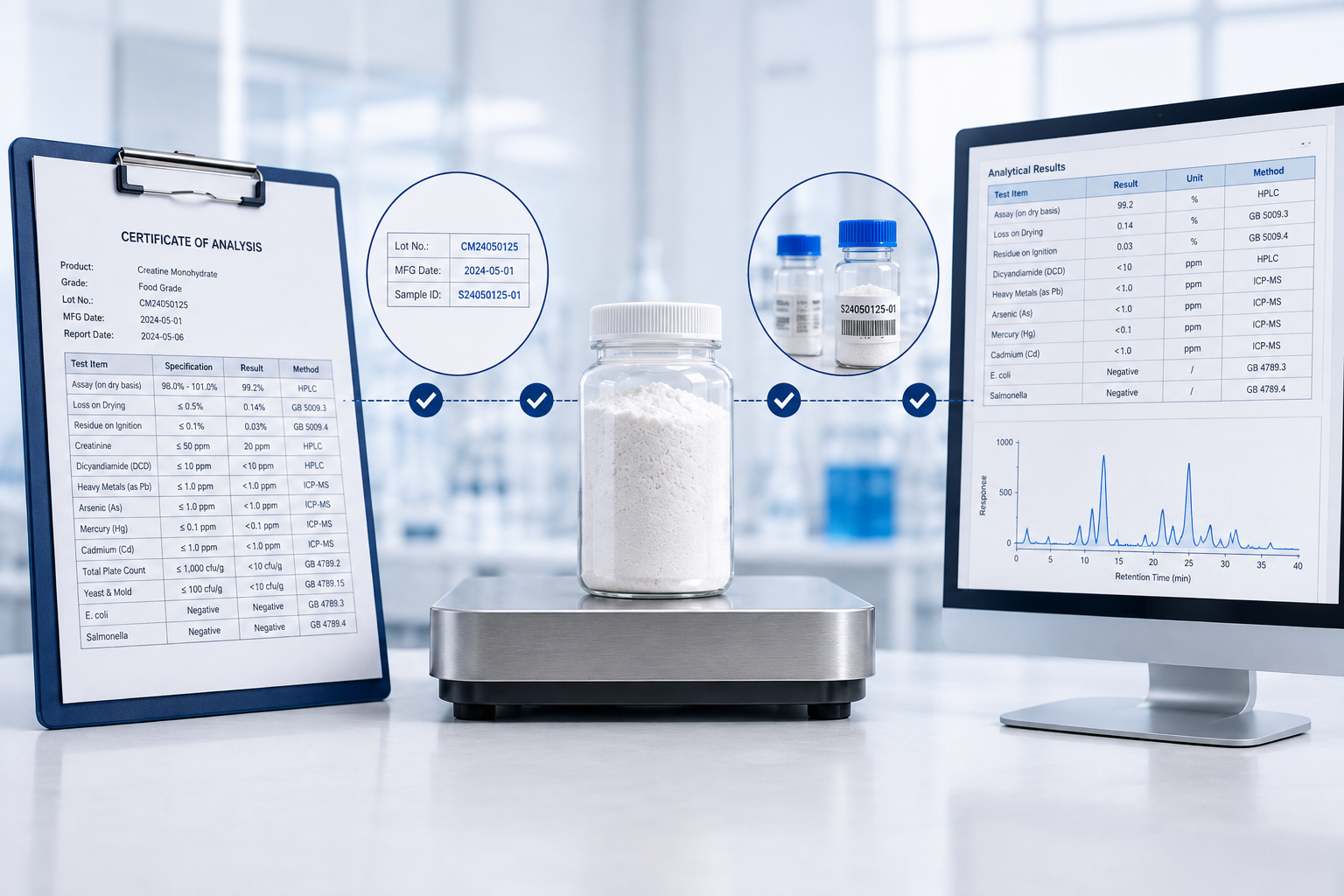
A useful certificate of analysis identifies the product, batch, manufacturing site or responsible entity, test method, acceptance limit and actual result. “Pass” alone gives procurement and quality teams little information for comparison or trend analysis.
A DHT result of “not detected” is meaningful only when the detection or quantification limit is disclosed. Confirm that the COA represents the commercial lot rather than a generic example.
Use impurity benchmarks with the correct evidence boundary
FDA GRAS Notice 931 describes a specific AlzChem creatine monohydrate and includes specifications of at least 99.9% assay, creatinine at no more than 100 mg/kg, DCD at no more than 50 mg/kg and DHT at no more than 3 mg/kg, the stated detection limit. The dossier also cites an EFSA 2004 opinion that evaluated a high-purity material and considered creatinine, DCD and DHT controls.
These figures are useful comparison points, not FDA standards for every commercial creatine. GRN 931 also covers specified food uses and use levels; FDA’s “no questions” response is not blanket approval for every supplier, dose or finished product.
Qualify the supplier under a risk-based program
For US dietary supplements, 21 CFR Part 111 generally requires at least one appropriate identity test or examination for each dietary ingredient unless an applicable exemption has been granted. A manufacturer may rely on a supplier COA for other component specifications only after establishing its reliability through confirmation testing, documenting qualification, periodically reconfirming reliability and obtaining quality-control approval.
The regulation does not prescribe “three initial lots” as a universal rule. Testing several early lots may be a sensible internal policy, but its scope and frequency should be justified by risk, supplier history, material variability and the consequences of failure.
Supplier review should also cover:
- manufacturing-site identity, quality agreements and change-notification controls;
- deviations, complaints, recalls, traceability and document retention;
- audit evidence and relevant certifications, which support—but do not replace—qualification;
- capacity, lead time, inventory location and contingency stock.
Confirm physical performance in the intended application
Mesh labels such as 80, 200 or 500 are screening tools, not complete descriptions of a powder. Two lots that pass the same sieve can still differ in fines, coarse particles, density, cohesion and flow. Where performance matters, request the sieve method or laser-diffraction data such as Dv(10), Dv(50) and Dv(90), together with representative density results and test methods.
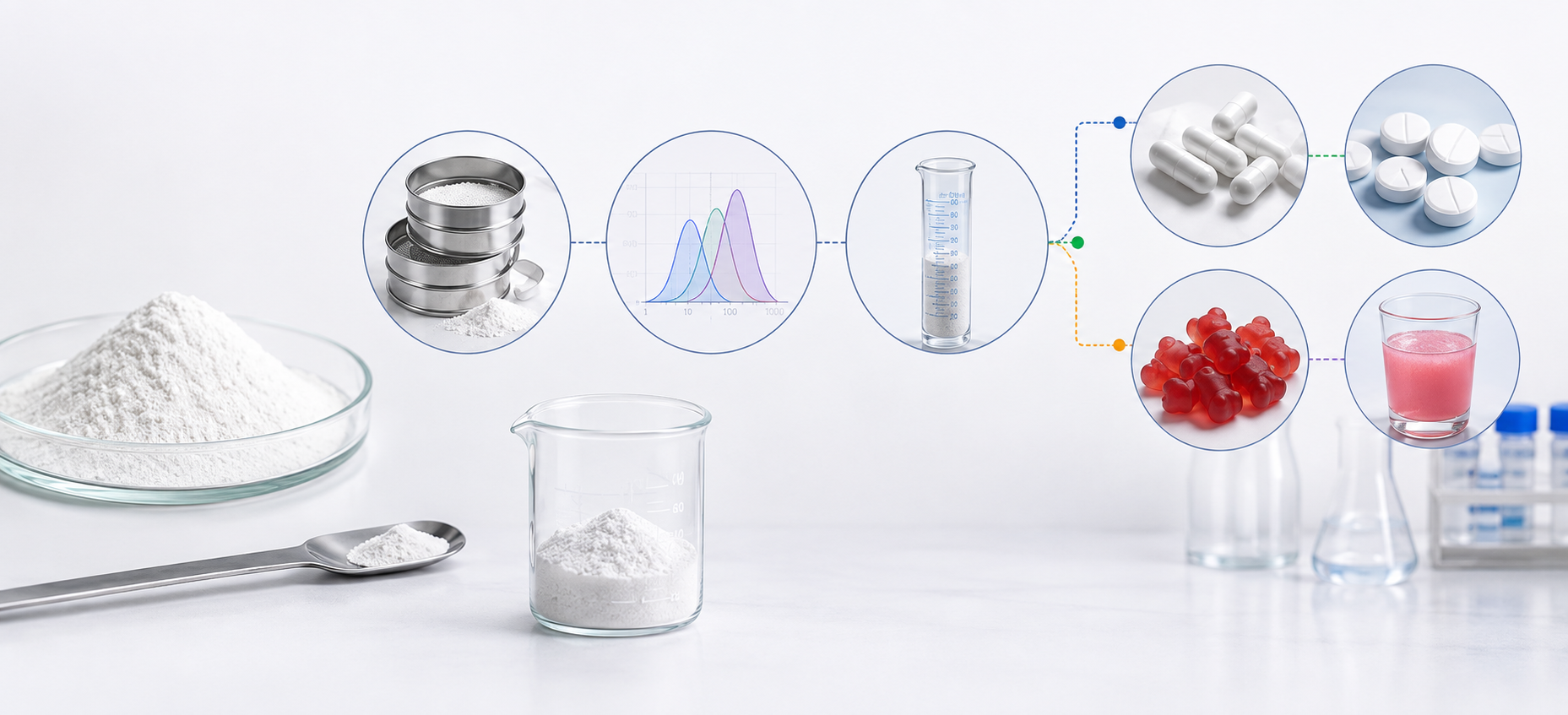
Then run the proposed grade in the real system: capsule blend, tablet compression trial, powder mix, gummy matrix or beverage process. Water dispersion alone cannot predict filling consistency, grittiness, sediment, heat exposure or low-pH stability in the finished formulation.
Build ongoing monitoring into the approval
After approval, trend critical results across lots and define escalation rules. Changes in site, process, method, grade or specification may require renewed testing or finished-product validation.
How SRS can support your qualification process
Changing suppliers should begin with a specification comparison—not price alone. SRS Nutrition Express can provide representative creatine monohydrate samples, grade-specific specifications, lot COAs and available particle-size or density data for qualification trials. These documents describe the proposed SRS material; they do not replace the buyer’s incoming controls or finished-product validation.
Share your current specification, intended dosage form, destination market, target annual volume and supply location. SRS can then identify an appropriate grade and documentation package for your technical, quality and procurement review.
Evidence boundaries
- Published impurity limits may relate to a particular evaluated product and should not automatically be treated as universal regulatory limits.
- FDA GRAS notices are notifier- and use-specific and do not constitute general FDA approval.
- Particle size and density vary by grade, batch, sampling and test method; application suitability requires trials in the intended formulation and equipment.
- Market, customer and retailer requirements may be stricter than the reference values discussed here.
Recommended Reading
- Creatine Mesh Size vs Particle Size Distribution: Why Dv(10), Dv(50) and Dv(90) Matter
- How to Read a Creatine Monohydrate Specification Sheet
References
1. U.S. Food and Drug Administration (FDA). GRAS Notice No. 931 — Creatine Monohydrate.
2. U.S. Food and Drug Administration (FDA). 21 CFR Part 111 — Current Good Manufacturing Practice in Manufacturing, Packaging, Labeling, or Holding Operations for Dietary Supplements.
3. European Food Safety Authority (EFSA). Opinion on the safety of creatine monohydrate. 2004.
4. United States Pharmacopeia (USP). General Chapter <786> — Particle Size Distribution Estimation by Analytical Sieving.
5. International Organization for Standardization (ISO). ISO 13320:2020 — Particle Size Analysis — Laser Diffraction Methods.
6. International Organization for Standardization (ISO). ISO 14488:2007 — Particulate Materials — Sampling and Sample Splitting for the Determination of Particulate Properties.
7. ASTM International. ASTM E11-24 — Standard Specification for Woven Wire Test Sieve Cloth and Test Sieves.
8. United States Pharmacopeia (USP). General Chapter <616> — Bulk Density and Tapped Density of Powders.
9. United States Pharmacopeia (USP). General Chapter <1174> — Powder Flow.
10. Kreider RB, et al. International Society of Sports Nutrition position stand: safety and efficacy of creatine supplementation in exercise, sport, and medicine. Journal of the International Society of Sports Nutrition. 2017;14:18.
Post time: Sep-09-2026


