

“Citrulline Malate 2:1” appears to be an exact description. In practice, it leaves several questions unanswered: Is 2:1 a mass ratio or a molar ratio? How much L-citrulline does the material deliver? Is the malic acid DL or L form? Which test confirms the composition?
Those details affect raw-material comparison, pre-workout formulation and the amount of L-citrulline that can be declared per serving. A ratio printed on a specification or certificate of analysis (COA) is therefore a starting point—not complete verification.
Two Definitions Produce Different Numbers
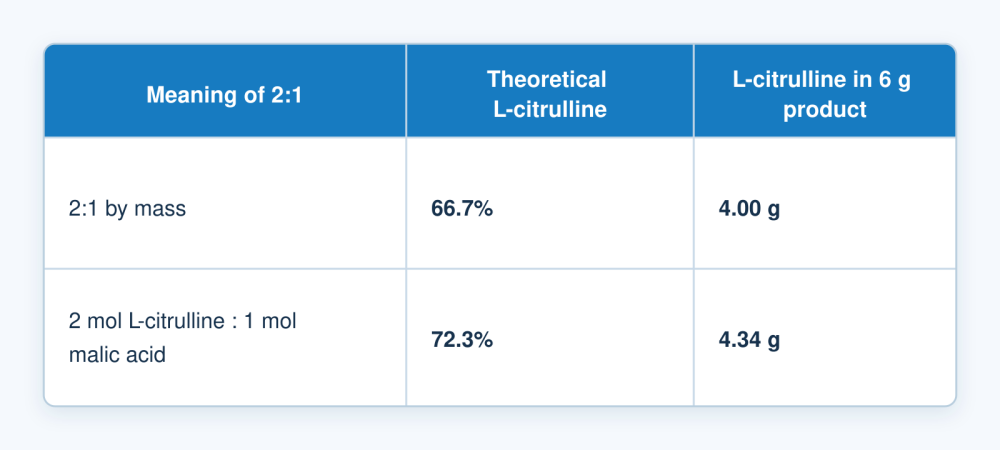
L-citrulline and malic acid have molecular weights of 175.19 and 134.09 g/mol, respectively.[1–2] If 2:1 means two parts L-citrulline to one part malic acid by mass, L-citrulline represents 66.7% of the material. A 6 g serving would theoretically provide 4.00 g.
PubChem also lists an L-Citrulline DL-Malate (2:1) entity containing two citrulline units and one malic-acid unit, with a molecular weight of 484.46 g/mol.[3] Under that molar interpretation, L-citrulline represents approximately 72.3%, and 6 g would theoretically provide 4.34 g.
Neither calculation proves the composition of a commercial batch. The supplier must state which definition is used and support it with actual results.
Why the Name and Total Assay Are Not Enough
A COA entry such as “assay ≥98%” is ambiguous unless it identifies the analyte, method and calculation basis. A combined or summed result cannot show whether the expected amount of each component is present. Moisture can also change the apparent percentage if one result is reported as-is and another on a dry basis.
This is not merely theoretical. In a 2018 study, researchers used nuclear magnetic resonance spectroscopy to examine five commercial products described as 2:1. NMR analysis of five commercial products labelled as 2:1 found that only one was close to the declared ratio. The remaining products reportedly ranged from approximately 1.11:1 to 1.62:1, indicating less citrulline relative to malate than the name implied.[4] The sample was small and should not be treated as a market-wide survey, but it demonstrates why a name alone cannot establish composition.
The term “DL-malate” needs equal care. It indicates the racemic designation of malic acid, whereas L-malic acid is a specific stereoisomer. A purchase specification should use the intended chemical name consistently across the specification, COA and finished-product documentation.
Match Each Question to the Right Test
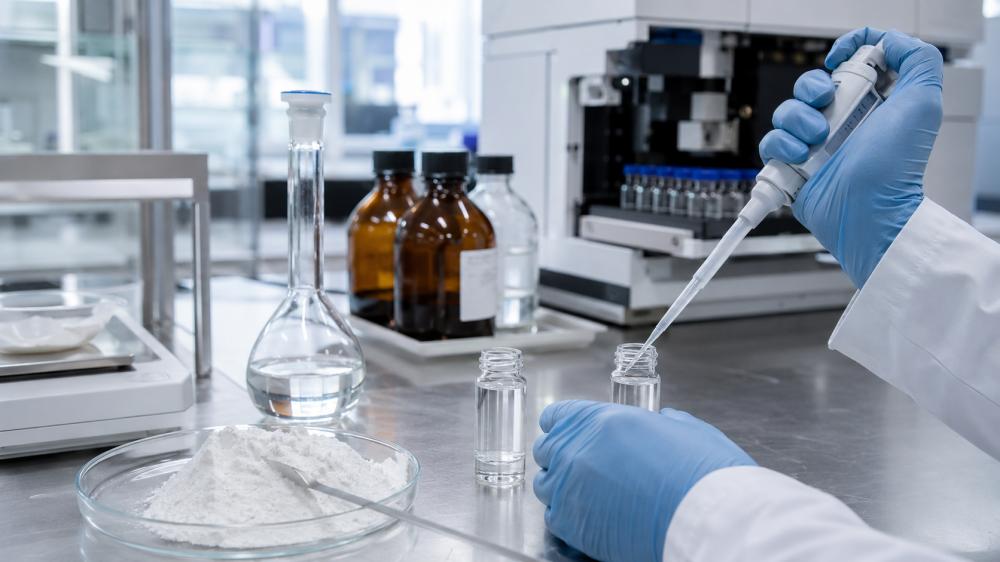
An identity technique such as FTIR may support raw-material identification and help detect major differences, but spectrum matching alone does not provide sufficiently specific quantitative confirmation of the citrulline-to-malate ratio.Quantitative methods should report L-citrulline and malic acid separately and be capable of distinguishing the target analytes from related compounds or formulation components.
U.S. dietary-supplement GMP rules require manufacturers to establish component specifications for identity and for the purity, strength and composition needed to meet finished-product specifications. Dietary-ingredient identity normally requires an appropriate test or examination. For other applicable component specifications, reliance on a supplier COA is permitted only after its reliability has been established, documented and periodically reconfirmed.[5–6]
Build the Purchase Specification Around the Finished Product
● Before approving Citrulline Malate 2:1, confirm:
● Whether 2:1 is defined by mass or by moles
● Separate acceptance limits and actual results for L-citrulline and malic acid
● The malic-acid designation and identity criteria
● Test methods, reference standards and as-is or dry-basis reporting
● Moisture, relevant contaminants and microbiological limits
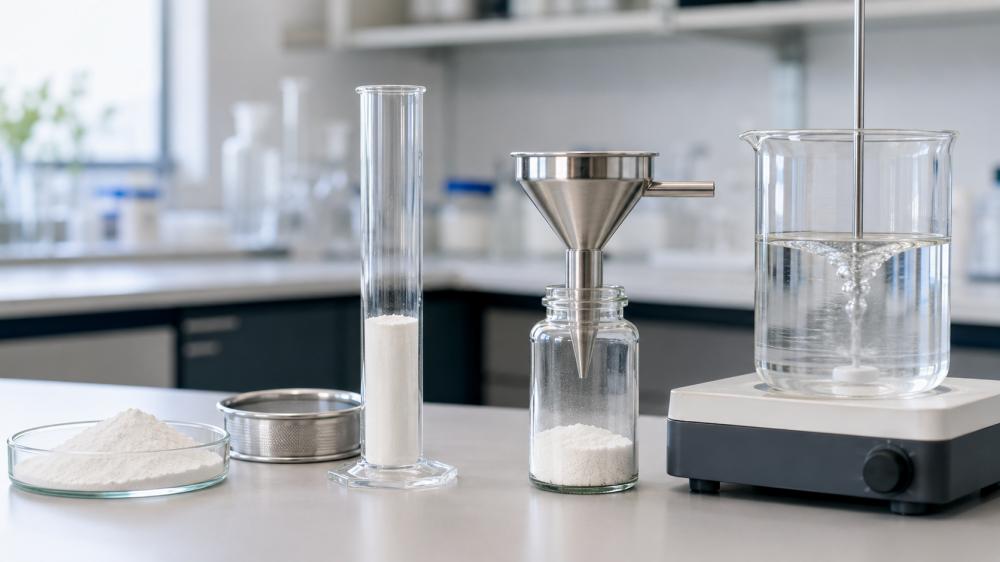
● Particle size, bulk density, flow and solubility needed for the dosage form
● Whether the finished-product quantity refers to total citrulline malate or delivered L-citrulline
Research cannot repair an unclear specification. A 2021 critical review noted inconsistent characterisation of citrulline-malate products and uncertainty over the L-citrulline amounts used in parts of the exercise literature.[7] Evidence from one characterised material should not automatically be transferred to another powder carrying the same 2:1 name.
SRS Nutrition Express supplies L-Citrulline DL-Malate 2:1 and can support specification review, batch documentation, samples and application testing. The decisive purchasing question is not simply “Is it 2:1?” but “How is 2:1 defined, measured and confirmed for this batch?”
References
1. National Center for Biotechnology Information. PubChem Compound Summary for L-Citrulline. CID 9750.
2. National Center for Biotechnology Information. PubChem Compound Summary for Malic Acid. CID 525.
3. National Center for Biotechnology Information. PubChem Compound Summary for L-Citrulline DL-Malate (2:1). CID 145710262.
4. Chappell AJ, Allwood DM, Johns R, Brown S, Sultana K, Anand A, Simper T. Citrulline Malate Supplementation Does Not Improve German Volume Training Performance or Reduce Muscle Soreness in Moderately Trained Males and Females. Journal of the International Society of Sports Nutrition. 2018;15:42.
5. U.S. Food and Drug Administration. 21 CFR §111.70—Specifications.
6. U.S. Food and Drug Administration. 21 CFR §111.75—Verification of Specifications.
7. Gough LA, Sparks SA, McNaughton LR, et al. A Critical Review of Citrulline Malate Supplementation and Exercise Performance. European Journal of Applied Physiology. 2021;121:3283–3295.
Post time: Aug-08-2026


