

A clear whey drink can pass its first bench test and still become hazy, develop floating particles or form sediment during storage. Day-one transparency is useful—but it is not a shelf-life conclusion.
Stability depends on the complete system: whey source, protein concentration, pH, ionic strength, heat treatment, flavours, minerals, water quality, packaging and storage temperature. Selecting an ingredient described as “Clear WPI” is only the beginning.
1 Clear Whey Has a Narrow Formulation Window
Whey protein behaviour changes sharply with pH. As the formulation moves closer to the isoelectric region of major whey proteins, electrostatic repulsion decreases and aggregation becomes more likely.
A 2026 study tested two lots of milk-derived whey protein isolate at protein concentrations from 2% to 10%, pH values from 3.0 to 7.0 and three sodium-chloride levels. The low-pH samples were heat-treated at 109°C for three seconds.
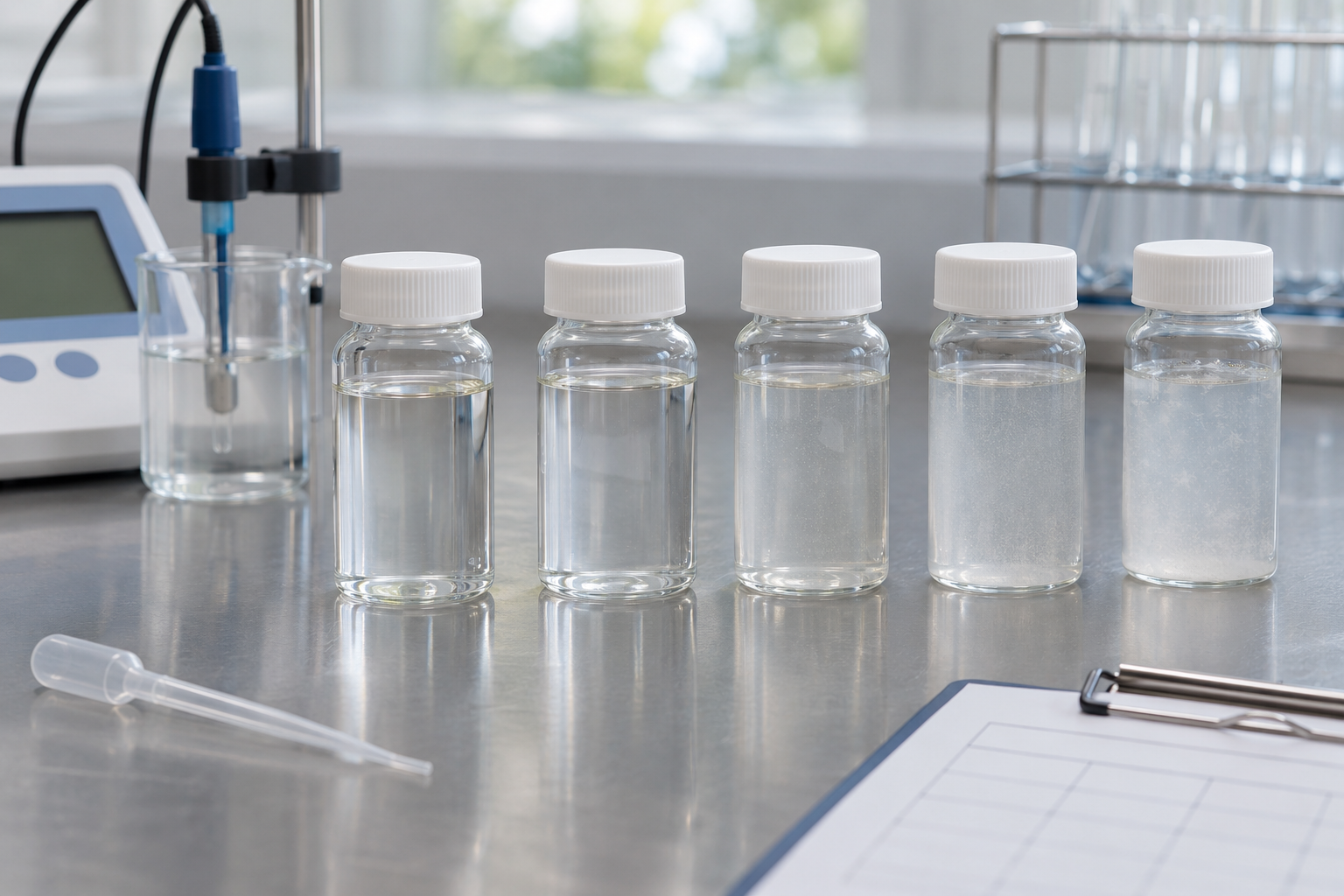
Within that experimental system, beverages remained optically clear at pH 3.0 to below 3.5. At pH 3.5 and above, turbidity increased, while added salt generally reduced the clear formulation region. The authors concluded that the tested mWPI could support clear acidic beverages containing up to approximately 8% protein under selected conditions.[1]
This is a useful formulation map—not a universal Clear WPI recipe. Only two lots from one commercial manufacturer were evaluated, and the researchers specifically called for future long-term storage studies.
2 Heat Can Expose a Problem the Bench Mix Hides
A cold-mixed laboratory sample may look clear because the proteins have not yet experienced commercial processing.
Heat can unfold whey proteins and encourage protein–protein interactions. A 2010 study found that tested whey protein beverages at pH 3.6 or below remained essentially clear before and after heating across the evaluated ingredient systems. At pH 3.8 and above, ingredient selection became substantially more important. Salt addition also increased turbidity at pH 4.0.[2]
3 Minerals, Flavours and Water Change the Result
Electrolytes alter ionic strength and can weaken the electrostatic forces keeping proteins apart. Acids determine both flavour and protein environment, while the acid type and order of addition may expose protein to damaging local pH conditions before the tank reaches its final equilibrium.
Flavour emulsions, colours, botanical extracts and mineral premixes can introduce particles or interactions that are absent from a protein-and-water test.
The formulation trial should therefore use process-representative water and the complete commercial formula. A protein that remains clear in deionised water may behave differently in mineral-rich production water or an electrolyte beverage.
4 Clarity at Release Does Not Prove Shelf-Life Stability
Protein aggregation can continue after processing.
In one storage study, a heat-treated acidic whey beverage at pH 4 developed increasing turbidity and protein aggregation over six weeks. Higher storage temperatures accelerated the process. Removing aggregates formed during heating reduced later turbidity, supporting the conclusion that initial aggregates can influence subsequent instability.[3]
Long-term defects may include:
- increasing haze or turbidity;
- fine sediment or visible particles;
- floating threads or cotton-like aggregates;
- ring formation at the liquid surface;
- colour, flavour or odour changes;
- declining soluble-protein measurements.
A passing release sample does not guarantee that the beverage will look and taste the same after twelve months.
5 What Should a Clear-Whey Stability Program Measure?
A useful program should evaluate more than visual transparency:
- • turbidity or optical clarity at release and planned intervals;
- • particle size, sediment and ring formation;
- • pH, colour, flavour and odour;
- • soluble protein or another justified protein-integrity measure;
- • performance after the intended heat and filling process;
- • samples stored in the proposed commercial package;
- • real-time stability supported—not replaced—by accelerated testing.
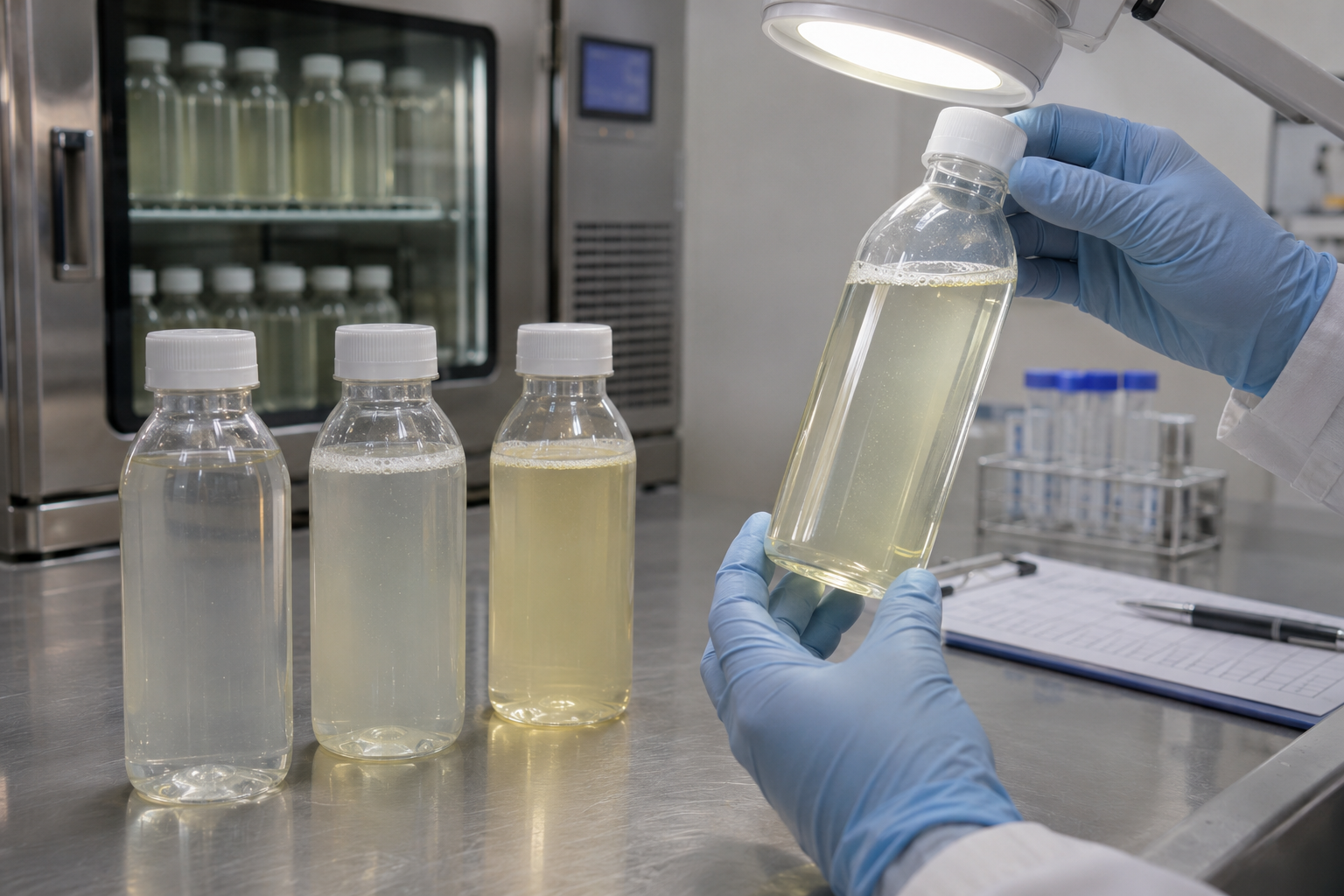
Acceptance criteria should be established before the results are available. Otherwise, a development team may gradually redefine “acceptable clarity” as problems appear.
Hydrolysis Can Solve One Problem and Create Another
Partial hydrolysis can reduce protein size and improve behaviour in some acidic systems. However, it can also expose bitter peptides.
A highly transparent drink may therefore require more flavour-masking work than a slightly less hydrolysed alternative. Protein percentage alone cannot predict this balance.
Sensory testing should use the complete acid, sweetener and flavour system after the intended heat process. A formula that tastes acceptable immediately after mixing may change after processing or storage.
Design the Trial Around Commercial Production
The pilot process should reproduce:
- water quality and hydration time;
- ingredient addition order;
- shear and deaeration;
- acidification procedure;
- heat treatment and cooling;
- filling temperature;
- packaging and closure;
- realistic storage conditions.
Record the commercial lot number of the Clear WPI used in successful trials. If the supplier later changes the source, process or grade, an agreed change-notification and revalidation procedure can prevent a seemingly minor substitution from becoming a shelf-life failure.
Developing a Clear Protein Beverage?
A useful supplier brief should state the target protein per serving, serving volume, desired clarity, pH range, heat process, mineral system, flavour profile, packaging and shelf-life target.
SRS Nutrition Express can provide available Clear WPI specifications, representative COAs and samples for formulation trials. Share your application conditions so the proposed grade can be evaluated in the intended process rather than selected from protein assay alone.
Evidence Boundaries
- Low pH improves clarity in many whey systems but does not guarantee long-term stability.
- The 2026 study evaluated two lots of one milk-derived WPI source, not every commercial Clear WPI.
- Approximately 8% protein was achievable only within the tested formulation and processing conditions.
- Accelerated testing cannot independently establish a twelve-month shelf life.
- Raw-material data cannot replace finished-formula, process and package validation.
Recommended Reading
References
- Zaitoun B, Amamcharla JK. Whey protein-based beverage formulation: Stability diagrams for acidic drinks made with milk whey protein isolate. Journal of Dairy Science. 2026. DOI: 10.3168/jds.2026-28867.
- LaClair CE, Etzel MR. Ingredients and pH are key to clear beverages that contain whey protein. Journal of Food Science. 2010;75(1):C21–C27. DOI: 10.1111/j.1750-3841.2009.01400.x.
- LaClair CE, Etzel MR. Turbidity and protein aggregation in whey protein beverages. Journal of Food Science. 2009. PMID: 19895456.
- Deeth HC, et al. Shelf-stable dairy protein beverages—Scientific and technological aspects. Journal of Dairy Science. 2022.
Post time: Nov-03-2026


