

Drop a tablet into water, wait for the fizz and drink. The consumer experience sounds simple. The development brief needs more detail.
For creatine effervescent tablets, the first constraint is space. Creatine must share each tablet with an acid–carbonate or bicarbonate system, flavoring and the ingredients needed to manufacture a usable product. The effervescent reaction releases carbon dioxide when water brings the components together. [1]
Before requesting a price for “one creatine tablet,” define the amount per serving, tablets per serving and water volume. Those decisions determine whether the proposed product is worth taking into trials.
Calculate the Whole Tablet, Not Only the Creatine
Consider a hypothetical target of 3 g creatine monohydrate per serving. If creatine accounts for 50% of the finished tablet mass, the serving requires 6 g of total tablet material.
One tablet would weigh 6 g; two would weigh 3 g each. These are arithmetic examples, not recommended formulas, serving recommendations or confirmed manufacturing capabilities.
The remaining mass must accommodate the effervescent system and other ingredients. Increasing creatine loading leaves less room for that system, while reducing loading increases total serving weight.
Ask the manufacturer to assess feasible tablet weight, tooling, thickness and tablet count together. A target expressed only as “3 g creatine” cannot settle those questions.
Specify What Happens in the Glass
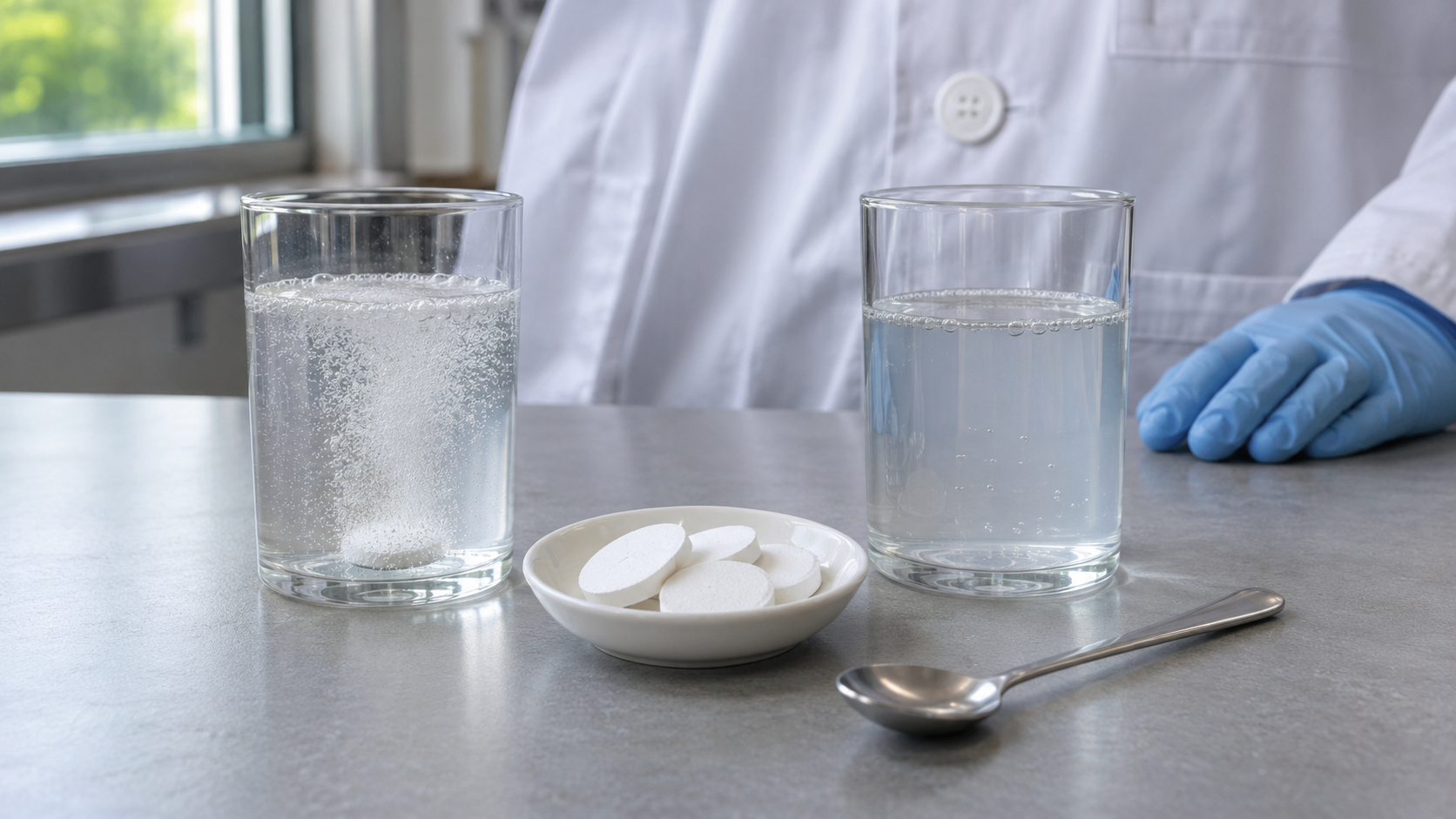
“Dissolves quickly” is an incomplete acceptance criterion. Set the water volume, water temperature, mixing instructions and observation time before comparing prototypes.
Separate tablet breakup, the end of visible fizzing and the behavior of the creatine-containing drink. The disappearance of the tablet does not by itself prove complete ingredient dissolution.
Evaluate sediment, redispersion, foam, taste and the amount remaining after the intended drinking procedure. Define whether the user should stir or swirl the glass.
A larger water volume may improve one aspect of the experience while making the product less convenient. Test the serving consumers will actually prepare.
Treat Moisture Protection as Part of the Formula
The components are intended to react after preparation, so premature exposure to moisture is a development concern. Published work on effervescent systems shows why moisture uptake, sticking and compactibility need attention. Those findings explain general formulation challenges; they do not validate a specific creatine tablet. [2]
Review raw-material handling, production conditions and the time between compression and final packing with the manufacturer.
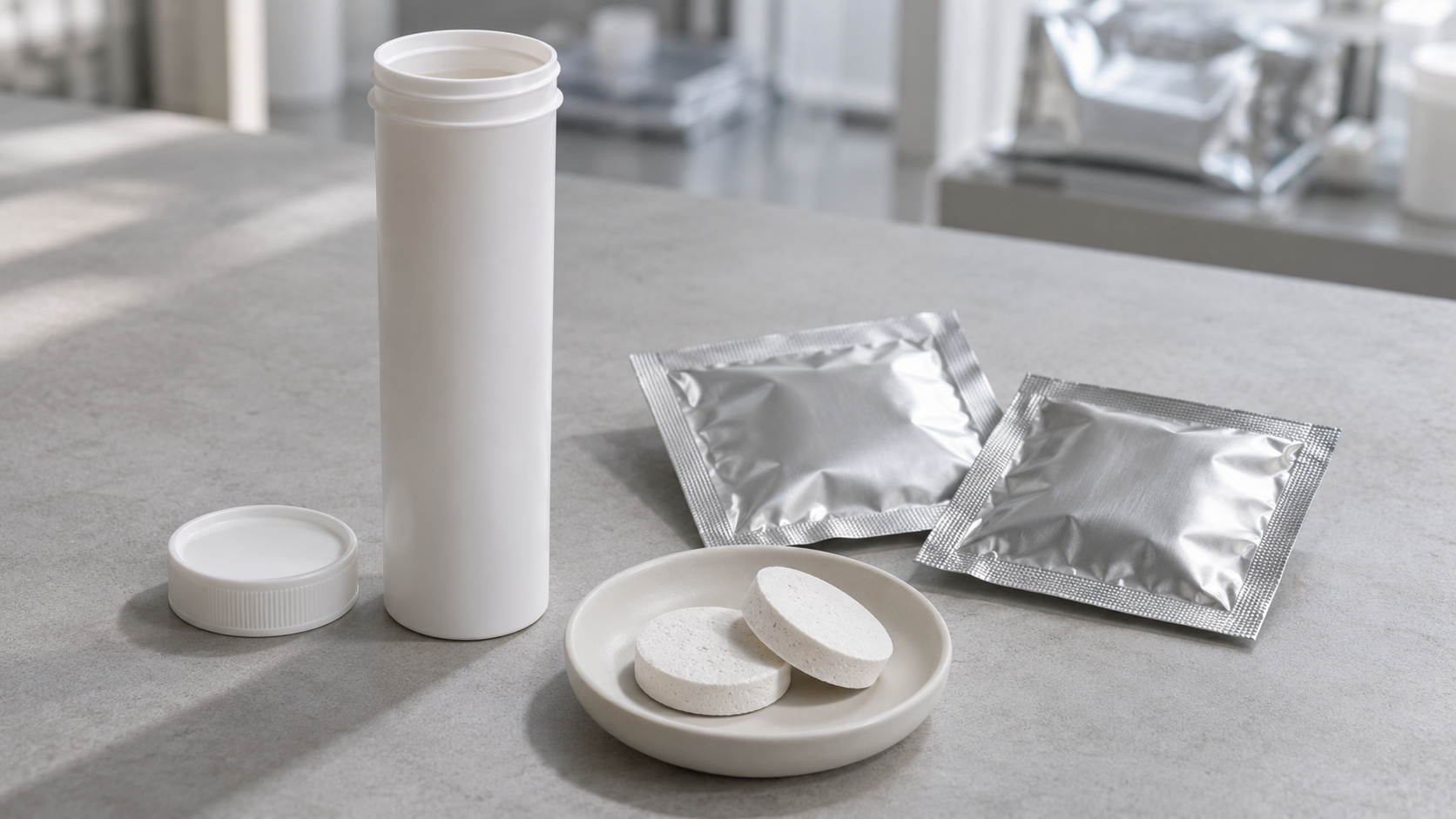
Then test the commercial package. A tube with a suitable closure and desiccant system, or individually protected units, presents different practical considerations. Assess the intended configuration through storage and, where relevant, repeated opening. Selecting a package from appearance alone leaves an important part of the product untested.
Keep the Dry Product and Prepared Drink Separate
Dry-tablet shelf life and stability after preparation answer different questions. A published study examined solutions prepared from specific effervescent creatine powders during storage at 25°C and 4°C for 45 days. That design should not be treated as a universal stability result for every freshly prepared serving. [3]
Measure the prepared drink’s final pH and define the intended consumption window. If the brand wants consumers to prepare it hours in advance, include that use condition in the development work rather than relying on dry-product shelf-life data.
Ask for a Trial Plan Before a Finished-Product Quote
A useful enquiry identifies the target creatine monohydrate per serving, maximum tablets per serving, water volume, preferred flavor, proposed package and destination market.
Also state who will manufacture the tablets. An ingredient supplier and an effervescent-tablet manufacturer have different responsibilities.
SRS Nutrition Express can discuss candidate creatine monohydrate grades, available specifications, representative COAs and sample options for the manufacturer’s evaluation. Particle-size information can help screen options, but a mesh designation alone cannot establish suitability for the complete effervescent formula.
Start with the intended serving and package. Use trial results to define the commercial product.
Evidence Boundaries
- • The 3 g serving and 50% loading example is hypothetical, not a recommended formula or an SRS specification.
- • General effervescent-system research does not establish finished creatine tablet performance.
- • Tablet breakup and visible fizzing do not prove complete creatine dissolution or improved absorption.
- • Ingredient samples do not establish finished-product manufacturing feasibility, MOQ or shelf life.
- • No finished effervescent-tablet production capability or delivery commitment is asserted here.
Recommended Reading
References
- Jungbunzlauer. CITROCOAT EP — A New Effervescent Compound for Versatile Applications. Technical application paper.
- Improvements in sticking, hygroscopicity, and compactibility of effervescent systems by fluid-bed coating. RSC Advances. 2019.
- Evaluation of the stability of creatine in solution prepared from effervescent creatine formulations. 2003.
Post time: Nov-19-2026


