

For years, creatine was marketed in a very familiar way: large tubs, dark packaging, gym-focused imagery and messaging built around strength and bodybuilding.
But the market is changing.
Recent research has brought more attention to creatine for women. A 2026 systematic review and multilevel meta-analysis covering 34 studies and 692 female participants found possible small positive effects across selected exercise performance and body-composition outcomes. At the same time, the researchers emphasized that the overall certainty of evidence remains limited.
Meanwhile, women-focused creatine products are becoming much easier to find in the market.
From an ingredient supplier’s perspective, this raises a more interesting question:
Do women really need a different creatine — or simply a different creatine product experience?
The Market Is Already Testing the Answer
Looking across current women-focused supplement products, several patterns are beginning to appear.
Some products developed for women in their 30s, 40s and beyond now combine a full serving of creatine monohydrate with collagen. Other formulations add ingredients already familiar in beauty and women’s wellness, such as vitamin C, biotin, hyaluronic acid, magnesium or vitamin D.
The positioning is changing as well. Instead of talking only about muscle size and workout performance, these products increasingly connect strength with beauty, recovery, daily wellness and healthy aging.
This does not mean every woman needs creatine plus collagen, or that all female consumers want the same formulation. What it shows is that creatine is moving beyond the traditional bodybuilding environment and entering a much broader consumer category.
Lifestyle Matters — But So Does Quality
How easily does creatine fit into everyday life?
A large sports-nutrition tub works perfectly well at home. But a well-designed single-serving creatine stick pack can fit into a handbag, work bag or travel kit.

Flavor can also change the experience. Fresh profiles such as lemon, berry or strawberry can create a very different impression from traditional sports-nutrition products.
But making creatine more lifestyle-oriented does not mean lowering expectations for quality. Many women-focused products now emphasize transparent dosing, ingredient purity, third-party testing, clean formulations and clear ingredient labeling alongside convenience and design.
In other words, the women’s creatine category is becoming more lifestyle-oriented without becoming less quality-conscious.
Where Particle Size Can Make a Difference
This is where the raw material itself becomes relevant. In certain applications, finer creatine particles can help improve dispersion and create a smoother mouthfeel.
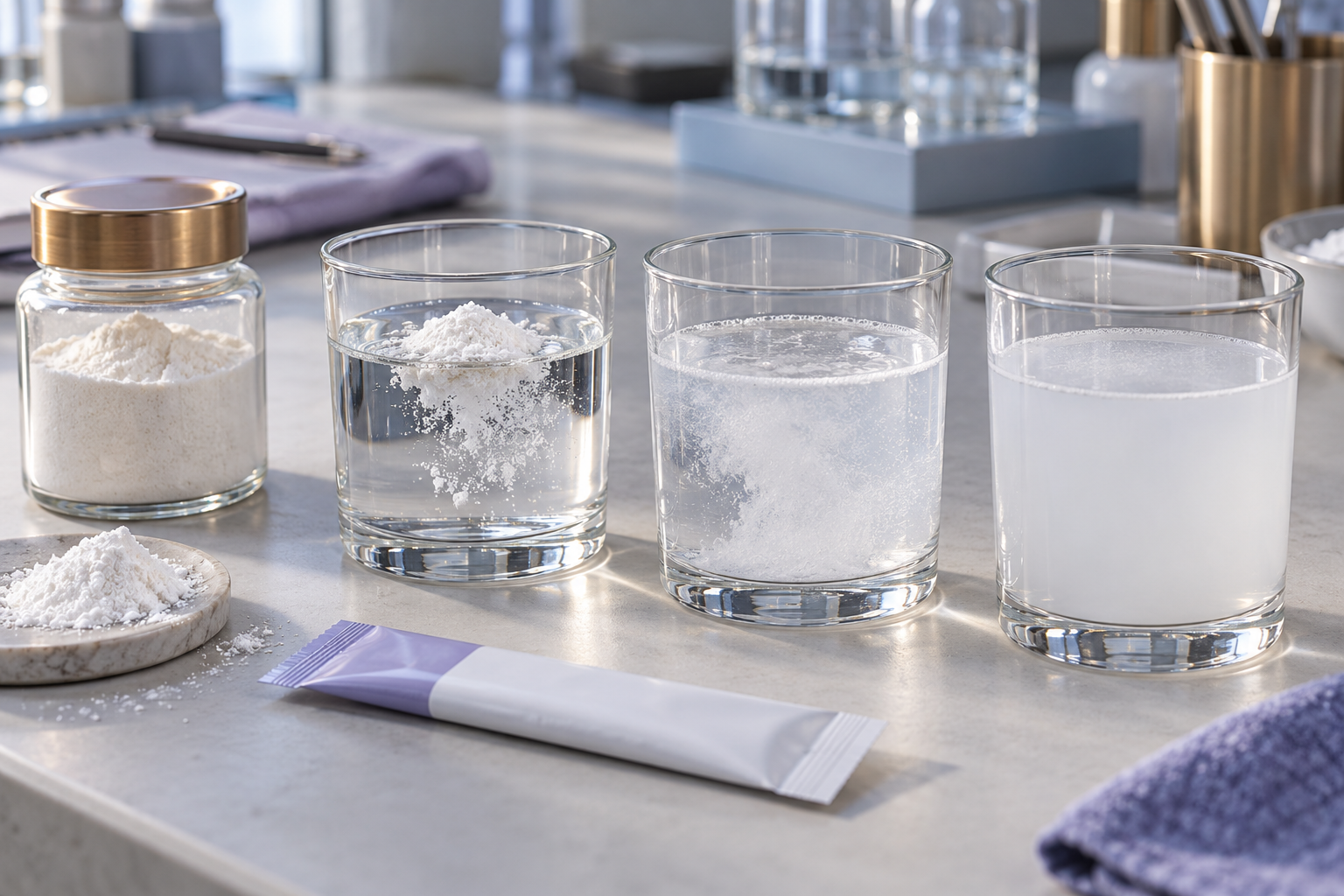
From our own experience with very fine 500-mesh creatine monohydrate, the difference can be noticeable even during direct consumption. When the powder is placed directly in the mouth and followed with water, it disperses quickly and leaves relatively little residual gritty sensation.
For brands trying to create a lighter, cleaner and easier everyday experience, this type of sensory performance can become important. That does not mean finer is always better. Mesh alone cannot fully describe particle-size distribution, and formulators should still evaluate the actual application, serving size, processing conditions and desired finished-product experience.
The opportunity in creatine for women may therefore not be about inventing a new kind of creatine.
It may be about taking an established ingredient and reconsidering how it tastes, how it travels, how it looks, what surrounds it in the formulation, and how confidently its purity and quality can be communicated.
Women were never outside the creatine market. Perhaps the market simply did not design enough creatine products with their lives in mind.
For brands evaluating creatine formats for women, SRS Nutrition Express can provide grade-specific specifications, samples and available particle-size information for formulation trials.
Evidence Boundaries
- The 2026 review included 34 studies and 692 female participants, but only 21 studies and 424 participants entered the quantitative meta-analysis.
- Results suggest small potential benefits for selected performance and body-composition outcomes, but the overall certainty of evidence remains limited.
- Current evidence does not show that women require a different type of creatine.
- Women-focused ingredient combinations and packaging formats reflect market trends, not proof of superior effectiveness.
- Finer particle size may influence dispersion and mouthfeel, but mesh alone cannot guarantee finished-product performance.
- Published creatine research does not validate every commercial product or SRS production batch.
Recommended Reading
References
- Lin Y, Zhu W, Hong B. Effects of creatine supplementation in females engaged in exercise or training: a systematic review and multilevel meta-analysis. Frontiers in Nutrition. 2026;13:1921827.
- Smith-Ryan AE, et al. Creatine supplementation in women’s health: a lifespan perspective. Nutrients. 2021;13(3):877.
- Antonio J, et al. Common questions and misconceptions about creatine supplementation. Journal of the International Society of Sports Nutrition. 2021;18:13.
- Kreider RB, et al. ISSN position stand: safety and efficacy of creatine supplementation. Journal of the International Society of Sports Nutrition. 2017;14:18.
Post time: Oct-09-2026


