

A creatine specification showing “heavy metals ≤10 ppm” may look complete, but it gives buyers limited control. It does not identify which metals were tested, whether the result is a sum or a lead-equivalent test, or whether the limit is suitable for a 5 g daily serving.
Brands should normally set individual limits for lead, cadmium, arsenic and mercury. The calculation should begin with the finished product, intended daily intake and destination market—not with a generic supplier specification.
Why “Total Heavy Metals” Is Not Enough
Lead, cadmium, arsenic and mercury have different toxicological profiles and regulatory treatment. A single colorimetric “heavy metals as lead” result cannot show the concentration of each element.
A more useful creatine specification identifies:
- ➤ lead (Pb);
- ➤ cadmium (Cd);
- ➤ arsenic (As);
- ➤ mercury (Hg);
- ➤ units and reporting basis;
- ➤ analytical method;
- ➤ limit of detection and limit of quantification;
- ➤ numerical acceptance limit for each element.
Total arsenic also does not distinguish inorganic from organic species. Speciation may be necessary when required by the product category, market or risk assessment.
Convert ppm Into Daily Exposure
For solid ingredients, 1 ppm is equivalent to 1 mg/kg or 1 µg/g. Daily exposure can therefore be estimated as:
Daily exposure (µg/day) = concentration (ppm) × daily ingredient intake (g)
For a product supplying 5 g of creatine per day:
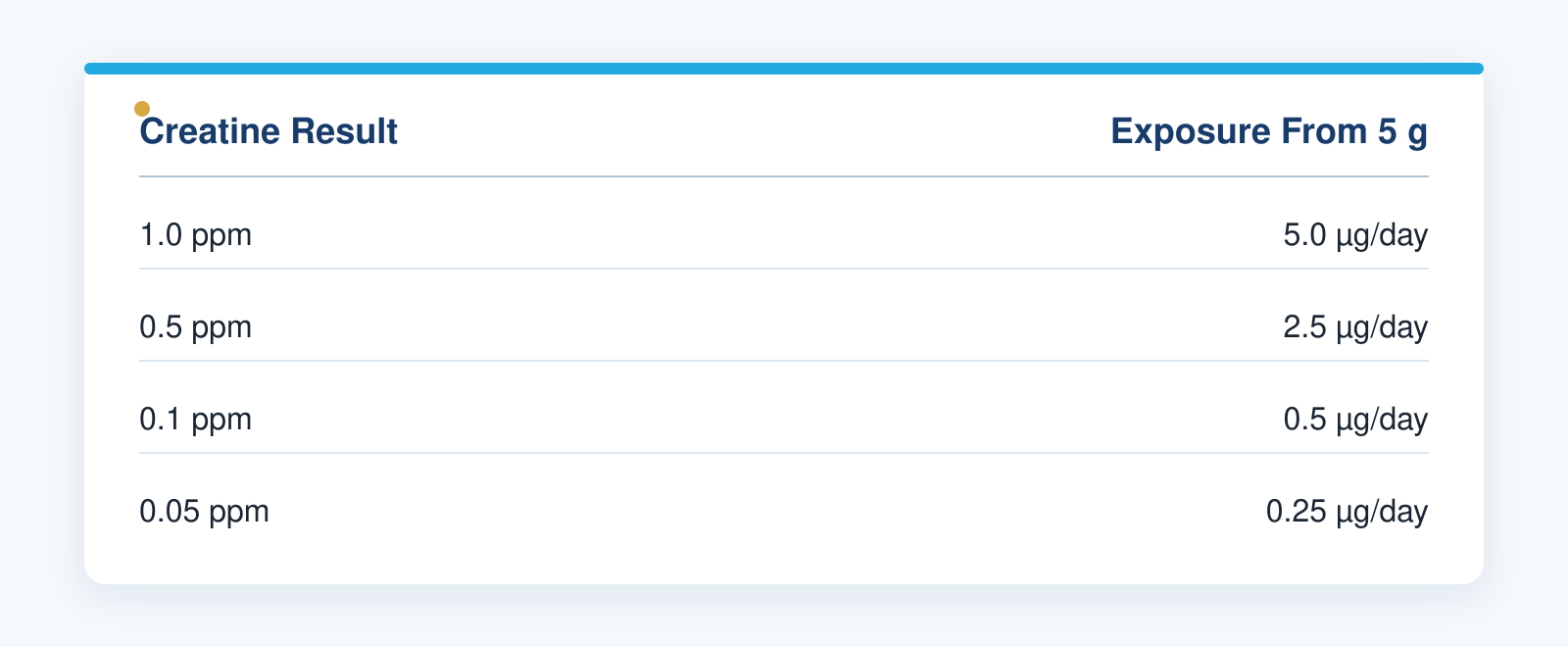
This calculation explains why a limit that appears low in ppm may still be unsuitable for a high-dose ingredient. It must also account for other ingredients, multiple daily servings and background contribution from the finished product.

How California Proposition 65 Changes the Calculation
California Proposition 65 uses exposure levels rather than a universal concentration limit for ingredients.
OEHHA’s Maximum Allowable Dose Level for lead as a reproductive toxicant is 0.5 µg/day. For a product containing 5 g of creatine daily, 0.1 ppm lead would contribute 0.5 µg before considering other ingredients or sources of exposure.
That does not mean “0.1 ppm” is a universal legal specification for every creatine product. Proposition 65 assessments depend on the listed chemical, route and reasonably anticipated exposure. Businesses must also consider current warning requirements and obtain qualified legal advice where necessary.
OEHHA lists an oral cadmium MADL of 4.1 µg/day. Different rules and safe-harbour values should not be combined into one generic “Prop 65 limit.”
How EU Limits Should Be Applied
Commission Regulation (EU) 2023/915 establishes maximum contaminant levels for specified food categories. For food supplements, the regulation includes category-specific maximum levels of 3.0 mg/kg for lead, 1.0 mg/kg for cadmium and 0.10 mg/kg for mercury, subject to the regulation’s definitions and listed exceptions.
These finished-product limits should not automatically be copied into a creatine raw-material specification. A brand may need a stricter incoming limit because the final supplement contains several ingredients and the finished product must remain compliant.
The EU regulation does not provide one general harmonised arsenic limit for every food supplement. Arsenic requirements should therefore be checked against the actual product category, national rules, customer standards and current regulatory text.
What Applies in the United States?
US dietary-supplement CGMP does not establish one universal federal ppm table specifically for creatine monohydrate.
Under 21 CFR §111.70, manufacturers must establish component and finished-product limits for contamination that may adulterate the supplement. Under §111.75, appropriate tests or examinations must be used to determine whether those specifications are met.
A supplier COA may support qualification, but the brand or manufacturer remains responsible for its own specification, supplier-control program and finished-product decision.
Method, LOQ and “Not Detected”
ICP-MS is commonly selected for low-level multi-element analysis because it can achieve suitable sensitivity. ICP-OES may also be appropriate when its validated quantification limit is sufficiently below the specification.
A report of “Not Detected” is not a zero result. It means the concentration was below the method’s detection limit. Buyers should request the actual LOD or LOQ, particularly when the acceptance limit is close to the laboratory’s reporting capability.

The method should also address digestion, interference controls, calibration, reference materials and the material matrix. Results from different laboratories should not be compared without confirming that the methods and reporting bases are compatible.
Building a Defensible Creatine Specification
Before commercial approval, define:
- ✔ individual Pb, Cd, As and Hg limits;
- ✔ raw-material and finished-product requirements;
- ✔ maximum daily creatine intake;
- ✔ destination markets;
- ✔ test method and required LOQ;
- ✔ supplier COA and confirmation-testing frequency;
- ✔ actions for atypical, OOS or disputed results.
The specification should include a practical safety margin for other formulation components and analytical variability. It should not be presented as a global legal standard unless the cited regulation clearly applies.
How SRS Can Support Heavy-Metal Qualification
SRS Nutrition Express can provide grade-specific creatine monohydrate specifications, representative COAs, commercial-lot documentation and available third-party heavy-metal data.
Share your target limits, daily dose, destination market, finished-product format and required test method. SRS can then identify an appropriate grade and arrange a qualification sample or additional testing where available.
Supplier documentation describes the proposed SRS material; final regulatory assessment and finished-product compliance remain the responsibility of the brand, OEM and qualified laboratory.
Evidence Boundaries
- A raw-material result does not by itself establish finished-product compliance.
- Proposition 65 safe-harbour levels are exposure values, not universal ingredient ppm limits.
- EU limits apply according to the food category and regulatory definitions.
- “Not detected” is meaningful only when the detection limit is disclosed.
- Customer or retailer requirements may be stricter than statutory limits.
Recommended Reading
- How to Read a Creatine Monohydrate Specification Sheet
- Creatine Impurities Explained: Creatinine, DCD, and DHT
- Changing Creatine Suppliers? A Qualification Checklist Before Your First Commercial Order
References
- California OEHHA. Proposition 65 NSRLs and MADLs.
- California OEHHA. Cadmium—Proposition 65 Chemical Profile.
- European Commission. Commission Regulation (EU) 2023/915 on Maximum Levels for Certain Contaminants in Food.
- Electronic Code of Federal Regulations. 21 CFR §111.70—Specifications.
- Electronic Code of Federal Regulations. 21 CFR §111.75—Determining Whether Specifications Are Met.
Post time: Sep-21-2026


