

One gram of creatine monohydrate is not chemically identical to one gram of anhydrous creatine or creatine hydrochloride (HCl). Water and hydrochloride contribute to molecular weight, so the three raw materials contain different theoretical proportions of the creatine molecule.
That calculation is useful for formulation. It does not prove that one form produces better absorption, muscle retention or performance.
What Does “One Gram of Creatine” Mean?
The first question is whether a specification or label refers to the weight of the complete ingredient or to its creatine moiety—the creatine part remaining after water or hydrochloride is excluded.
Creatine has a molecular weight of 131.13 g/mol. The corresponding values are 149.15 g/mol for creatine monohydrate and 167.59 g/mol for creatine HCl.[1–3] On a purely stoichiometric basis, the comparison is:
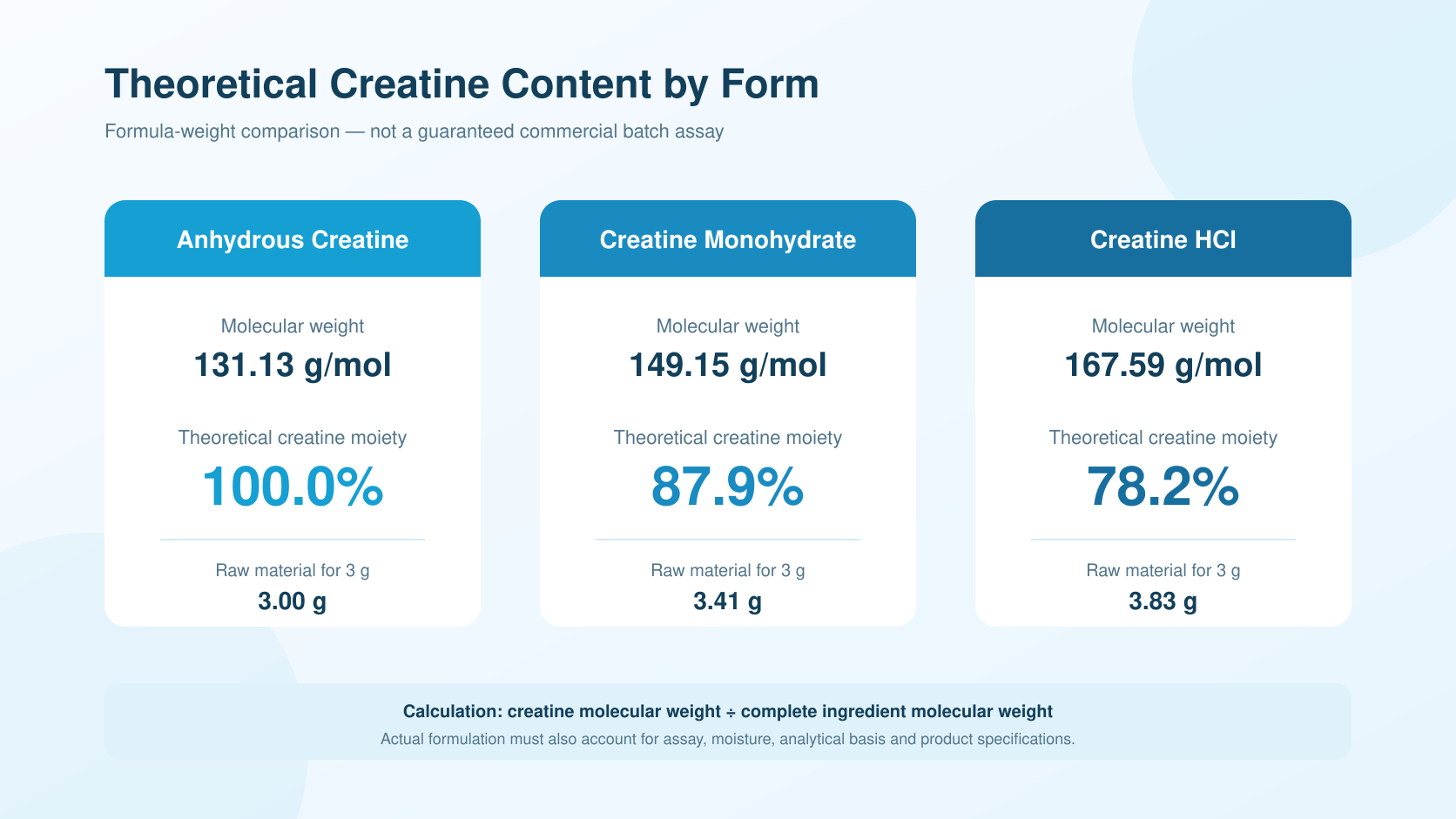
For example, 5 g of creatine monohydrate contains approximately 4.40 g of theoretical creatine moiety: 5 × 131.13 ÷ 149.15.
These are formula-weight calculations, not guaranteed values for a commercial batch. Actual delivery also depends on assay, moisture, test method and whether the result is reported as-is or on a dry basis.
Chemical Equivalence Is Not Evidence Equivalence
Most of the established supplementation evidence uses creatine monohydrate as the complete ingredient. A commonly studied maintenance protocol is 3–5 g of creatine monohydrate per day, while loading studies often use about 20 g/day for five to seven days.[4] These amounts should not silently be redefined as “pure creatine equivalents.”
Anhydrous creatine contains more creatine moiety per gram, but there is far less direct human evidence for it as a separate commercial form. Its higher theoretical percentage alone cannot demonstrate superior uptake or a stronger physiological effect.
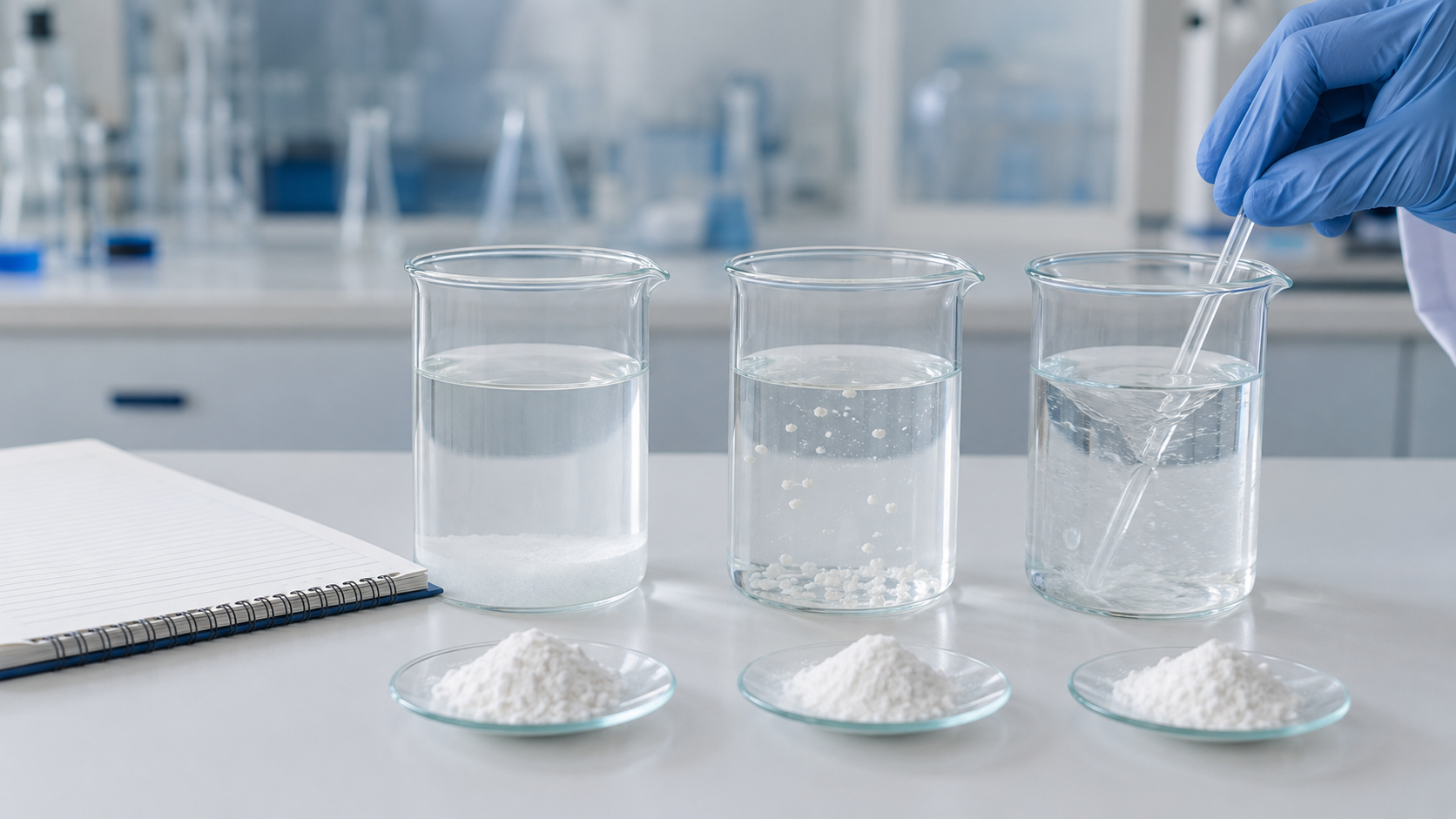
The same distinction applies to HCl. Higher aqueous solubility may improve dispersion or allow a more concentrated serving. Solubility in a glass, however, is not the same outcome as absorption, muscle creatine saturation or performance.
What Do HCl Comparisons Show?
A 2022 systematic review identified 17 randomised trials of alternative creatine forms but found only three that compared an alternative directly with monohydrate. HCl was not among the forms represented in that review, illustrating how limited the evidence was at that point.[5]
One direct human comparison has begun to narrow the gap, but the HCl evidence base remains small. In a 2025 triple-blind trial, 31 team-sport athletes received 5 g/day of monohydrate, 5 g/day of HCl or placebo for eight weeks. No significant between-group differences were found for the measured neuromuscular or body-composition outcomes.[6] One small trial cannot settle every application, but it does not support claims that HCl automatically works better or requires only a fraction of the dose.
Choose the Form by the Finished Product
Monohydrate remains the evidence benchmark and is suitable for conventional powders, capsules, tablets and gummies. Anhydrous creatine may help when formula space is tight, provided its stability and evidence position match the intended claim.Creatine HCl may be considered where supplier-specific testing confirms useful dissolution behaviour at the finished product’s actual pH, temperature and concentration. Its lower creatine proportion means that an equivalent theoretical creatine amount requires more—not less—raw material than creatine monohydrate.Before approving any form, buyers should confirm:
SRS Nutrition Express supplies creatine monohydrate, anhydrous creatine and creatine HCl for different formulation needs. The useful comparison begins with molecular weight, but the purchasing decision should end with verified specifications, finished-product trials and evidence appropriate to the chosen form.
References
Post time: Aug-04-2026


