

A specification says “L-Theanine ≥98%.” The sales description says “green tea extract.” It is tempting to treat those two statements as confirmation of the same thing.
They are not.
An assay can establish how much L-theanine a tested sample contains. It does not, by itself, determine whether the ingredient was extracted from Camellia sinensis, produced through a biological process or manufactured using another route.
For buyers marketing a product as natural or green-tea-derived, source verification therefore begins where the assay ends.
Establish the Exact Location Before Discussing the Cause
An appropriate chromatographic method can separate and quantify L-theanine against a reference standard. The result may support identity and concentration when the method, calculation basis and reference material are suitable.
It does not automatically reveal:
- • the original raw material;
- • the plant species or plant part;
- • the manufacturing route;
- • whether other materials were introduced;
- • whether “natural” is legally supportable in the destination market.
Chemically equivalent L-theanine can produce a similar assay result despite being manufactured through different routes. A COA reporting 98% or 99% should therefore not be presented as proof of botanical origin.
“Green Tea Extract” Needs a Traceable Manufacturing Story
If the ingredient is sold as green-tea-derived, buyers should request evidence connecting the commercial lot to the claimed source.
The review may include:
- botanical name and plant part;
- raw-material supplier and country of origin;
- extraction and purification flow;
- manufacturing-site identity;
- batch traceability;
- processing aids and solvents;
- carrier or excipient declaration;
- representative and commercial-lot COAs;
- change-notification controls.
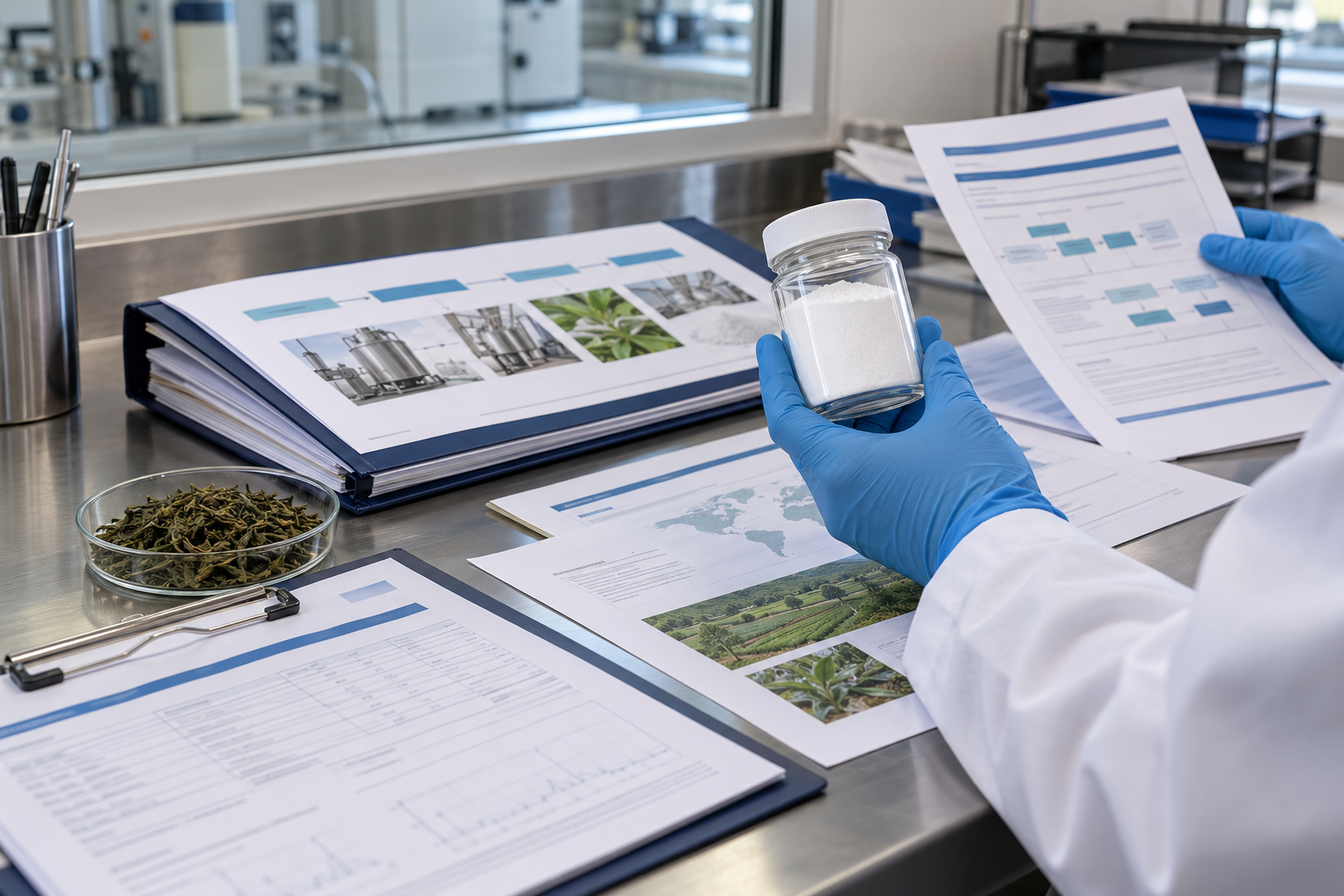
Tea leaves placed beside a powder sample are marketing imagery, not traceability evidence. Likewise, a general botanical declaration that cannot be connected to the manufacturing site or lot provides limited support.
Can Stable Isotopes Distinguish the Source?
Stable-isotope ratio analysis can provide additional evidence because biological and industrial production pathways may leave different isotopic patterns.
A 2021 study measured carbon and nitrogen isotope ratios in tea-derived, synthetic and commercial L-theanine samples. The results showed useful differentiation among the materials studied, demonstrating that isotope analysis can contribute to authenticity assessment. pubmed.ncbi.nlm.nih.gov
That does not create a universal rule under which one carbon-isotope value automatically proves “plant origin.”
Interpretation depends on:
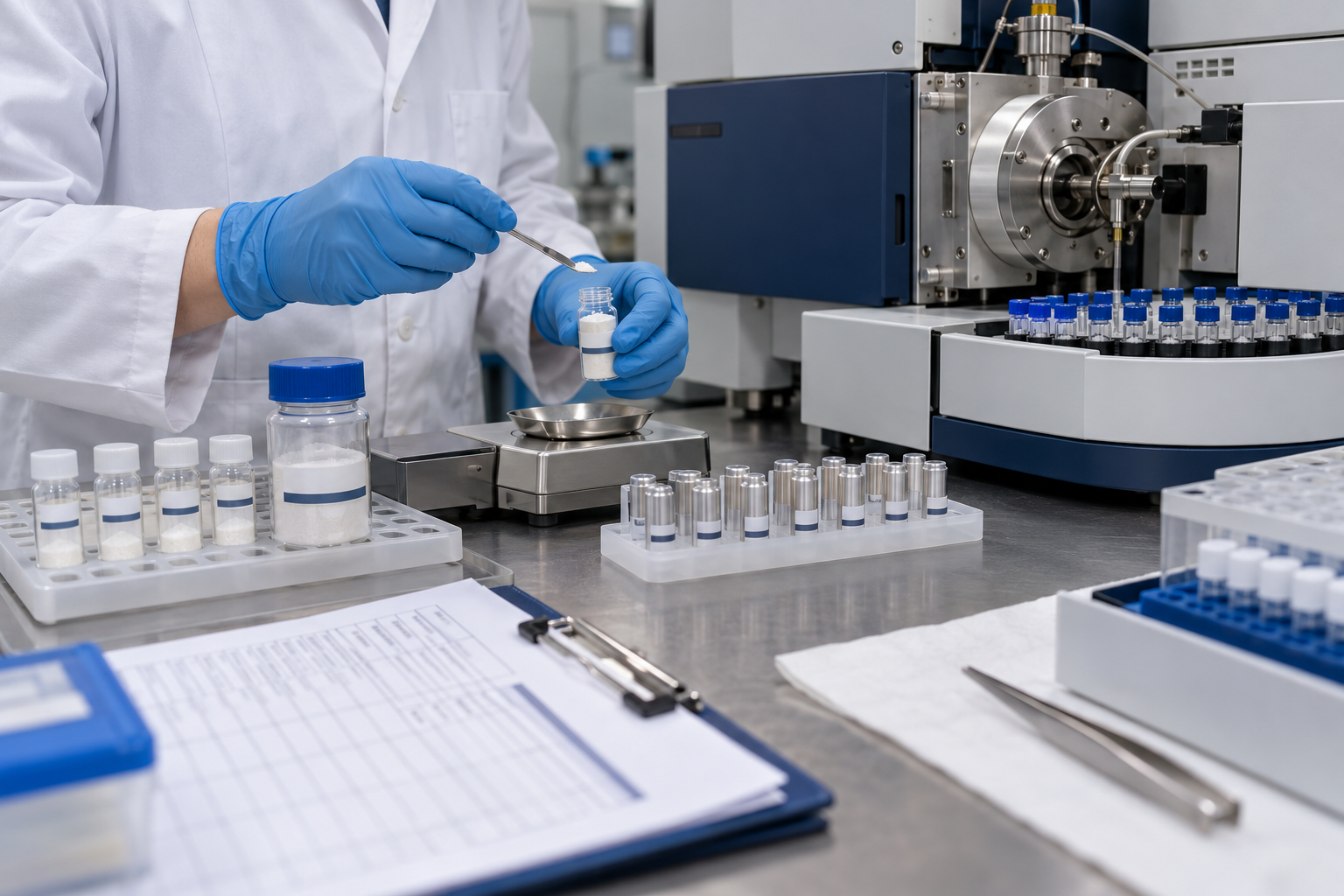
A laboratory result should be reviewed against the method and suitable reference samples—not only against a number copied from another supplier’s report.
Absence of Tea Markers Does Not Automatically Prove Synthesis
Highly purified L-theanine may contain very little of the caffeine, catechins, pigments or other compounds associated with a conventional green tea extract.
This creates a practical limitation: successful purification can remove some of the secondary markers a buyer expects to find.
Conversely, the presence of a small amount of tea-related material does not prove that all the L-theanine was extracted from tea. Authentication should consider the complete evidence package rather than rely on one expected marker.
Source and EU Regulatory Status Are Separate Questions
In the EU, novel-food assessment concerns the specific food, production process, intended use and evidence of significant consumption before 15 May 1997. Regulation (EU) 2015/2283 provides the governing framework.
The European Commission’s Novel Food Status Catalogue is a non-binding orientation tool and must be read with the Union list and applicable authorisations. If status remains uncertain, a food business operator may consult the competent authority of the Member State where the product will first be marketed.
This means:
- botanical origin does not automatically settle regulatory status;
- chemical equivalence does not guarantee regulatory equivalence;
- one supplier’s conclusion may not cover another manufacturing process;
- a pending application is not the same as an authorisation.
Write the Purchasing Specification Around the Claim
If the finished product will only declare “L-theanine,” the qualification package may differ from a product marketed as “natural L-theanine from green tea.”
For a botanical-source claim, the purchase specification or quality agreement should identify:
- claimed source and manufacturing route;
- required supporting documents;
- agreed source-verification method;
- acceptance criteria and reference materials;
- change-notification requirements;
- actions when laboratories disagree.
Do not wait for an unexpected isotope result to decide what “green-tea-derived” was supposed to mean.
Evaluate L-Theanine Documentation With SRS
SRS Nutrition Express can coordinate L-theanine specifications, batch COAs, available source and process information, samples and third-party testing requirements for technical review.
Send the intended label claim, destination market, specification and required analytical scope. SRS can confirm what evidence is available for the proposed grade and identify items requiring additional verification before commercial approval.
Evidence Boundaries
- A high L-theanine assay does not independently prove botanical origin.
- Stable-isotope analysis can support authentication but requires method-specific interpretation and suitable references.
- Tea-related marker compounds may be reduced or removed during purification.
- “Natural” and “green-tea-derived” claims must be evaluated for the intended market.
- Novel-food status depends on the specific material, process and intended use—not the ingredient name alone.
Recommended Reading
- Can One Raw-Material Specification Work for Every Finished Product?
- COA vs Ingredient Qualification: Why One Document Is Not Enough
References
- Perini M, Paolini M, Camin F, et al. Characterization of L-theanine in tea extracts and synthetic products using stable isotope ratio analysis. Journal of Food and Drug Analysis. 2021;29(2):311–318. DOI: 10.38212/2224-6614.3349
- European Parliament and Council. Regulation (EU) 2015/2283 on Novel Foods.
- European Commission. Novel Food Status Catalogue.
- European Commission. Consultation Process on Novel Food Status.
- Vuong QV, Golding JB, Nguyen M, Roach PD. Optimum conditions for the water extraction of L-theanine from green tea. Journal of Separation Science. 2011;34(18):2468–2474. DOI: 10.1002/jssc.201000863.
Post time: Oct-27-2026


