

A buyer’s laboratory reports a failed creatine result, while the supplier’s Certificate of Analysis shows compliance. Should the lot be rejected immediately—or should another sample be tested?
Neither decision should be automatic. An out-of-specification (OOS) result is a quality event that requires a structured review. The purpose is not to keep testing until a result passes. It is to determine whether the specification, analytical work, sample and conclusion are scientifically sound.
Confirm What Actually Failed
Start by recording the product grade, lot number, specification version, test item, limit, result, unit, method, test date and sample identity.
For creatine, two results may look inconsistent when they are reported on different bases. One laboratory may report creatine monohydrate, while another reports anhydrous creatine equivalent. Moisture correction, as-is versus dried-basis reporting, unit conversion or a transcription error can also change the conclusion.
The first question is therefore not simply, “Did it pass?” It is: “Were the same requirement, method and calculation basis used?”
Clarifying the requirement does not mean changing an approved specification after an unexpected result appears.
Review the Laboratory Work
Before blaming the commercial lot, check whether the correct method and specification were used. Review instrument calibration and system suitability, reference-standard validity, sample weight, dilution, calculation, chromatograms and any unexpected peaks or integration changes.
Analytical methods are not automatically interchangeable. A titration result should not be treated as directly equivalent to an HPLC result without understanding what each method measures. A method suitable for pure creatine monohydrate may also be unsuitable for a flavoured or multi-ingredient finished product.
An initial result should only be invalidated when there is documented evidence of a scientifically supportable cause. “Analyst error” by itself is not a root cause.
Check Whether the Sample Represents the Lot
A laboratory can test a sample correctly, but the sample may not represent the shipment.
Confirm which bags or drums were sampled, where the material was taken from, whether the package had been opened, how the sample was sealed and labelled, and whether it was exposed to moisture or unsuitable storage conditions.
Differences in particle-size distribution, segregation, compaction and sampling position may affect sample representativeness, particularly when the submitted quantity is small compared with the commercial lot.
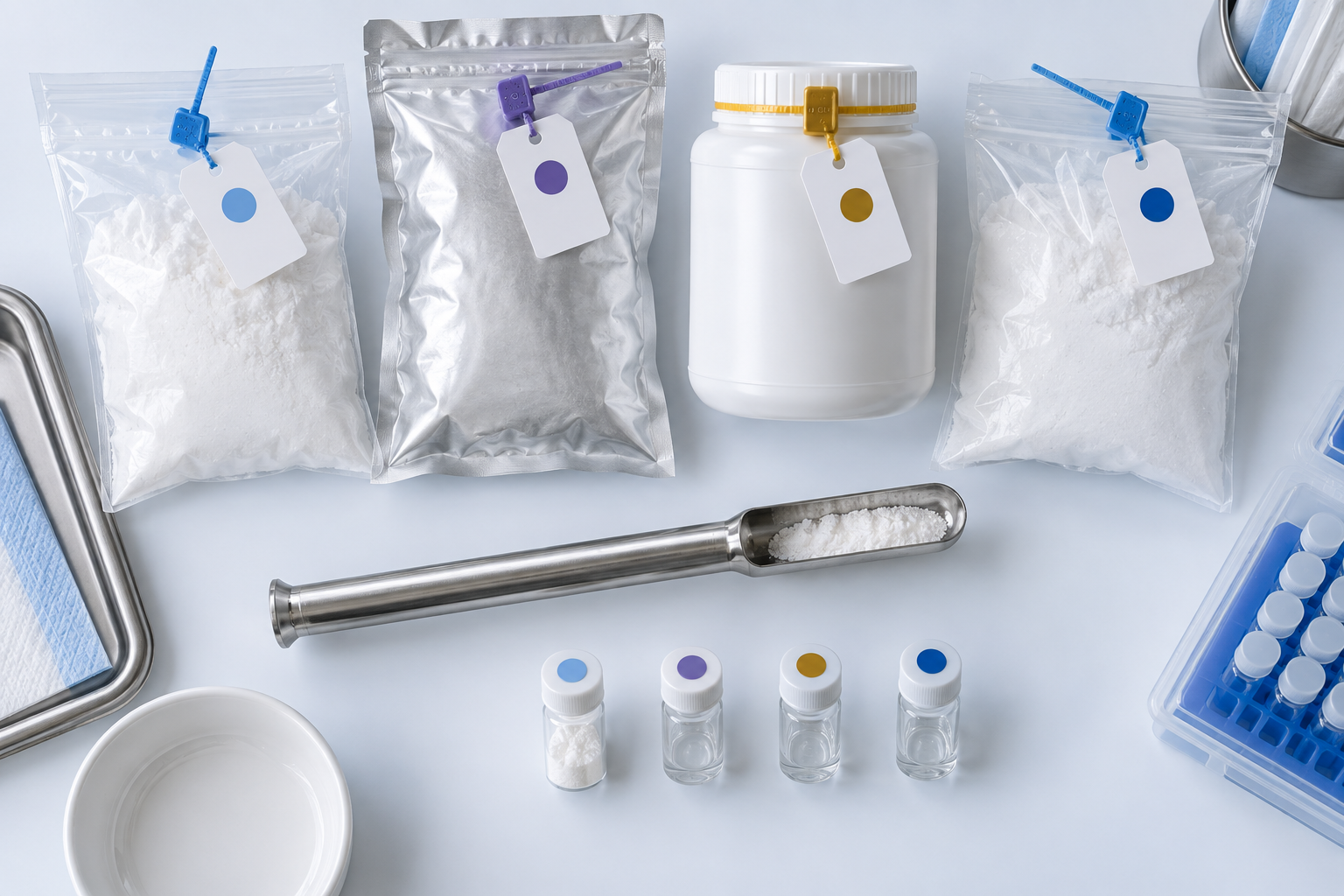
Retest With a Defined Purpose
Retesting can be appropriate, but the plan should be agreed before the new results are known. It should define:
- ✔ which retained or newly collected samples will be tested;
- ✔ which laboratory and method will be used;
- ✔ the reporting basis and number of replicates;
- ✔ how the results will be interpreted;
- ✔ what happens if the laboratories still disagree.
Retesting the original preparation helps investigate laboratory performance. Testing an unopened retained sample or a newly collected representative sample helps investigate the lot. These approaches answer different questions.

A passing retest does not automatically erase the original result. Failed and passing results should not simply be averaged to create a passing mean.
Make and Document the Lot Decision
If no laboratory cause is found, review the relevant manufacturing, packaging, storage, transport and batch-history records. Compare the analytical methods and calculation bases used by both parties.
For physical properties such as particle size or bulk density, also compare sample conditioning, sampling procedures, equipment settings and test conditions.
The responsible quality team should document the evidence, conclusion and final disposition. Corrective actions may include:
- aligning test methods;
- improving sampling instructions;
- clarifying specification terminology;
- strengthening sample traceability;
- adding scientifically justified confirmation testing.
How SRS Supports Creatine Result Investigations
When a customer’s result does not match the supplier COA, SRS Nutrition Express can help assemble the applicable specification, commercial-lot COA, analytical basis, method information, batch traceability and available retained or representative samples.
Send us the complete laboratory report—not only the failed number—together with:
- the sample identity;
- the analytical method;
- the applicable specification;
- the product format;
- the sampling procedure;
- the storage history.
Evidence Boundaries
- • A supplier COA alone cannot invalidate an OOS result.
- • One failed sample does not automatically prove that every container is defective.
- • A passing retest does not automatically invalidate the original result.
- • Retesting should follow a written and scientifically justified plan.
- • Final disposition belongs to the responsible quality team under its approved procedures.
Recommended Reading
- Creatine Assay Explained: Monohydrate Basis vs Anhydrous Creatine Basis
- How to Read a Creatine Monohydrate Specification Sheet
- Can One Raw-Material Specification Work for Every Finished Product?
References
- U.S. Food and Drug Administration. Investigating Out-of-Specification (OOS) Test Results for Pharmaceutical Production: Guidance for Industry. May 2022.
- U.S. Food and Drug Administration. Current Good Manufacturing Practice in Manufacturing, Packaging, Labeling, or Holding Operations for Dietary Supplements: Small Entity Compliance Guide.
- Electronic Code of Federal Regulations. 21 CFR Part 111—Current Good Manufacturing Practice in Manufacturing, Packaging, Labeling, or Holding Operations for Dietary Supplements.
- Tang PH, Miles MV, Steele P, et al. Evaluation of creatine content and stability from over-the-counter dietary supplement preparations. Food and Chemical Toxicology. 2011;49(4):757–762. DOI: 10.1016/j.fct.2010.11.042.
- Dash AK, Sawhney A. A simple LC method with UV detection for the analysis of creatine and creatinine and its application to several creatine formulations. Journal of Pharmaceutical and Biomedical Analysis. 2002;29(5):939–945. DOI: 10.1016/S0731-7085(02)00167-X.
Post time: Sep-15-2026


