

A beverage brief that says “calm energy” still leaves the formulation team with several decisions. How much caffeine should the drink contain? What does L-theanine contribute? And which evidence supports the intended positioning?
Recent ingredient concepts illustrate the opportunity. Ethical Naturals’ MachaWave combines organic matcha with AlphaWave L-Theanine for tea and beverage applications. Its published composition is 800 mg matcha and 200 mg added L-theanine per gram of blend. That describes a commercial ingredient concept; it does not specify the blend’s caffeine content or establish the performance of another finished drink. [1]
For brands, the next step is to translate the idea into measurable serving targets.
Start with Milligrams, Not a Ratio
A 2:1 L-theanine-to-caffeine ratio is easy to communicate. It is not a universal research standard.
In a randomized trial involving 44 young adults, Giesbrecht and colleagues compared 97 mg L-theanine plus 40 mg caffeine with placebo. The combination improved task-switching accuracy and self-reported alertness, but did not significantly improve several other cognitive measures. Assessments were made 20 and 70 minutes after consumption. [2]
Haskell and colleagues used a different combination—250 mg L-theanine and 150 mg caffeine—in a randomized crossover study that also tested the ingredients separately. [3]
Those combinations are approximately 2.4:1 and 1.7:1. They show why a ratio alone is an incomplete development target: 40 mg and 150 mg caffeine create very different serving propositions.
Read the Comparator Before Writing the Claim
The 44-person study compared the combination with placebo. It therefore cannot establish how much benefit came from adding L-theanine to the same dose of caffeine.
That distinction matters when writing phrases such as “better focus than caffeine alone,” “no jitters” or “no crash.” Each is a separate claim requiring appropriate evidence and market review.
The published trials also examined short-term responses under controlled conditions. They do not demonstrate all-day productivity, long-term cognitive improvement or identical results in every consumer.
A useful brief names the specific outcome being considered and the evidence supporting it, rather than asking the formulation to deliver several loosely defined benefits.
Count What the Tea Base Already Supplies
Matcha, tea extracts and added caffeine can all contribute to the final caffeine total. Record their contributions separately, using relevant composition data.
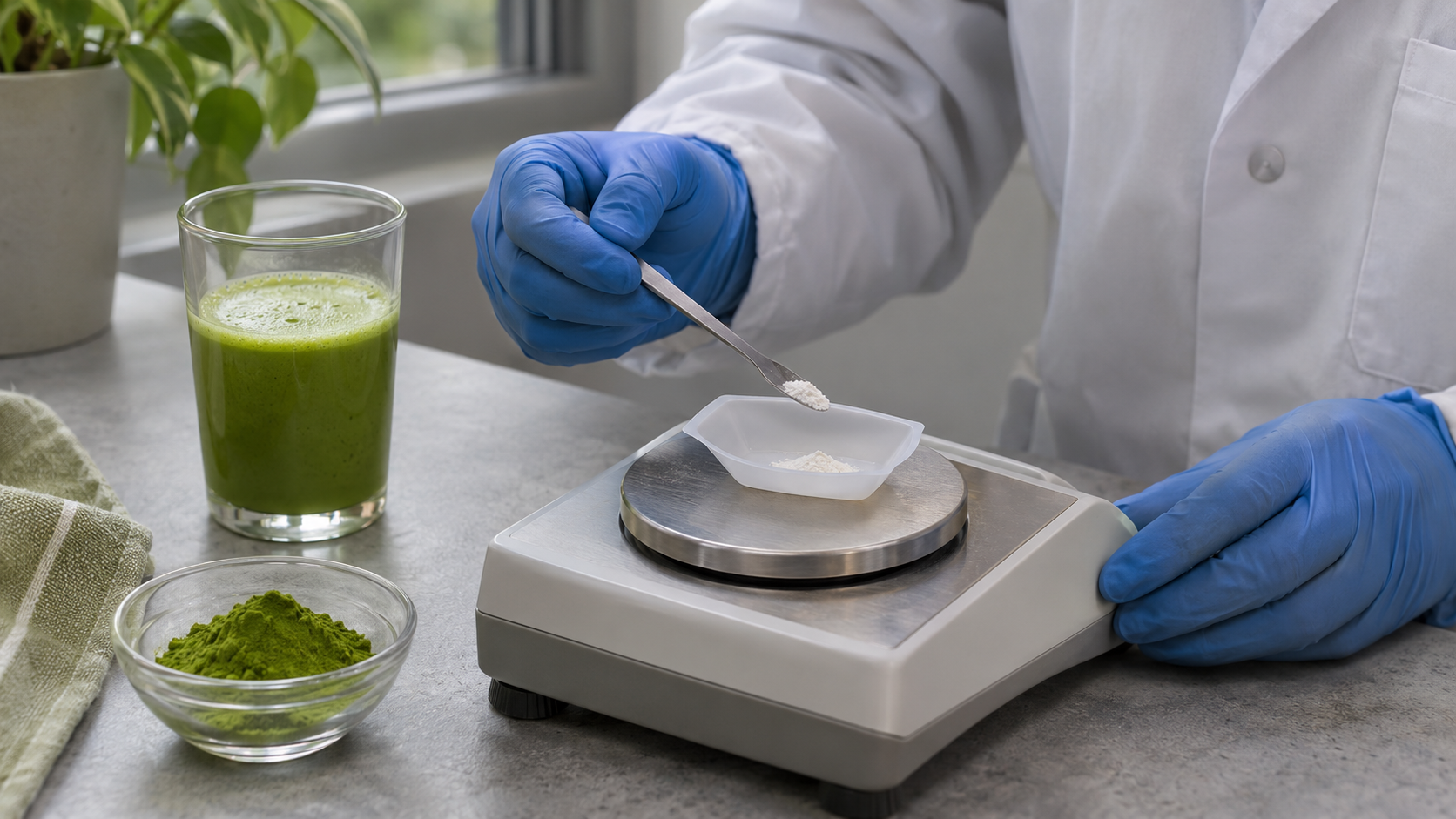
For illustration, suppose one serving contains 1 g matcha tested at 30 mg caffeine and 10 mg L-theanine per gram. A development target of 60 mg caffeine and 100 mg L-theanine would require another 30 mg caffeine and 90 mg L-theanine on an active-content basis.
If the added L-theanine powder assays at 98% as supplied, supplying that additional 90 mg would require approximately 91.8 mg powder.
These are hypothetical inputs, not typical matcha values, recommended doses or SRS specifications. The calculation should be updated using the approved ingredients, assay basis and any justified processing allowance. Confirm the finished serving analytically.
Decide When the Product Will Be Used
A morning drink and an evening relaxation product need different briefs.
EFSA notes that 100 mg caffeine may affect sleep duration and patterns in some adults, particularly near bedtime. Its general healthy-adult safety assessment considers caffeine from all sources; adding L-theanine is not a reason to disregard that exposure. [4] Learn more at EFSA
Define the intended audience, serving frequency and likely use occasion before choosing caffeine content. Keep caffeine-containing positioning consistent across the product name, directions and marketing.
Make the Finished Drink the Test Sample
A pleasant ingredient solution does not establish that the complete beverage will work.
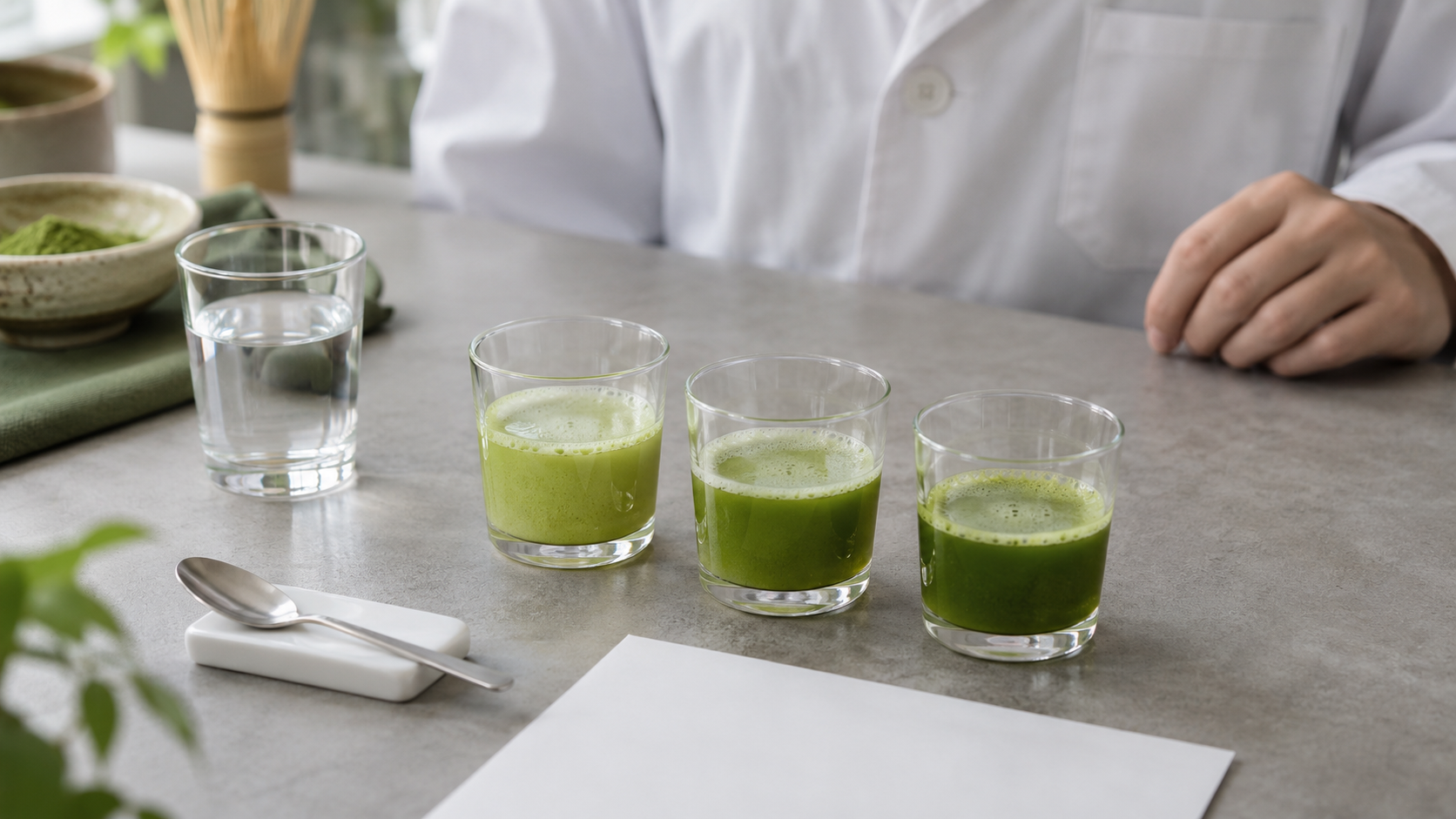
Evaluate bitterness, tea astringency, sweetness, aftertaste and appearance at the intended serving concentration. A matcha drink should also be assessed for settling and redispersion. Test the actual acid, flavor and sweetener system through the proposed processing and storage conditions.
Agree how caffeine and L-theanine will be measured in the finished product. A premix ratio does not demonstrate serving-level uniformity or content through shelf life.
Discuss Your Beverage Brief with SRS
Send SRS Nutrition Express your target caffeine and L-theanine per serving, beverage format, tea-base composition, processing conditions and destination market. Our team can discuss available L-theanine grades, specifications, representative COAs and sample options for evaluation.
A precise brief makes ingredient comparison and pilot work more useful.
Evidence Boundaries
- The cited trials examined acute responses; they do not establish long-term benefits for every beverage.
- A combination-versus-placebo result does not establish an added benefit over caffeine alone.
- No universal L-theanine-to-caffeine ratio is established here.
- The matcha calculation is hypothetical and does not describe an SRS batch or recommended dose.
- Supplier ingredient concepts do not validate another finished formula or its claims.
References
- Ethical Naturals. MachaWave. Ingredient composition and beverage application information.
- Giesbrecht T, et al. The combination of L-theanine and caffeine improves cognitive performance and increases subjective alertness. Nutritional Neuroscience. 2010;13(6):283–290.
- Haskell CF, et al. The effects of L-theanine, caffeine and their combination on cognition and mood. Biological Psychology. 2008;77(2):113–122.
- European Food Safety Authority. Caffeine. Safety assessment summary.
Post time: Nov-18-2026


