

At a morning meeting, someone empties an electrolyte sachet into sparkling water. At lunch, another person adds creatine and a fruit-flavoured powder to the same bottle. Before bed, magnesium replaces the final cup of tea. Plain water is starting to look less like a drink and more like a blank formula.
Social media has given the habit a name: water stacking. At first glance it looks like another wellness trend built for short videos. Look closer, and it points to a bigger change. Consumers are no longer asking only which supplements to take; they are asking how those supplements can fit into something they already do every day.
So What Is Water Stacking, Exactly?
Water stacking means building a customised drink by adding functional ingredients such as electrolytes, creatine, collagen, fibre or flavour powders to water. The appeal is not difficult to understand: one bottle feels easier than several tubs, capsules and reminders. It turns supplementation into a visible daily ritual rather than another task.

That convenience is real, but the health halo can run ahead of the evidence. Combining familiar ingredients does not automatically improve absorption or hydration, and several products may quietly duplicate the same vitamins or minerals. Water stacking describes a behaviour, not a clinically defined nutrition strategy.
Why This Looks Bigger Than a TikTok Trick
The interesting part is not the phrase water stacking. Trend names come and go. The durable signal is that powders once associated with a gym shelf are moving into ordinary drinks, work bags and travel routines. Creatine is part of that shift because it has become familiar beyond traditional bodybuilding audiences, while electrolyte products already fit naturally into water.
The Business Is Not in the Water. It Is in Making the Ritual Easier
For product developers, the obvious format is a portioned powder: tear, pour, shake and drink. The harder decision is what the sachet is actually for. A creatine-and-electrolyte product for training, a lightly flavoured daily creatine drink and a broad wellness blend may all use the same packet but need different doses, tastes and messages.
A Good Trend Can Still Become a Bad Formula
This is where a social-media ritual meets production reality. Creatine is used at gram-level quantities and can dominate the powder mass. Electrolyte salts affect taste and ionic strength. Acids may improve flavour while changing the environment after mixing; fibre, protein or botanicals may add viscosity, sediment or foam. Familiar ingredients can still behave badly together.
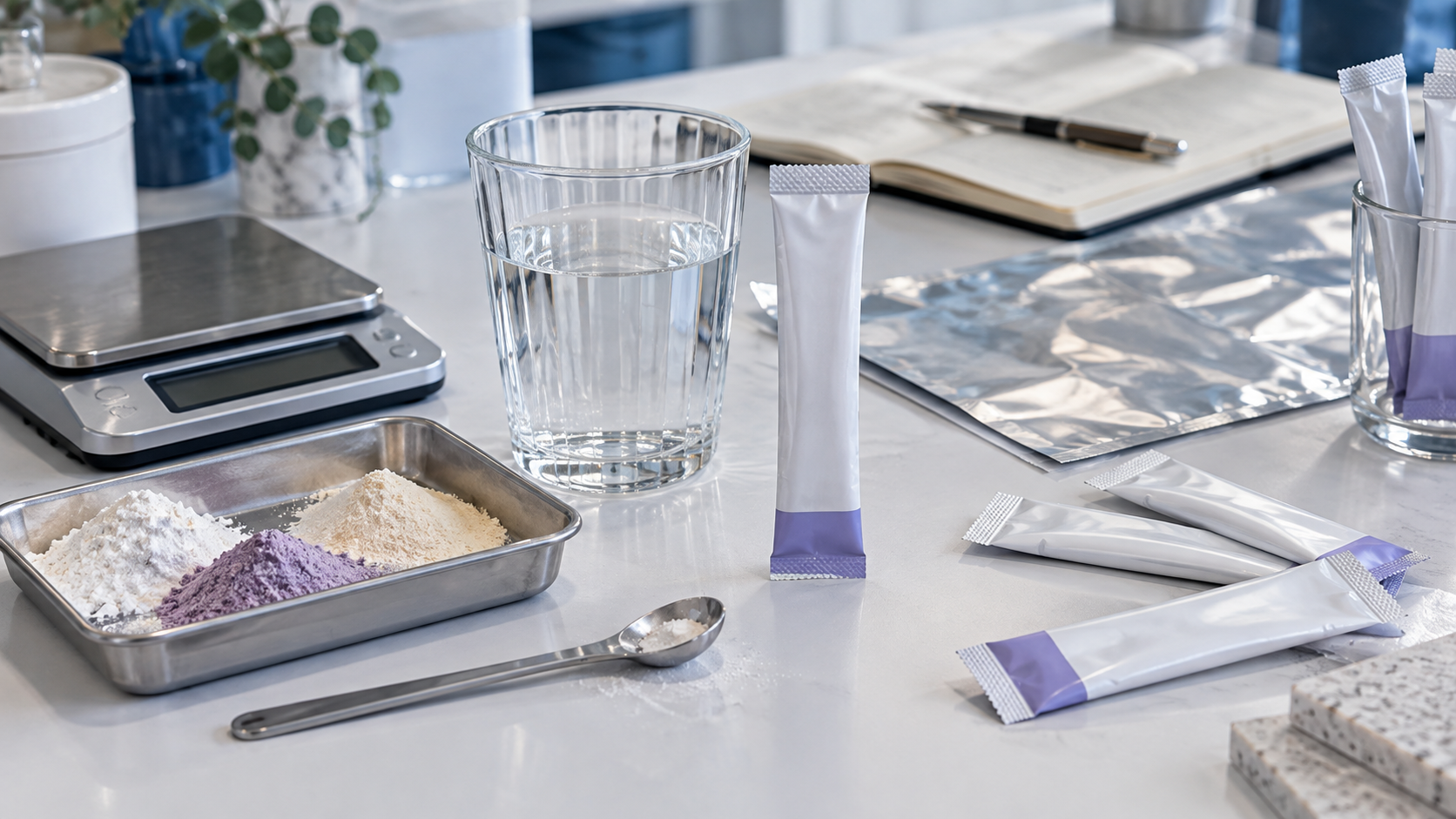
Development trials should measure:
- serving-level creatine and electrolyte content;
- dispersion, sediment and flavour at the instructed water volume;
- moisture uptake and caking in the unopened pack;
- creatine and creatinine at relevant release and stability intervals;
- consumer directions that discourage unplanned ingredient stacking.
Three Questions Before Turning the Trend Into a Product
First, who will drink it repeatedly after the novelty wears off? Second, does each featured ingredient appear at a meaningful and supportable dose? Third, can the complete formula survive real manufacturing, packaging and use conditions? If any answer is unclear, the product is still a trend board rather than a development brief.
SRS Nutrition Express supplies creatine monohydrate in multiple particle-size specifications and can provide grade specifications, lot documentation, samples and available physical-property data for trials. Share the intended use, daily dose, water volume, flavour system, packaging and destination market. We can help narrow the ingredient options before the concept reaches the line; the finished formula and shelf-life evidence must still be demonstrated by the brand and manufacturer.
What This Trend Does – and Does Not – Prove
- Water stacking is a consumer behaviour, not proof that multi-ingredient drinks outperform water or a balanced diet.
- An authorised claim applies only when its exact market and conditions of use are met.
- Dry-powder stability cannot be transferred automatically to an acidic ready-to-drink beverage.
- The compatibility of a stacked formula must be demonstrated in the final product.
Recommended Reading
- Creatine Mesh Size vs Particle Size Distribution
- How to Read a Creatine Monohydrate Specification Sheet
References
1. European Commission. Regulation EU No 432/2012 establishing permitted health claims on foods. https://eur-lex.europa.eu/eli/reg/2012/432/2024-08-19/eng
2. Uzzan M, Nechrebeki J, Zhou P, Labuza TP. Effect of water activity and temperature on the stability of creatine during storage. Drug Development and Industrial Pharmacy. 2009;35(8):1003–1008. DOI 10.1080/03639040902755197. https://pubmed.ncbi.nlm.nih.gov/19635041/
3. Jäger R, Purpura M, Shao A, Inoue T, Kreider RB. Analysis of the efficacy, safety, and regulatory status of novel forms of creatine. Amino Acids. 2011;40:1369–1383. https://pmc.ncbi.nlm.nih.gov/articles/PMC3080578/
4. SELF. What Is Stacked Water and Is It Better Than Regular Water. February 2026. Used only to document the consumer trend. https://www.self.com/story/what-is-stacked-water
Post time: Sep-24-2026


