

For product developers, the relevant question is not simply whether a whey protein dissolves. It is whether the protein remains physically and sensorially acceptable after the intended manufacturing process and shelf life.
Heat Stability Is More Than Initial Solubility
Solubility describes how much protein remains dissolved or dispersed under defined conditions. Heat stability describes what happens after the proteins are exposed to temperature.
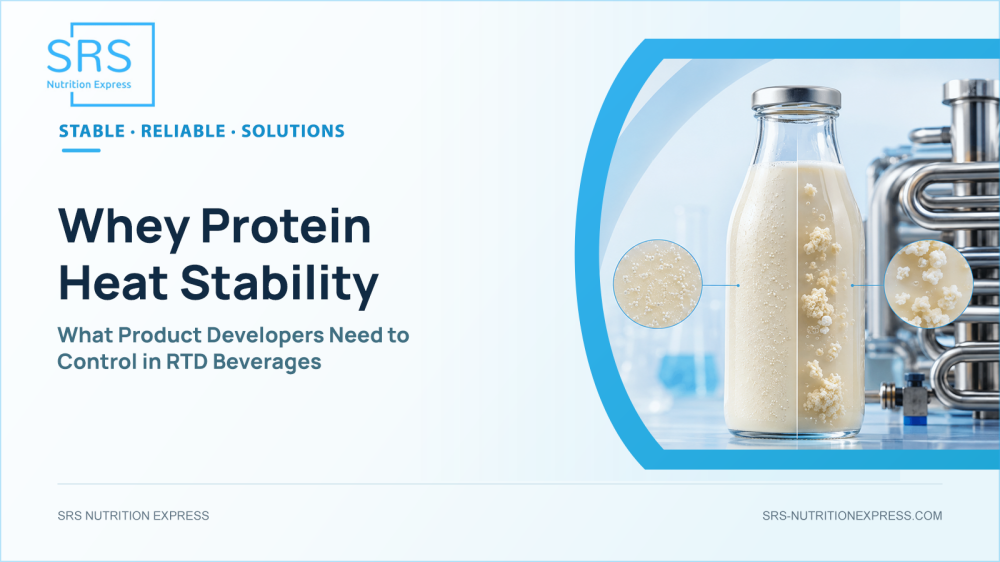
During heating, whey proteins can unfold and interact with one another. Depending on the formulation, this may lead to larger aggregates, increased viscosity, cloudiness, sedimentation, gelation or fouling inside processing equipment.
A powder can disperse well during laboratory preparation and still become unstable during commercial sterilization. Room-temperature solubility results therefore cannot replace processing trials.
Protein Concentration and pH Change the Response
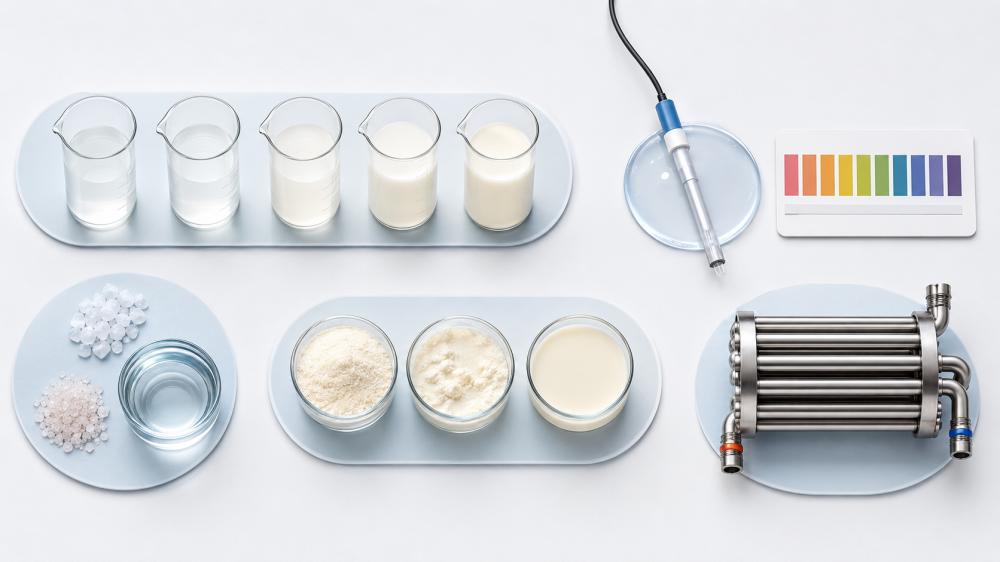
A pilot-scale study tested WPI solutions containing 1%, 4%, 8% or 12% protein at pH 6.2, 6.7 or 7.2. The solutions were preheated at 85°C for 30 seconds before further assessment.
Systems prepared at pH 6.2 developed more extensive denaturation, larger insoluble aggregates, greater particle size and higher turbidity than comparable systems prepared at pH 6.7 or 7.2. At 12% WPI and pH 6.2, the formulation formed a gel.
This demonstrates why the performance of a 3% protein beverage should not be used to predict the stability of an 8% or 12% formulation.
Acidified clear beverages operate under different conditions. U.S. Dairy Export Council guidance describes many acidified WPI drinks within approximately pH 2.8–4.0. Low-turbidity products are often developed toward the lower end of that range, while beverages closer to the protein isoelectric region may require additional stabilization.
Neutral shakes and clear acidic beverages should therefore be treated as separate development platforms.
Heating Method Matters as Much as Peak Temperature
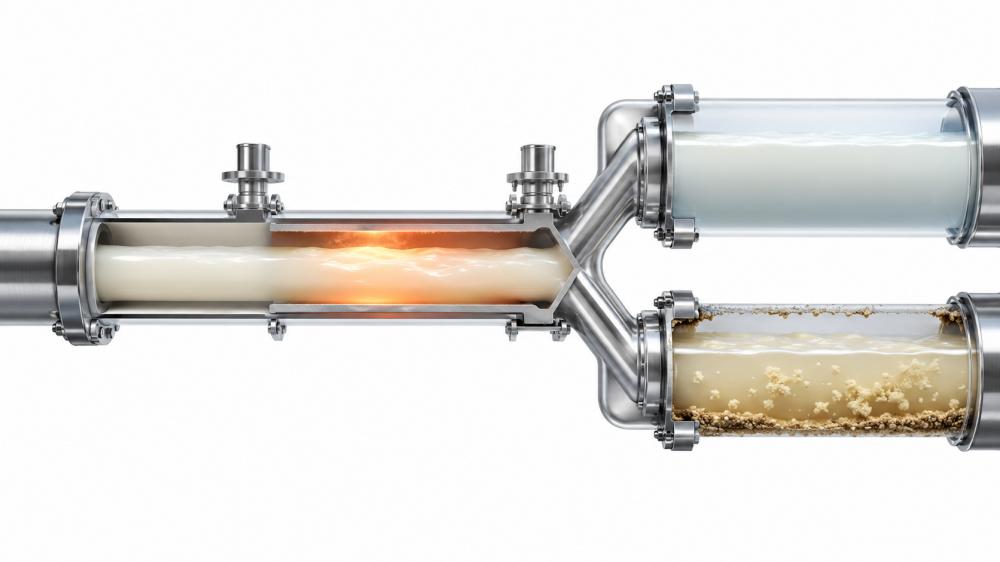
Commercial processing cannot be described by temperature alone. Holding time, heating rate, preheating and direct versus indirect energy transfer can change the final result.
One study processed WPI beverages containing 4%, 6% or 8% protein by direct and indirect heating to final temperatures of 121°C or 135°C.
Direct heating produced whey protein denaturation levels of 66%–94%, compared with 95%–99% after indirect heating. Under the tested conditions, direct heating also resulted in lower viscosity and less extensive changes to the volatile profile.
This does not mean direct heating will always prevent instability. It shows that two facilities using the same WPI and similar peak temperatures may still produce beverages with different physical and sensory properties.
Newer Research Is Exploring Controlled Protein Modification
A 2026 study investigated whether whey protein could be deliberately modified before final beverage processing.
Acidified WPI at pH 3.5 was heated at 90°C for 10 minutes while being mixed at 10,000 rpm. The process created small whey protein aggregates of approximately 61 nm. The modified protein was then tested in beverages containing 8% or 10% total protein, with different casein-to-whey-protein ratios.
In the 10% protein system containing a 50:50 casein-to-whey ratio, heat coagulation time increased from 0.8 minutes with untreated H2:whey protein to 2 minutes with the modified protein.
The study used mixed casein–whey systems rather than a pure WPI clear beverage. Its results should therefore not be generalized to every RTD formulation. It nevertheless demonstrates that protein structure and controlled pretreatment may be as important as the protein percentage shown on the specification.
Hydration, Minerals and Ingredient Order Cannot Be Ignored
Processing problems can begin before the beverage reaches the heat exchanger.
In one acidified model system containing 25 g/L protein at pH 3.2, the beverage was heated at 88°C for two minutes. Immediate heating produced post-process turbidity of 79 NTU. Allowing the WPI to hydrate for 10 minutes reduced turbidity to 39 NTU, while 20 minutes produced 38 NTU.
Mineral composition also matters. Calcium, sodium and other ions influence electrostatic interactions and protein aggregation. WPI ingredients produced by different filtration, clarification or ion-exchange processes may therefore behave differently even when their total protein contents are similar.
A 2024 study produced experimental WPI containing approximately 91% protein after reducing minerals, residual lipids and denatured fractions. The resulting ingredients demonstrated low turbidity and heat stability comparable with commercial microfiltered WPI.
Acids and mineral salts should also be added in a controlled sequence. Localized pH or ionic-strength changes can initiate aggregation that may not be corrected later in the process.
What Product Developers Should Test
Before approving a whey protein for an RTD beverage, the technical assessment should cover:
Pilot trials should reproduce the intended water source, protein concentration, hydration time, ingredient order, homogenization conditions, thermal process, packaging and storage temperature.
The Ingredient Name Does Not Predict Finished-Product Stability
Whey protein heat stability is a property of the complete formulation and manufacturing process. It cannot be predicted from “WPI90” alone.
Protein concentration, pH, minerals, hydration, protein structure and thermal history all influence whether an RTD beverage remains smooth and stable or develops sediment, cloudiness, fouling and excessive viscosity.
At SRS Nutrition Express, ingredient composition, supplier documentation and application suitability are treated as separate layers of evaluation. A specification establishes what the raw material contains. Product-specific testing determines whether it can perform consistently in the intended beverage and process.
References
1. Buggy AK, McManus JJ, Brodkorb A, Hogan SA, Fenelon MA. Pilot-Scale Formation of Whey Protein Aggregates Determine the Stability of Heat-Treated Whey Protein Solutions—Effect of pH and Protein Concentration. Journal of Dairy Science. 2018;101(12):10819–10830. doi:10.3168/jds.2017-14177.
2. Kelleher CM, O’Mahony JA, Kelly AL, O’Callaghan DJ, Kilcawley KN, McCarthy NA. The Effect of Direct and Indirect Heat Treatment on the Attributes of Whey Protein Beverages. International Dairy Journal. 2018;85:144–152. doi:10.1016/j.idairyj.2018.05.011.
3. Singh R, Rathod G, Meletharayil GH, Kapoor R, Sankarlal VM, Amamcharla JK. Invited Review: Shelf-Stable Dairy Protein Beverages—Scientific and Technological Aspects. Journal of Dairy Science. 2022;105(12):9327–9346. doi:10.3168/jds.2022-22208.
4. Prabhakaran GYS, Molitor M, Govindasamy-Lucey S, Lucey JA. Heat-Stable Whey Protein Isolate Made Using Isoelectric Precipitation and Clarification. Journal of Dairy Science. 2024;107(9):6629–6642. doi:10.3168/jds.2024-24671.
5. Roy S, Amamcharla JK. Increasing the Thermal Stability of High-Protein Beverages Through the Modification of Whey Proteins Through Thermal Processing. Journal of Dairy Science. 2026;109(5):4915–4926. doi:10.3168/jds.2025-27874.
6. U.S. Dairy Export Council. U.S. Dairy Proteins and Permeates in Ready-to-Drink Beverages. Application Monograph
Post time: Jul-31-2026


