

Two L-theanine samples can both report 98% or 99% assay and still arrive with very different prices.
One may be produced synthetically or by fermentation. The other is claimed to have been extracted and purified from Camellia sinensis leaves.
On paper, both are L-theanine. So what is the buyer paying for?
The answer should not be “natural” printed on a sales sheet. A higher price is defensible only when the botanical origin, manufacturing route, purity and commercial batch can be supported with appropriate evidence.
The Extra Cost Starts Before the Final Powder
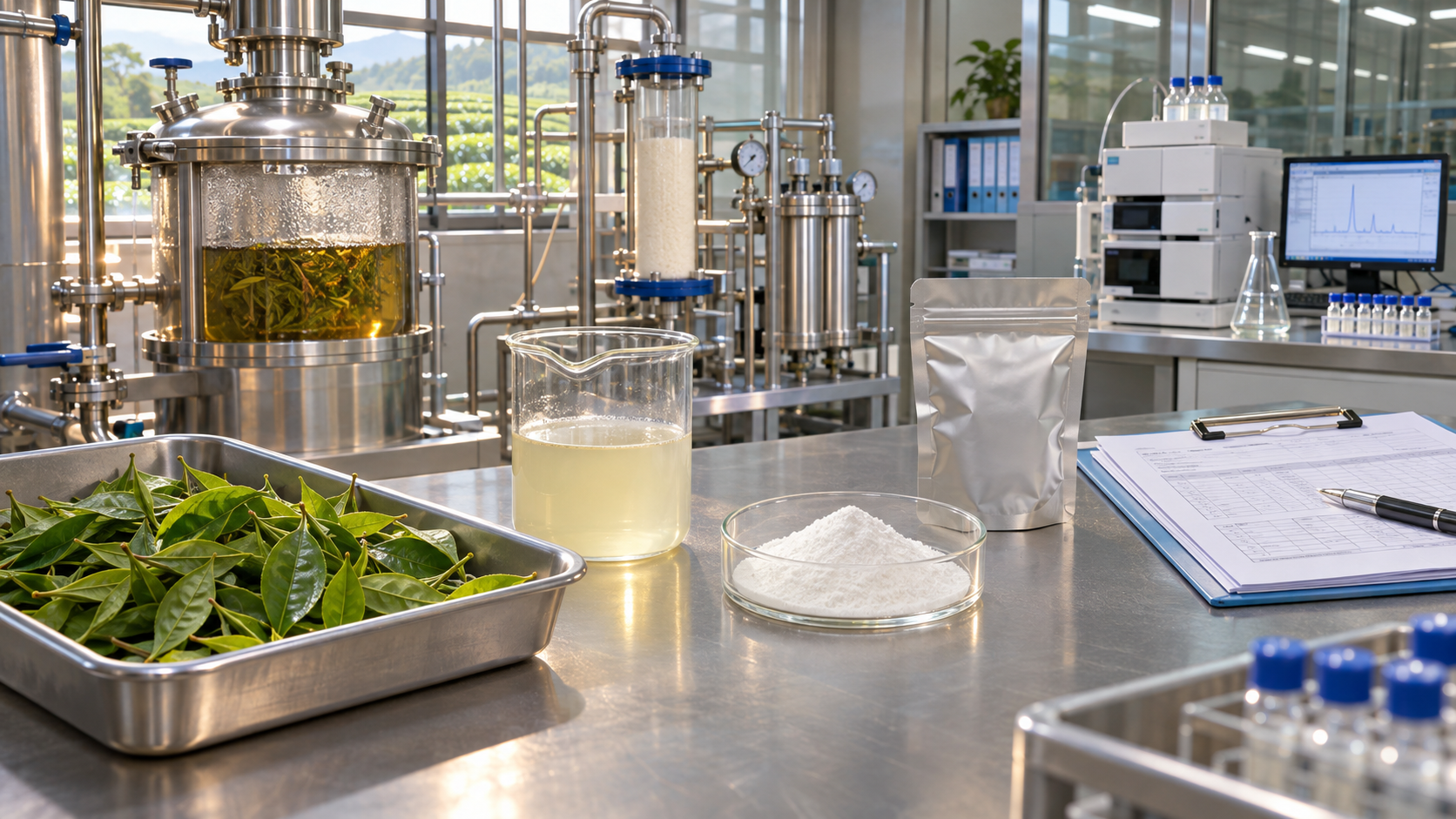
Synthetic and enzymatic routes can produce L-theanine efficiently from controlled starting materials. Green tea-derived material begins with an agricultural raw material whose composition can vary by tea variety, growing conditions, harvest and storage.
The manufacturer must then separate L-theanine from a complex tea matrix and concentrate and purify it to the required specification.
Depending on the process, the cost can reflect:
- • tea-leaf raw material;
- • extraction and filtration;
- • concentration and purification;
- • removal or control of other tea constituents;
- • solvent and water use;
- • yield losses during processing;
- • origin verification and contaminant testing.
These steps do not automatically make the final ingredient better for every formulation. They help explain why a genuinely tea-derived product should not be priced like a routine synthetic grade.
Assay Cannot Prove Tea Origin
An HPLC assay can determine how much L-theanine is present. It cannot, by itself, show where that L-theanine came from.
A 99% result may be obtained for tea-derived, chemically synthesised or enzymatically produced material. Identity and assay therefore answer different questions from botanical origin.
Buyers paying a premium for tea-derived L-theanine should request more than a standard COA:
botanical name and plant part;
• manufacturing-flow description;
• extraction and purification information;
• assay and identity methods;
• commercial-batch traceability;
• supporting origin or authenticity evidence.
The documents should relate to the material being offered, not merely to a generic example.
Can Carbon-Isotope Testing Help?
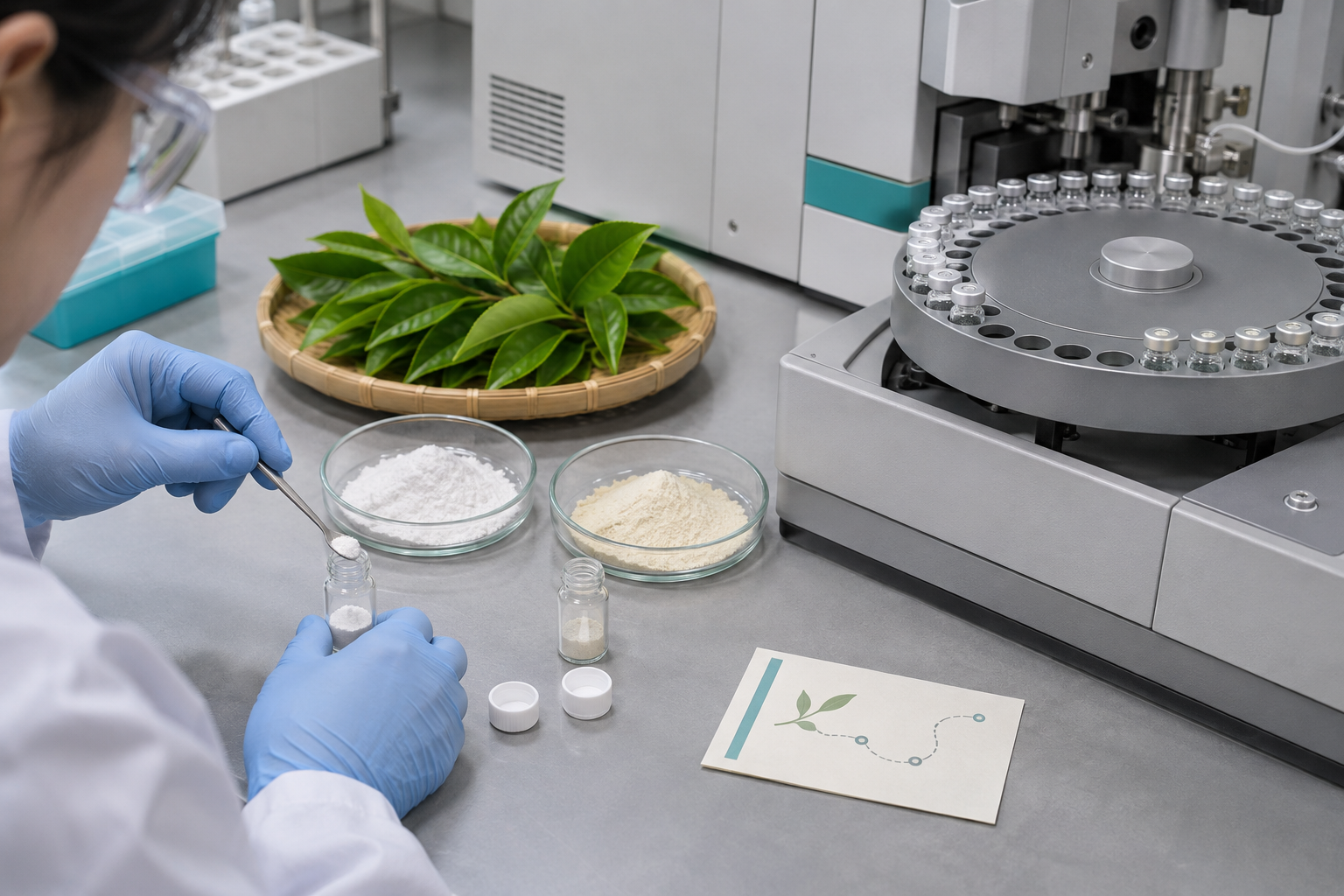
A published study used stable carbon- and nitrogen-isotope ratios to compare L-theanine extracted from tea with synthetic commercial samples.
The tea-derived samples had a mean δ¹³C value of −24.4 ± 1.3‰, while the synthetic samples evaluated had a mean of −14.3 ± 1.5‰. The researchers proposed −21.7‰ as an initial screening threshold based on the authentic samples included in that study.
This makes isotope-ratio mass spectrometry potentially useful when investigating whether a premium “green tea L-theanine” claim is plausible.
It is not a universal pass/fail certificate. The research was exploratory, the database was limited and isotope results can be influenced by the carbon source and manufacturing route. A C13 result should therefore be interpreted alongside traceability, process information and other analytical evidence.
“From Green Tea” Can Create Additional Testing Questions
Botanical sourcing introduces a different risk profile from a highly controlled synthetic process.
Depending on the source, process, destination market and customer specification, qualification may need to consider:
- • pesticide residues
- • ethylene oxide
- • PAH4
- • heavy metals
- • microbiology
- • residual solvents
- • mineral-oil hydrocarbons
- • remaining caffeine/catechins
Not every test is automatically required for every L-theanine shipment. The correct panel depends on the material, manufacturing process, market and buyer’s risk assessment.
A supplier should not simply add every possible test to a generic COA. The buyer and supplier should agree on the required scope, method, reporting limit and testing frequency before the first commercial order.
Compare the Same Product Before Comparing Prices
A low quotation may be entirely reasonable if it covers a different production route.
Before comparing offers, confirm:
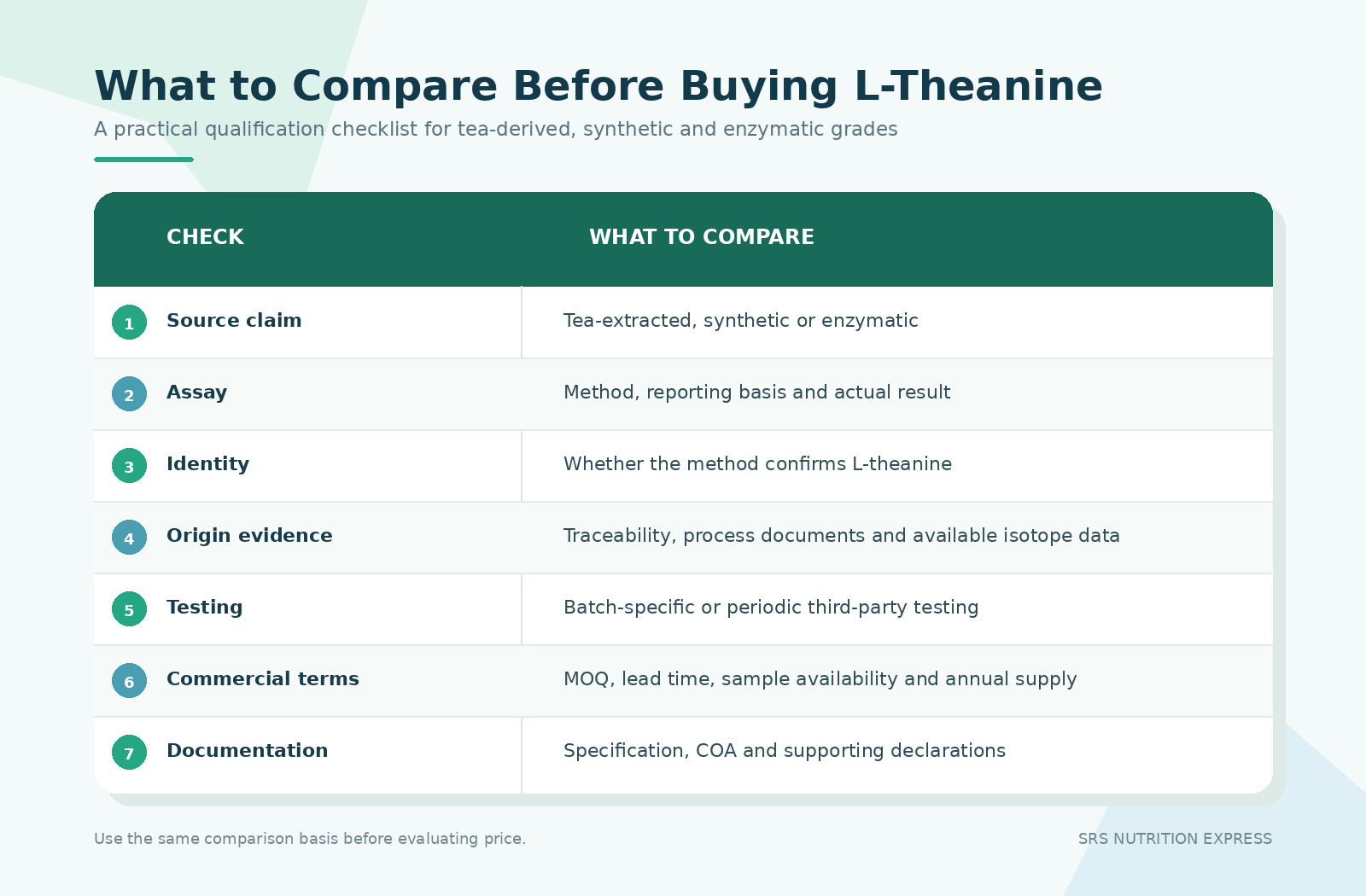
Without this alignment, the lowest and highest quotations may not describe equivalent materials.
Qualification Matters More Than the First Sample
A sample can confirm appearance, taste and suitability for the intended formula. It cannot prove that future commercial batches will have the same origin and contaminant profile.
For higher-value natural L-theanine projects, buyers should agree on:
- the approved manufacturing source;
- batch traceability;
- specification and test methods;
- required third-party testing;
- change-notification requirements;
- retained-sample arrangements;
- investigation procedures if results differ.
Planning a Green Tea L-Theanine Project?
SRS Nutrition Express can support qualification of green tea-derived L-theanine with available specifications, commercial-lot COAs, representative samples and origin documentation.
For projects requiring additional assurance, batch-specific third-party testing can be discussed according to the destination market and agreed specification, including C13, pesticides, PAH4, ethylene oxide, assay and other requested items.
Share your target purity, annual volume, delivery schedule, intended market and required testing panel so we can prepare a relevant quotation and qualification package.
Evidence Boundaries
- • A high assay does not prove botanical origin.
- • Carbon-isotope testing is a useful screening tool, not a universal standalone origin certificate.
- • Tea-derived does not automatically mean safer, more effective or suitable for every formulation.
- • Testing requirements differ by process, destination market and customer specification.
- • Supplier documents and test results must be connected to the commercial material being purchased.
Recommended Reading
References
- Perini M, Pianezze S, Ziller L, Camin F. Characterization of L-theanine in tea extracts and synthetic products using stable isotope ratio analysis. Journal of Food and Drug Analysis. 2021;29(2):311–318.
- U.S. Food and Drug Administration. GRAS Notice No. 338: L-Theanine Extracted From Tea Leaves.
- European Commission. EU Pesticides Database.
- European Commission. Ethylene Oxide: Questions and Answers.
Post time: Nov-16-2026


