

A strawberry flavour that tastes creamy in whey may become bright and jam-like in a gummy, then sharp or medicinal in a pre-workout. This does not necessarily mean the flavour supplier changed the formula. The surrounding product changed what reached the nose and tongue.
Flavour is not a fixed property of a flavouring. It is the combined perception of aroma, sweetness, sourness, bitterness, saltiness, mouthfeel and aftertaste. The food matrix controls how volatile molecules are retained and released, while the active ingredients create their own sensory background.
Whey Protein Can Hold, Hide and Alter Aroma
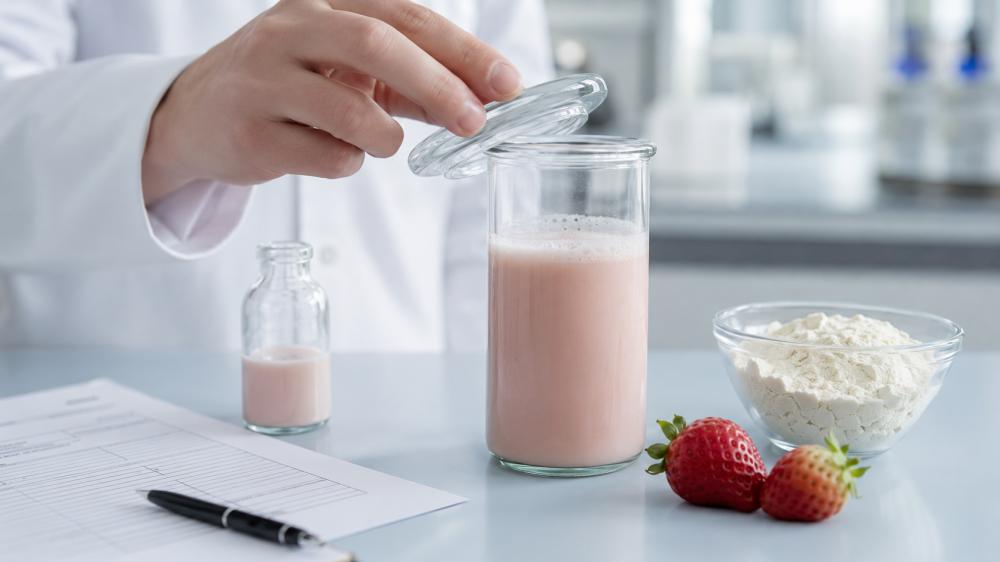
Whey is not a neutral carrier. Its proteins can interact with volatile compounds through reversible hydrophobic binding and, for some aldehydes, chemical reactions.
In a whey protein isolate study, binding strength followed the order trans-2-nonenal > nonanal > 2-nonanone. Heating or high-pressure treatment reduced 2-nonanone binding, left nonanal broadly unchanged and rapidly increased affinity for trans-2-nonenal. The same flavour can therefore shift after protein denaturation because individual aroma compounds do not respond equally.[1]
Another study examined aldehyde retention across different pH conditions using static headspace, dynamic release and exhaled air. Whey protein retained longer-chain aldehydes more strongly in static tests, particularly at higher pH, but the effect was less pronounced during actual oral release.[2] This is an important boundary: headspace analysis can explain a mechanism, but it cannot replace tasting the finished drink.
WPC versus WPI, protein concentration, residual fat, lecithin, heat history and serving dilution can all change the balance. A flavour developed in water is therefore not a finished whey flavour.
Gummies Release Flavour Through a Gel Network
In a gummy, aroma must move through a concentrated sugar phase and a three-dimensional gel before it reaches the air. Gelatin, pectin and gum arabic do not create the same structure, texture or release rate. Chewing and saliva then change that structure again.
A study tested natural and nature-identical strawberry flavourings at 0.15% and 0.30% in gummies structured with gelatin, pectin or gum arabic. GC–MS and electronic-nose results separated many of the formulations by gelling agent, flavour origin and concentration.[3]
At 0.30% flavour, sensory panellists correctly distinguished the two flavour origins in 75% of tests, regardless of the structuring agent. At 0.15%, correct discrimination varied from 40% in gelatin to 62% in gum arabic and 68% in pectin. Simply doubling the flavour did not create one universal response; the gel matrix still influenced what was released and perceived.
Acid also does more than create sourness. It changes the sweet–sour balance and may affect pectin setting and flavour stability. The point of acid addition, cooking temperature and drying conditions must therefore be included in flavour trials.
Pre-Workout Powders Begin With an Active Taste Load
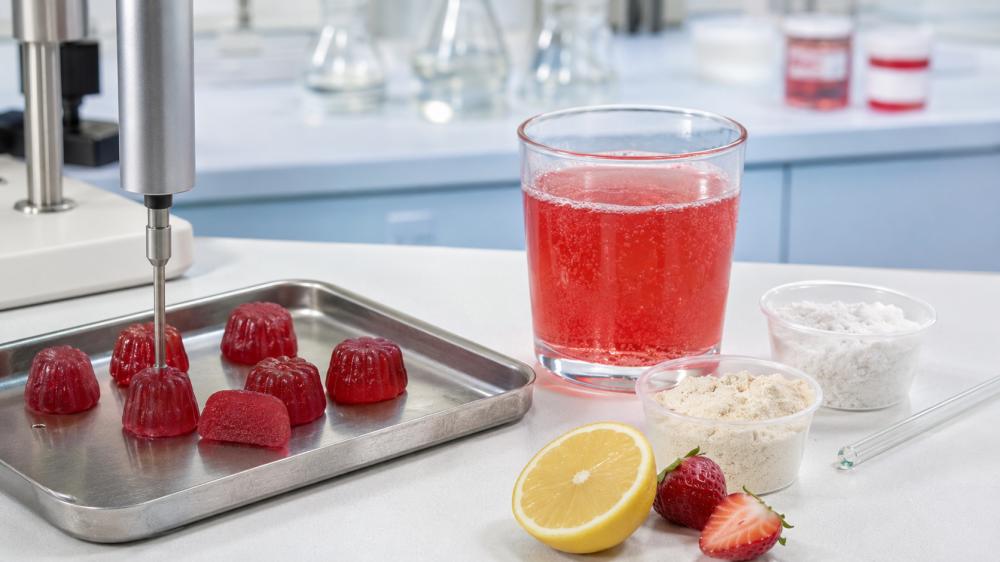
Pre-workouts are usually reconstituted in water, but they are not simple flavoured drinks. Caffeine contributes bitterness; amino acids, plant extracts and minerals may add sour, salty, metallic, astringent or lingering notes. High-intensity sweeteners can introduce delayed sweetness or their own aftertaste.
Taste interactions are not one-for-one. In a controlled caffeine study, 250 mM sucrose reduced perceived caffeine bitterness by 47%, but flavour aromas and cognitive cues were only partly effective.[4] In separate sucrose–citric-acid model solutions, citric acid raised the sucrose detection threshold from 0.424% to as high as 0.624%, while sucrose raised the citric-acid threshold from 0.0057% to 0.0082%.[5] These concentrations are experimental systems, not recommended supplement dosages, but they demonstrate why increasing acid or sweetener can rebalance several sensations at once.
A flavour that seems “weak” may actually be buried beneath bitterness or excessive acidity. Adding more top-note aroma may increase smell without fixing the aftertaste.
Develop the Flavour in the Final Matrix
The flavour name should be the starting brief, not the final specification. Product developers should compare prototypes at the intended serving size, water volume and temperature, then record aroma onset, sweetness, acidity, bitterness, mouthfeel and aftertaste over time.
For gummies, trials should use the intended gelling agent, cook, acid-addition step and drying process. For whey, they should include the selected protein grade and processing conditions. For pre-workouts, the full active load must be present before the masking system is approved.
SRS Nutrition Express can support ingredient selection, sample comparison and formula-level trials across protein, gummy and powdered supplement applications. The goal is not to make one flavour work everywhere, but to build the right flavour system around the matrix consumers will actually experience.
References
1. Kühn J, Considine T, Singh H. Binding of Flavor Compounds and Whey Protein Isolate as Affected by Heat and High Pressure Treatments. Journal of Agricultural and Food Chemistry. 2008;56(21):10218–10224.
2. Weel KGC, Boelrijk AEM, Burger JJ, et al. Effect of Whey Protein on the In Vivo Release of Aldehydes. Journal of Agricultural and Food Chemistry. 2003;51(16):4746–4752.
3. Pizzoni D, Compagnone D, Di Natale C, D’Alessandro N, Pittia P. Evaluation of Aroma Release of Gummy Candies Added With Strawberry Flavours. Journal of Food Engineering. 2015;167:77–86.
4. Keast RSJ. Modification of the Bitterness of Caffeine. Food Quality and Preference. 2008;19(5):465–472.
5. Mao Y, Tian S, Qin Y, Han J. Sensory Sweetness and Sourness Interactive Response of Sucrose–Citric Acid Mixture. npj Science of Food. 2022;6:33.
Post time: Aug-05-2026


