

A 500-mesh creatine sample may look impressively fine when it arrives. That does not yet prove that it is the right grade for your finished product.
The sample still needs to answer four commercial questions:
A good sample evaluation should produce evidence for a purchasing decision—not simply confirm that the powder feels fine between your fingers.
Test 1: Compare the Consumer Experience Under Controlled Conditions
If the objective is a smoother product, compare the 500-mesh sample against the grade currently used—often an 80- or 200-mesh creatine. Prepare both samples using the same:
- ✓ creatine dose;
- ✓ water volume and temperature;
- ✓ mixing time and method;
- ✓ standing time before evaluation;
- ✓ cup or shaker type.
Assess initial dispersion, visible particles, sediment, residue and perceived grittiness. Use coded samples where possible so evaluators do not know which grade they are testing.
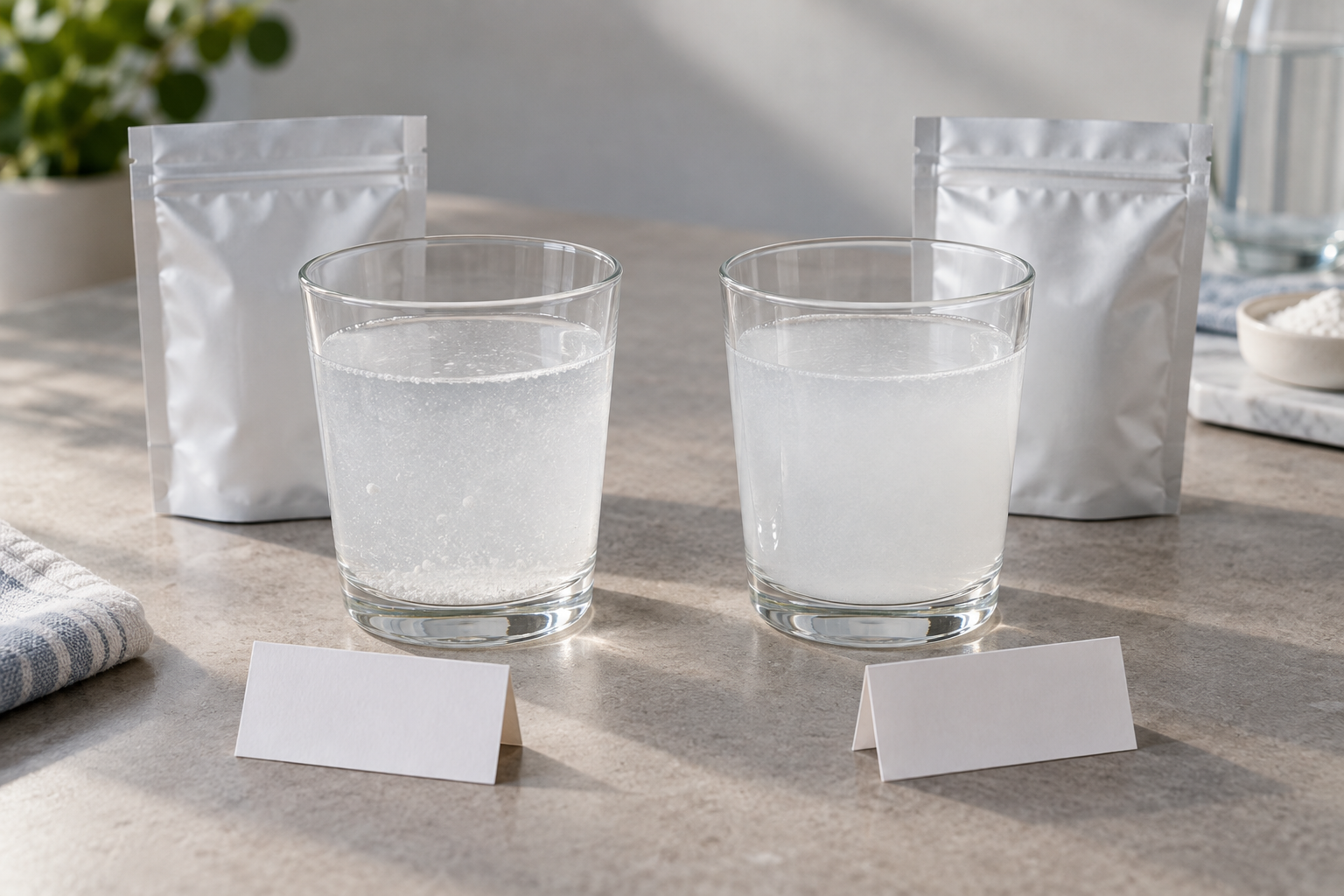
Particle size can influence oral grittiness, but it is not the only factor. Research using model food systems found that particle concentration and the surrounding medium also affected whether particles were perceived.[1] A favourable result in water therefore does not guarantee the same experience after flavours, acids, sweeteners or other active ingredients are added.
Test 2: Check Density Before Selecting the Package and Scoop
A finer powder may occupy a different volume from a coarser grade of the same weight. Measure both loose and tapped density using a defined method rather than estimating from the sample bag. Record:
- sample conditioning;
- test method;
- mass and measuring vessel;
- loose powder volume;
- tapped powder volume;
- number or endpoint of taps.
The results can help estimate container volume and show how much the powder may consolidate during filling or transport. They can also reveal whether an existing scoop is suitable. A volumetric scoop does not deliver a fixed mass across every powder. Verify the actual weight of multiple level scoops using the proposed grade or finished blend.
Do not approve the package based only on the volume of a freshly aerated laboratory sample.
Test 3: Run the Sample Through the Intended Filling Process
Manual handling cannot predict performance inside a hopper, auger filler, dosator or tamping-pin system. Very fine powders may exhibit stronger cohesive behaviour because surface forces become more important relative to particle weight. However, flow cannot be predicted from particle size alone. Density, morphology, surface properties, moisture and equipment conditions also matter.[2]
During a pilot run, monitor:
- hopper discharge and bridging;
- feeding consistency;
- individual fill weights;
- startup and steady-state performance;
- changes as the hopper level falls;
- dust around transfer and sealing areas;
- reject rate and cleaning time.
Do not judge the trial using the average fill weight alone. A correct average can conceal excessive package-to-package variation.
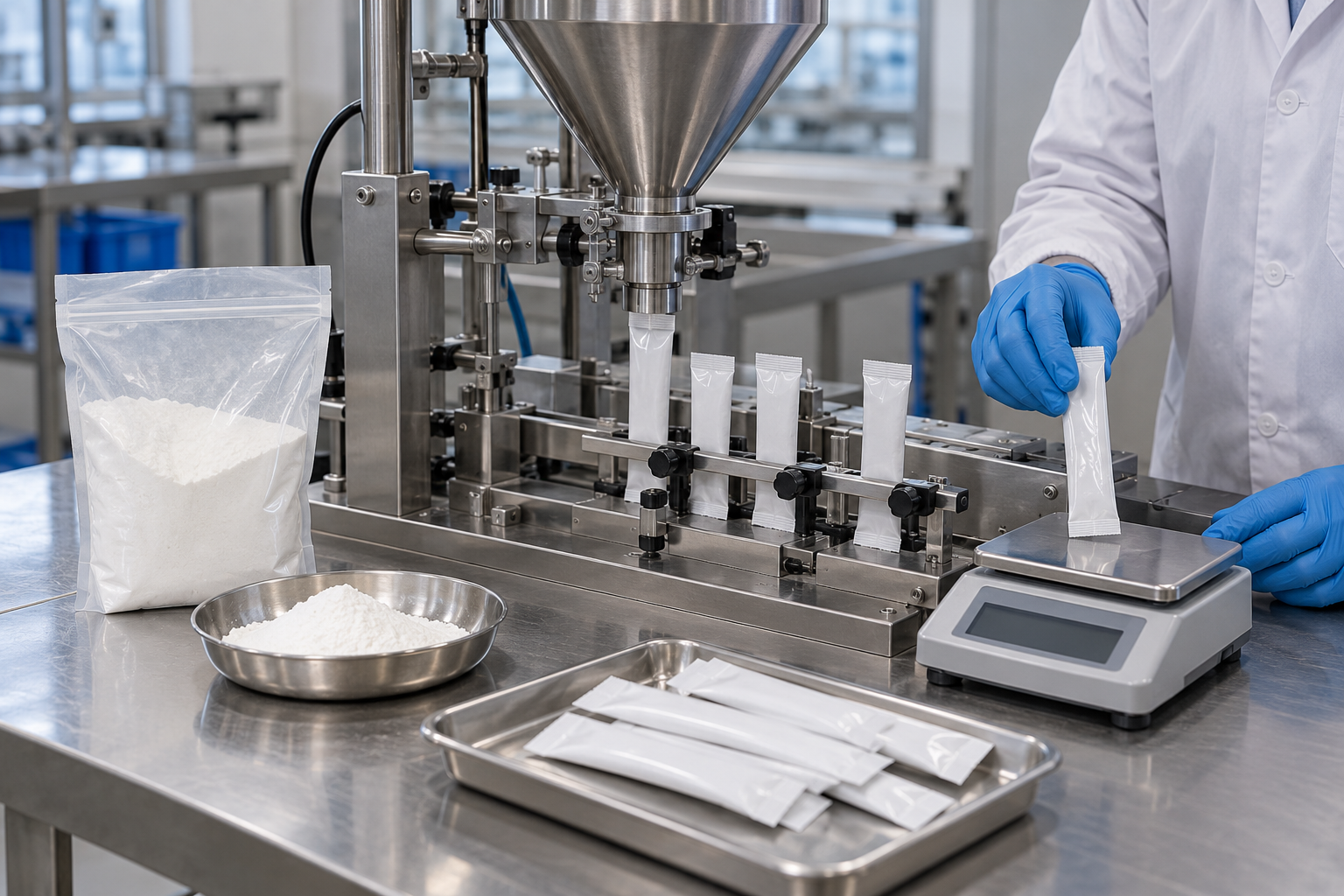
If the formula contains other ingredients, test the complete blend. Pure 500-mesh creatine may behave differently after it is combined with flavours, sweeteners, minerals or botanical powders.
Test 4: Connect the Sample to the Commercial Grade
A successful sample trial has limited value if the material cannot be linked to future orders. Before approval, confirm:
- grade name and product code; manufacturing site; sample or batch number;
- applicable specification; particle-size method and limit;
- whether Dv(10), Dv(50) and Dv(90) data are available;
- loose and tapped density information;
- whether the commercial material will follow the same specification.
Laser diffraction can provide a broader particle-size distribution than a single sieve result, but the method and dispersion conditions still need to be identified.[3]
Ask whether the sample represents routine commercial production or was prepared separately for evaluation. Future batches will not be numerically identical, so critical attributes and acceptable variation should be defined before ordering.
Should You Compare 200 Mesh and 500 Mesh?
For many projects, a side-by-side comparison is more useful than evaluating 500 mesh alone. A 200-mesh grade may already satisfy the product brief at a lower processing or material cost. A 500-mesh grade may justify its selection when evaluators can identify a meaningful sensory advantage and the material still performs reliably in production.
The objective is not to choose the finest available powder. It is to select the grade that creates the best balance between consumer experience, manufacturability and finished-product cost.
Ready to Compare 200-Mesh and 500-Mesh Creatine?
Share your product format, serving size, other ingredients, package type and filling method. SRS Nutrition Express can provide representative 200-mesh and 500-mesh creatine monohydrate samples, applicable specifications, lot COAs and available particle-size or density information for comparative trials.
Evidence Boundaries
- [!] A finer sample is not automatically more effective or bioavailable.
- [!] Mesh designation does not describe the complete particle-size distribution.
- [!] Water testing cannot predict performance in every finished formulation.
- [!] A qualification sample does not eliminate commercial-lot incoming controls.
- [!] Final suitability must be confirmed using the intended formula, package and equipment.
Recommended Reading
References
- Imai E, Hatae K, Shimada A. Oral perception of grittiness: effect of particle size and concentration of the dispersed particles and the dispersion medium. Journal of Texture Studies. 1995;26(5):561–576. DOI:
- Owasit A, et al. Predicting powder blend flowability from individual component properties. Pharmaceutical Research. 2025;42:665–683.
- International Organization for Standardization. ISO 13320:2020—Particle Size Analysis: Laser Diffraction Methods.
- United States Pharmacopeia. General Chapter <616>: Bulk Density and Tapped Density of Powders.
Post time: Oct-14-2026


