

Your team compared the sample, approved the product experience and completed a successful pilot run. It may feel like the next step is simply negotiating the price.
Not quite.
A passing 500-mesh creatine sample confirms that one submitted sample worked under the conditions tested. It does not automatically confirm the specification, supplier controls, commercial-lot consistency or delivery terms for future orders.
Before moving from sample approval to regular purchasing, the technical decision needs to become a controlled commercial agreement.
R Record Exactly What Was Approved
Sample approval should identify more than “500-mesh creatine.” Record:
- • supplier and manufacturing site;
- • product name and grade code;
- • sample or batch number;
- • specification version;
- • tests performed and methods used;
- • formula and equipment used in the trial;
- • results and acceptance decision;
- • person responsible for approval.
Photos and informal feedback can support the record, but comments such as “looked finer” or “mixed better” are not sufficient on their own.
If the approved sample cannot be traced to a defined grade, it will be difficult to determine whether the first commercial shipment represents the same material.
Turn the Sample into a Purchasing Specification
The specification should capture the attributes necessary to reproduce the approved product experience without demanding that every batch produce identical numerical results.
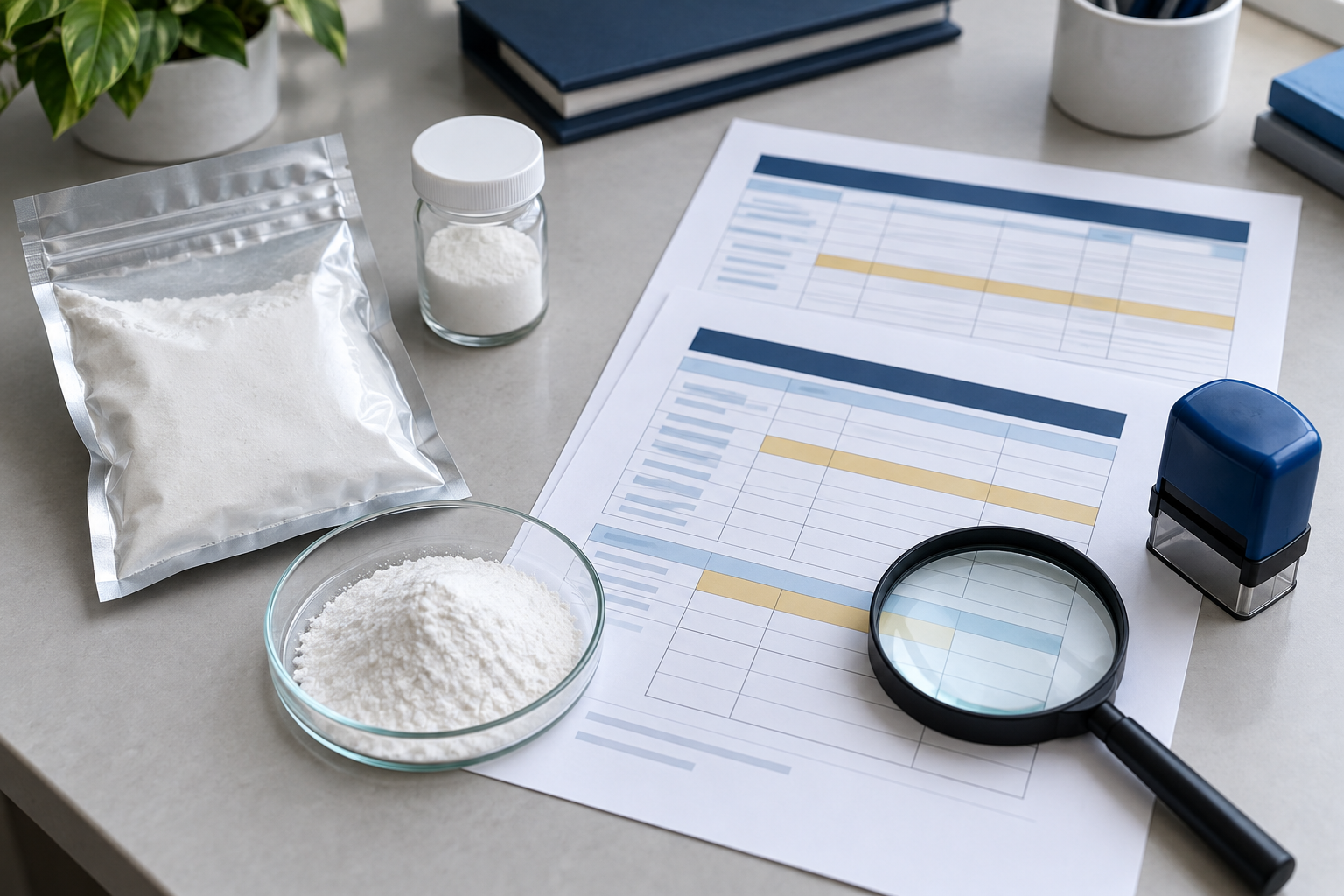
For 500-mesh creatine, buyers may need to define:
A mesh result alone may not describe the complete particle-size distribution. Laser-diffraction data can provide broader distribution information, but the method and dispersion conditions must be identified.[1]
Avoid copying every sample result into the specification. Normal batch variation exists, and limits should reflect product requirements, method capability and realistic manufacturing control.
Confirm That the Commercial Grade Matches the Sample
Before issuing the purchase order, ask the supplier to confirm that the approved sample represents routine commercial production. Questions should include:
- Was the sample taken from a production batch?
- Will the commercial order use the same grade code?
- Does the same specification apply?
- Is the manufacturing site the same?
- Will particle-size processing follow the same route?
- Are any changes planned before production?
A specially prepared evaluation sample may be useful for development, but it should not be treated as proof of routine commercial supply unless that relationship is documented.
Decide How the First Commercial Lot Will Be Released
The first commercial shipment deserves more control than a routine reorder.

Before arrival, agree on:
- required pre-shipment documents
- commercial-lot COA
- incoming sampling plan
- identity and confirmation testing
- retained-sample requirements
- procedure for resolving laboratory discrepancies
- quality responsibility for final release
For US dietary supplements, 21 CFR Part 111 generally requires an appropriate identity test or examination for each dietary ingredient unless an applicable exemption has been granted. Reliance on a supplier COA for certain other specifications requires supplier qualification, confirmation of COA reliability, documentation and periodic reconfirmation.[2]
This does not create one universal testing plan for every customer or market. The buyer’s approved quality system and applicable regulations remain decisive.
Lock the Commercial Details Before Production
A technically suitable grade can still become a poor purchasing decision if the commercial conditions are unclear. The purchase order should confirm:
- ordered quantity and permitted variation;
- price and Incoterm;
- packaging format and net weight;
- production and delivery schedule;
- destination and import requirements;
- shelf-life or retest-date information;
- document package;
- batch and pallet identification;
- complaint and return procedure.
For a first order, consider whether split delivery or a smaller qualification quantity is practical. This can reduce exposure while the customer confirms incoming results and full-scale production performance.
Define What Changes Require Notification
The approved sample should not become an indefinite reference while the material changes around it. A supply or quality agreement may require notification before changes involving:
- manufacturing site
- production process
- milling or particle-size classification
- specification or analytical method
- raw-material source
- packaging
- grade code
- regulatory or quality status
Not every change will require complete requalification. The buyer should assess whether the change could affect safety, compliance, production or the finished-product experience.
Plan the Second Order Before Placing the First
Supply reliability is easier to evaluate before inventory becomes urgent. Discuss anticipated annual volume, reorder frequency, manufacturing lead time, available supply locations and safety-stock expectations. If the product launch depends on a particular fine grade, identify the point at which a repeat order should be placed.
The objective is to move from “this sample worked” to “this supply program can be repeated.”
Ready to Move From Sample Approval to Commercial Supply?
Send SRS Nutrition Express your approved sample reference, intended product format, required specification, order quantity, destination market and target delivery date. SRS can provide the applicable grade specification, commercial-lot COA, packaging information, available particle-size or density data and quotation for your 500-mesh creatine qualification process.
Evidence Boundaries
- Passing one sample does not guarantee identical future batches.
- A supplier COA does not replace the buyer’s required incoming controls.
- Particle-size and density results depend on sampling and test methods.
- Regulatory and testing responsibilities differ by market and product category.
- Commercial suitability must be confirmed using the actual production grade.
Recommended Reading
- • Requesting a 500-Mesh Creatine Sample? Test These Four Things Before You Approve It
- • What Should You Include in a Creatine Monohydrate RFQ?
- • Changing Creatine Suppliers? A Qualification Checklist Before Your First Commercial Order
References
- International Organization for Standardization. ISO 13320:2020—Particle Size Analysis: Laser Diffraction Methods.
- Electronic Code of Federal Regulations. 21 CFR Part 111—Current Good Manufacturing Practice in Manufacturing, Packaging, Labeling, or Holding Operations for Dietary Supplements.
- U.S. Food and Drug Administration. Current Good Manufacturing Practice in Manufacturing, Packaging, Labeling, or Holding Operations for Dietary Supplements: Small Entity Compliance Guide.
- Consumer Healthcare Products Association. Dietary Supplement Component Supplier Qualification—Voluntary Guideline.
Post time: Oct-14-2026


