

A finer creatine powder can feel more refined in use. But place the same net weight into the wrong container and that premium upgrade may create an unexpected problem: the tub can look underfilled after transport.
This does not mean product is missing. It means powder weight and powder volume are not interchangeable.
For brands considering 500-mesh creatine monohydrate, particle size should therefore be evaluated alongside bulk density, settling behaviour, scoop volume and packaging—not only mouthfeel.
01 The Label Sells Weight, but Consumers See Volume
A 300 g creatine product should contain the declared net weight regardless of how much space the powder occupies. In the United States, net quantity is a required label statement, while serving size and servings per container must also be declared as applicable. These requirements concern the amount of product, not whether the tub appears visually full.[1][2]
Consumers, however, cannot judge net weight by sight. They see the distance between the powder surface and the lid. If a newly opened container has substantial empty space, some customers may assume it was underfilled—even when checkweighing confirms that the correct mass was packed.
02 Why Finer Does Not Automatically Mean More Compact
Bulk density describes the mass of powder occupying a given bulk volume, including the air between particles. Tapped density measures the volume after a defined mechanical consolidation procedure.[3]
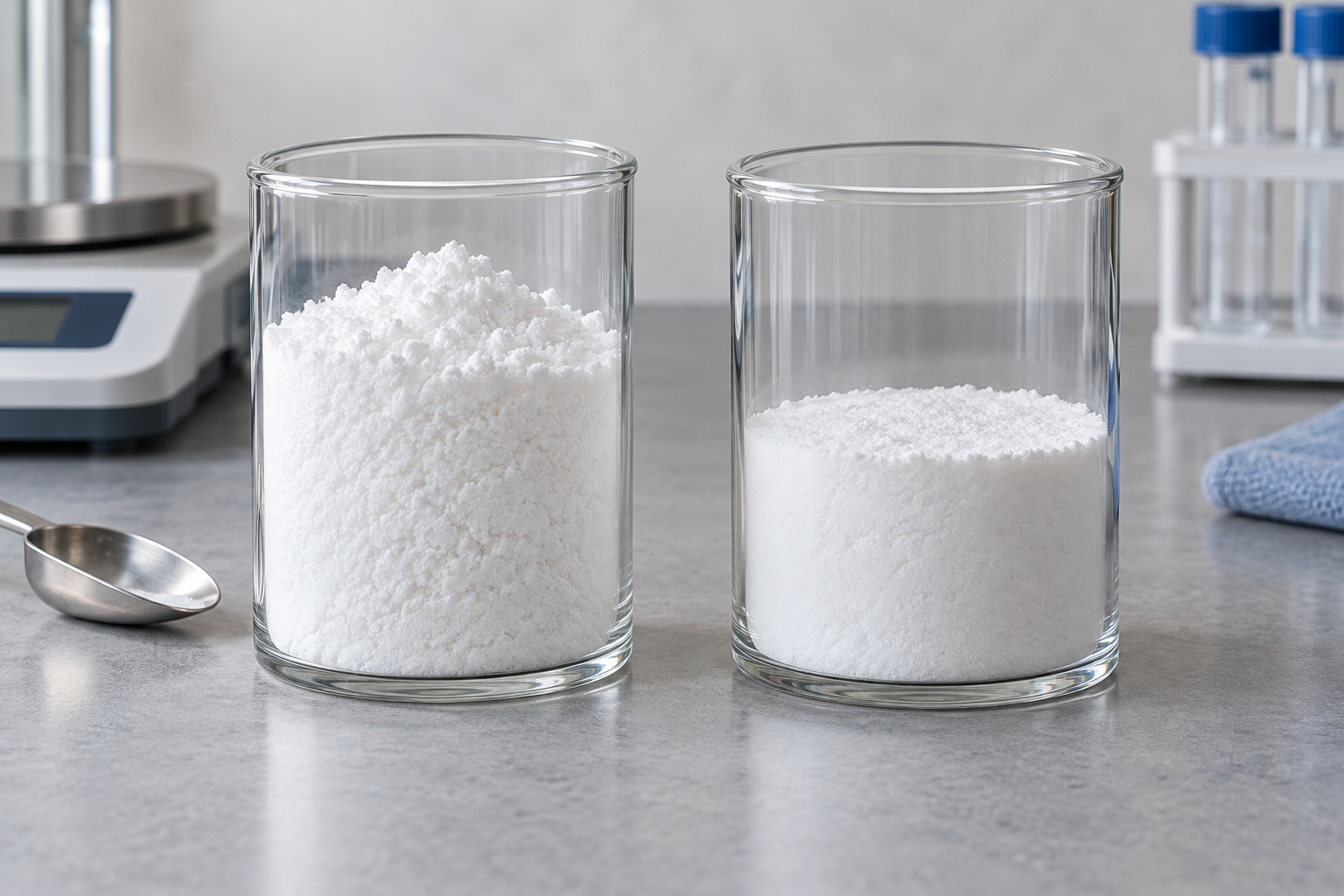
Reducing particle size changes more than appearance. Very fine particles have greater surface area relative to their mass and may exhibit stronger cohesive behaviour. Particle-size distribution, shape, moisture and interparticle forces can all influence how a powder packs and flows.[4]
As a result, a 500-mesh grade may occupy a different volume from an 80- or 200-mesh material of the same mass. But mesh designation alone cannot predict the difference.
03 The Fill Level Can Change After the Tub Leaves the Factory
A freshly filled powder may contain substantial air between particles. During conveying, case packing and transport, vibration can rearrange the powder bed and reduce that air space. The net weight remains unchanged, but the powder surface moves downward.

The effect may be more important when:
- the powder has a large difference between loose and tapped density;
- the container was selected using freshly aerated powder;
- the shipment experiences prolonged vibration;
- the tub is substantially larger than the settled powder volume;
- the label design or transparent packaging makes the fill level prominent.
04 Scoop Size Can Create a Second Surprise
Changing powder density can also change the mass delivered by a volumetric scoop. A scoop selected for one creatine grade may not deliver the same weight when used with another grade.
Brands moving to 500-mesh creatine should therefore verify the proposed scoop with the actual commercial material. The printed serving should be supported by finished-product fill and serving controls—not by scoop volume assumptions alone.
What Should Brands Test Before Choosing the Package?
Before finalising a tub, pouch or stick pack, evaluate the commercial grade in the intended process. A practical packaging trial should confirm:
- loose and tapped density using identified methods;
- target net weight and initial fill height;
- fill height after controlled vibration or transport simulation;
- achievable filling accuracy and line speed;
- scoop capacity using the finished powder;
- sealing, dust and cleanup behaviour;
- consumer preparation and sensory performance.
If flavours, sweeteners or other ingredients are present, test the complete blend. Density data for pure creatine cannot reliably predict the volume or flow of a multi-ingredient finished product.
When Does 500-Mesh Still Make Commercial Sense?
A finer grade may be valuable when the intended product competes on smoothness, refined powder appearance or a more premium preparation experience.
The commercial question is not simply whether 500 mesh is “better.” It is whether its consumer-facing advantages remain meaningful after accounting for manufacturing behaviour, container size, freight volume and finished-product cost.
Planning a 500-Mesh Creatine Product?
Before finalising the container or scoop, evaluate the proposed creatine grade at the intended net weight and under realistic filling and transport conditions. Share your product format, target net weight, container dimensions, serving size and filling method.
Evidence Boundaries
- A 500-mesh designation does not establish one universal particle-size distribution or bulk density.
- Finer creatine is not automatically more soluble, more bioavailable or more effective.
- Visible headspace does not prove that a correctly labelled package is underweight.
- Raw-material density cannot replace finished-blend and packaging trials.
- Actual performance depends on grade, batch, method, formulation, equipment and handling.
Recommended Reading
- Creatine Mesh Size vs Particle Size Distribution: Why Dv(10), Dv(50) and Dv(90) Matter
- Does a 5 g Creatine Claim Mean 5 g Per Serving?
- Creatine Monohydrate RFQ: What Buyers Should Include
References
- U.S. Food and Drug Administration. Dietary Supplement Labeling Guide: Chapter III—Net Quantity of Contents.
- Electronic Code of Federal Regulations. 21 CFR §101.36—Nutrition Labeling of Dietary Supplements.
- United States Pharmacopeia. General Chapter <616>: Bulk Density and Tapped Density of Powders. DOI: 10.31003/USPNF_M99375_02_01.
- Santomaso A, Lazzaro P, Canu P. Powder flowability and density ratios: the impact of granules packing. Chemical Engineering Science. 2003;58(13):2857–2874. DOI: 10.1016/S0009-2509(03)00137-4.
Post time: Oct-13-2026


