

A label may declare 5 g of creatine per serving, but the raw-material assay and the printed serving size are only two parts of dose control. The finished product must also remain sufficiently uniform during blending, filling, transport and consumer use.
This does not mean that every creatine product is inaccurately dosed. It means that a compliant creatine ingredient cannot, by itself, prove what every scoop or sachet of the finished product delivers.
A Raw-Material COA Does Not Measure the Finished Serving
A creatine monohydrate COA can confirm the tested lot’s identity, assay, moisture and other specified attributes. It does not confirm how much creatine is present in an individual serving after the ingredient has been blended with flavours, sweeteners, electrolytes or other active ingredients.
For a multi-ingredient product, two controls are required:
- [✓] The total weight placed into each serving;
- [✓] The proportion of creatine within that weight.
A sachet can meet its target fill weight and still contain the wrong creatine amount if the blend is not uniform. Conversely, a uniform blend can deliver an incorrect dose if the sachet, jar serving or capsule is underfilled.
Why a Uniform Blend Can Become Less Uniform
Dry powders do not always remain in the arrangement created by the blender. Particles can move differently during discharge, transfer, hopper residence, vibration and packaging.
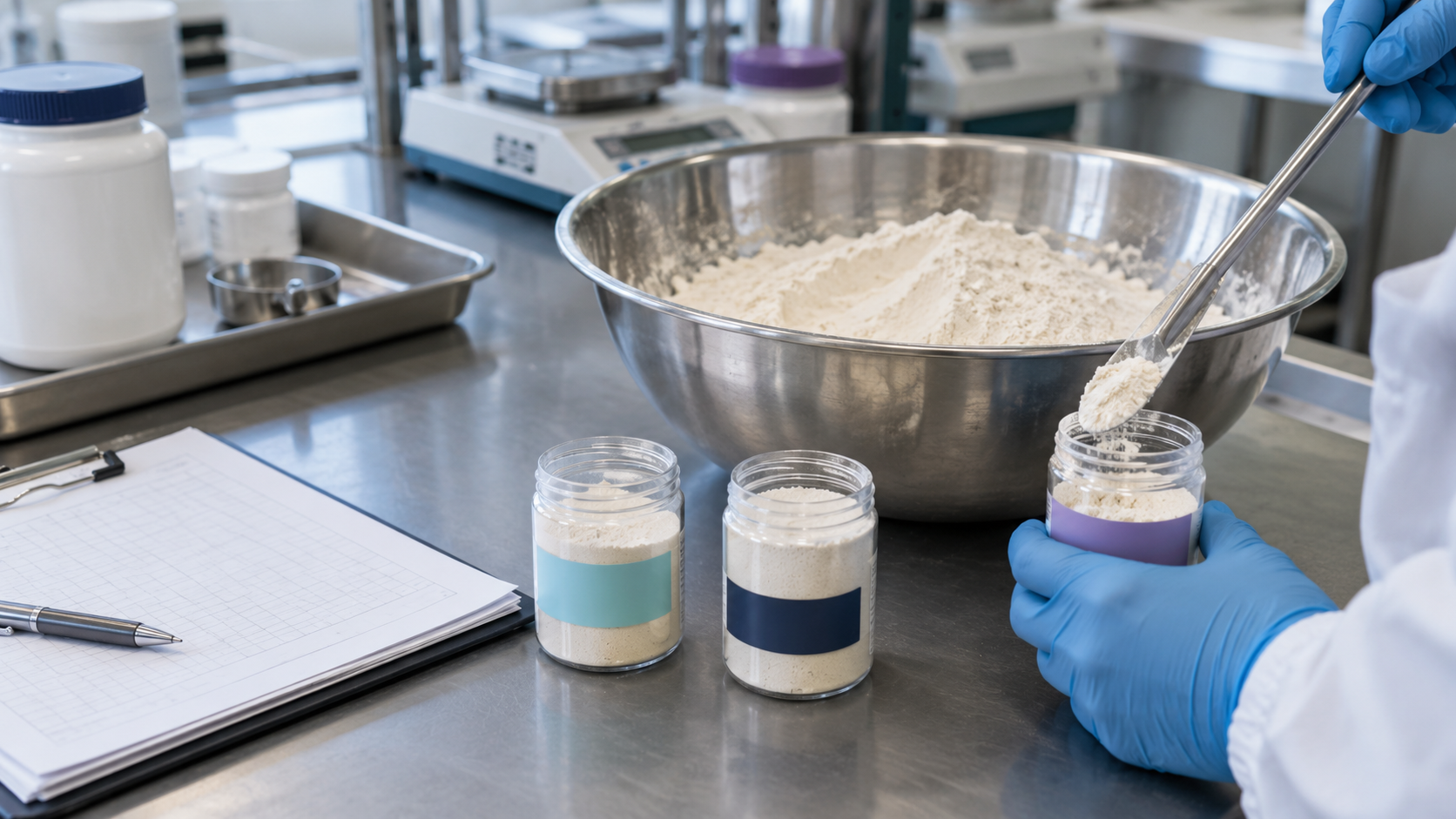
The risk depends on the complete formula and process, including:
- Ingredient proportions and particle-size distributions;
- Bulk density and cohesiveness;
- Mixing order and mixing time;
- Blender and discharge design;
- Transfer distance and vibration;
- Hopper level and filling speed.
This is why selecting a finer creatine grade does not automatically improve content uniformity. A finer powder may reduce visible grittiness but can also behave differently in blending and filling.
A Scoop Measures Volume, Not Mass
A plastic scoop has a defined volume. It does not independently weigh the powder placed inside it. The mass delivered can change with powder density, settling, compaction and the way the scoop is filled. “Level,” “rounded” and “heaped” are not interchangeable instructions.
A 2025 conference abstract examined 194 powdered dietary supplements… Across the 11 creatine products, the average difference from the labelled serving weight was approximately −1%, but variability was wide: the reported standard deviation was 20%, with individual results ranging from 25% below to 32% above the labelled weight. [1]
What Should Manufacturers Validate?
The validation plan should match the product format. For jars containing a multi-ingredient powder, manufacturers may need to evaluate blend uniformity, creatine content, scoop-delivered mass and variation across the filling run.

In the United States, 21 CFR Part 111 requires dietary-supplement manufacturers to establish finished-product specifications, collect representative samples and use appropriate tests or examinations. Each company must establish and justify controls appropriate to its formula and process. [2][3]
Do Brands Need to Add Extra Creatine?
Adding an overage should not be the first response to poor uniformity or inconsistent filling. The better sequence is to identify the source of variation, control it and then determine whether any technically justified overage is necessary. [2]
How SRS Can Support Creatine Product Development
SRS Nutrition Express can provide grade-specific creatine monohydrate specifications, commercial-lot COAs, representative samples and available particle-size and density information for formulation trials.
Evidence Boundaries
- A 5 g label claim does not automatically indicate that a product is inaccurately dosed.
- Raw-material compliance does not prove finished-serving uniformity.
- Scoop-weight variation is not the same as laboratory-confirmed variation in creatine content.
- Finished-product controls must reflect the actual formula and equipment.
References
- Braun H, et al. Dietary Supplements—(In)Accuracy of Manufacturers’ Dosing Instructions. 2025.
- U.S. Food and Drug Administration. Small Entity Compliance Guide.
- Electronic Code of Federal Regulations.
- Duan Y, et al. Designing non-segregating granular mixtures. 2021.
Post time: Oct-05-2026


