

A Certificate of Analysis shows 98% L-theanine. The product name says “green-tea-derived.” Has the botanical origin been proven?
Not necessarily.
An assay can show how much L-theanine was measured in a sample. It does not automatically reveal whether the ingredient was extracted from Camellia sinensis, chemically synthesized or produced through enzymatic synthesis or microbial fermentation.
For brands paying a premium for natural positioning, origin needs a different evidence package.
A 98% Assay Identifies Quantity, Not Origin
L-theanine from tea and correctly produced synthetic L-theanine can share the same chemical identity. A conventional assay may quantify the molecule without identifying how it was produced.
The COA remains essential, but buyers should check what each result actually establishes:
- ✔ Identity supports that the material is L-theanine.
- ✔ Assay measures the amount under the stated method.
- ✔ Optical purity can help confirm the intended L-form.
- ✔ Contaminant testing evaluates specified chemical or microbiological risks.
- ✘ None of these results alone necessarily proves botanical origin.
A COA describing “green tea L-theanine” without a supporting supply chain or origin method may simply repeat the commercial product name.
Traceability Must Connect the Leaf to the Powder
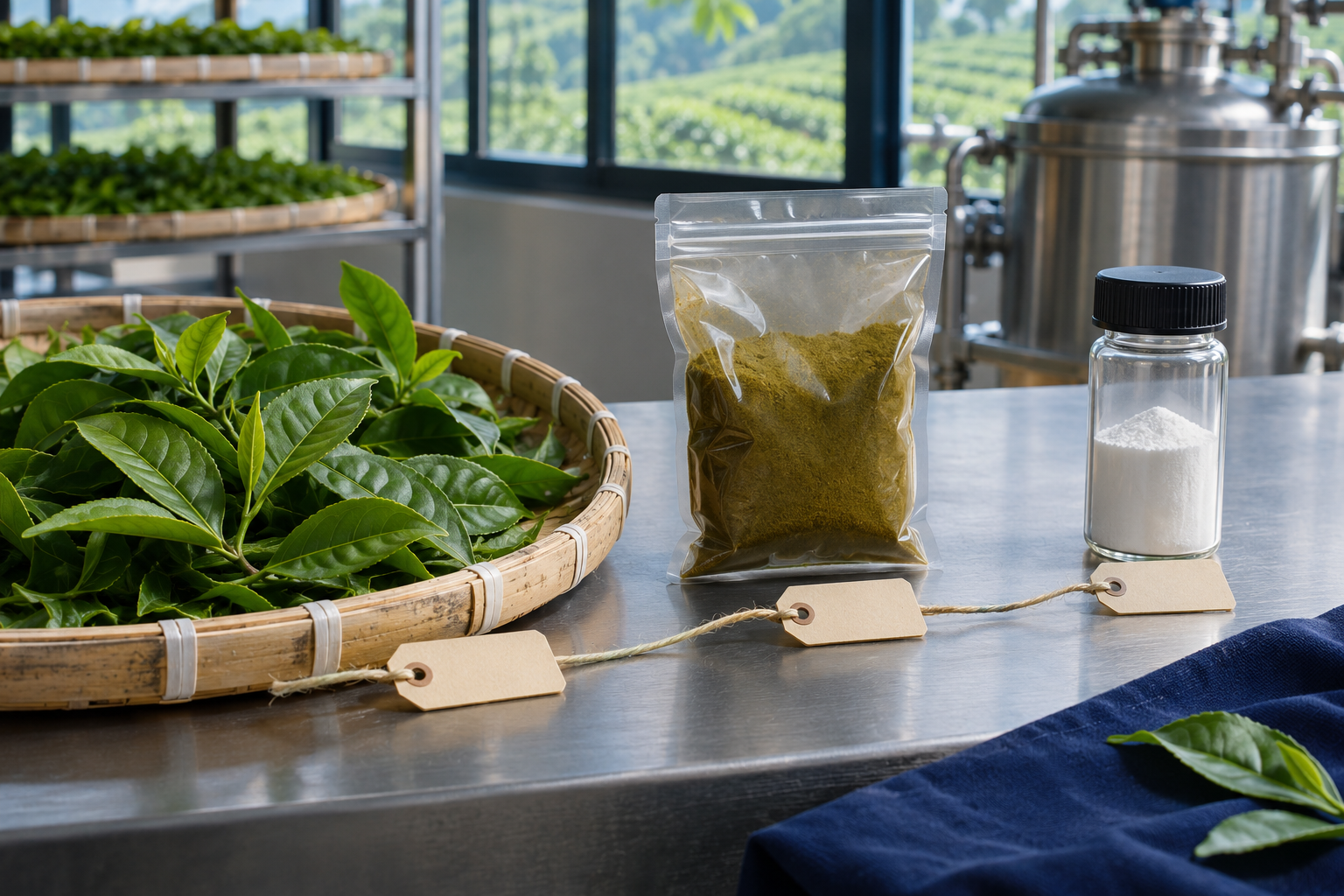
A credible green-tea-origin package should connect the commercial batch to its botanical starting material and processing history.
Relevant evidence may include:
- botanical name and plant part;
- country and region of cultivation;
- tea raw-material or extract batch numbers;
- extraction and purification process description;
- manufacturing-site identification;
- mass-balance or batch-production records;
- supplier origin declaration;
- pesticide and processing-contaminant assessments;
- retention samples and change-notification controls.
The documents must relate to the supplied grade and batch. A generic statement that L-theanine “occurs naturally in tea” does not prove that a particular commercial lot was extracted from tea.
What Can Stable-Isotope Testing Add?
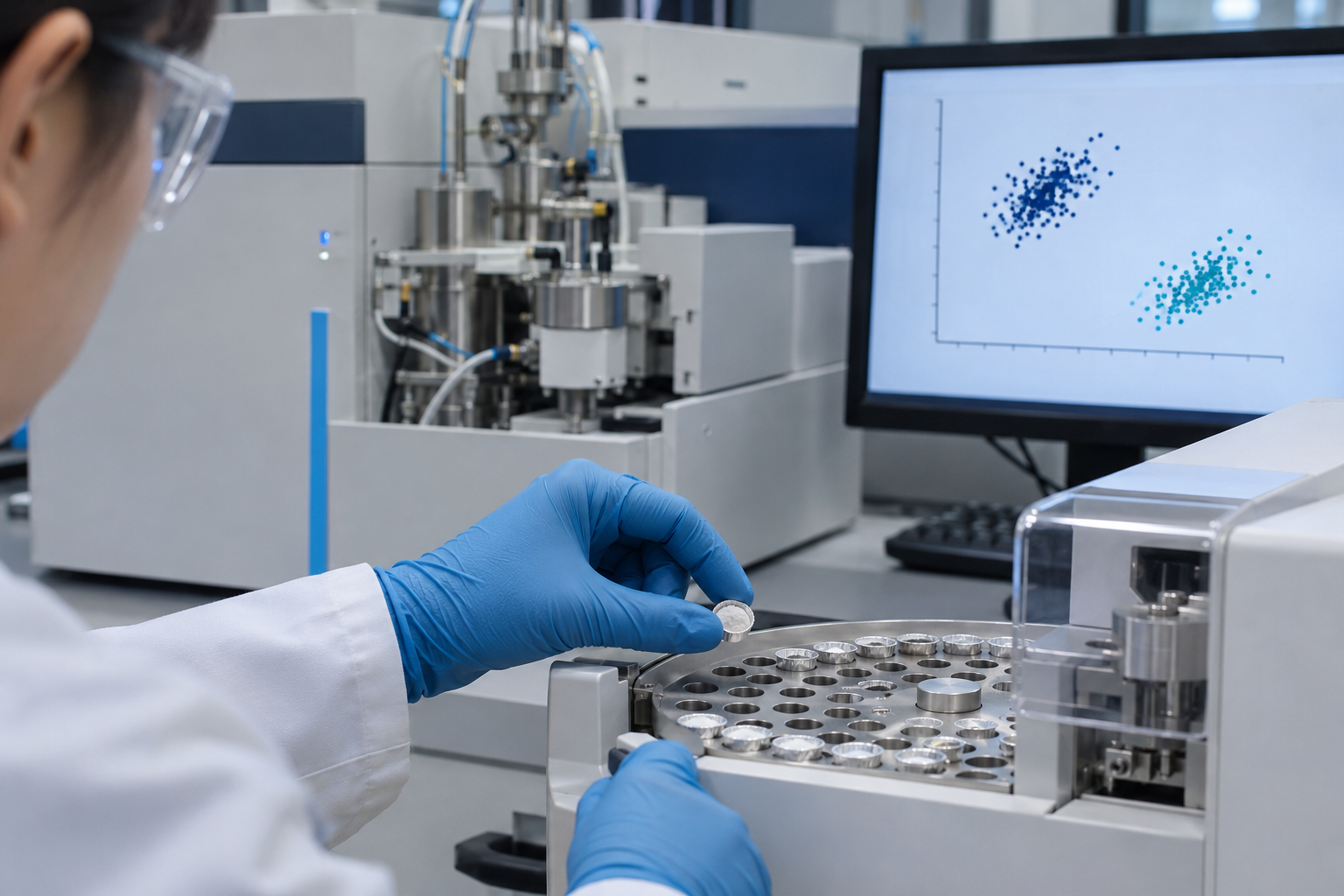
A 2021 exploratory study analysed L-theanine-enriched extracts from 30 tea samples, 10 synthetic samples and 28 commercial L-theanine products.
The tea-derived samples had an average carbon-isotope value of −24.4 ± 1.3‰, while the tested synthetic samples averaged −14.3 ± 1.5‰. The researchers associated the difference with C3 photosynthesis in tea and the C4 plant substrates commonly used to produce fermentation feedstocks.[1]
The study proposed a preliminary δ¹³C authenticity threshold of −21.7‰ for the materials it examined. It also found differences in nitrogen-isotope results, although the authors noted that cultivation, fertilisation and geography can influence δ¹⁵N.
This makes isotope-ratio mass spectrometry a useful supporting tool—but not an automatic global pass/fail test.
A synthetic process using different carbon feedstocks could produce another isotope profile. Tea origin, harvest region, processing and reference population can also affect interpretation. Results should therefore be assessed against an appropriate authentic reference database and the documented production route.
Contaminant Testing Should Follow the Claimed Source
Tea extraction and synthetic or fermentation production do not necessarily create the same risk profile.
For a tea-derived grade, the qualification program may need risk-based controls for:
- pesticides relevant to the growing region and destination market;
- heavy metals and microbiology;
- residual extraction solvents, where used;
- ethylene oxide where relevant to processing or market requirements;
- PAH4 or mineral-oil hydrocarbons when justified by the process, packaging, market or customer specification.
A long “not detected” list is meaningful only when the methods, reporting limits and sampled batch are identified.
For fermentation or synthetic grades, buyers may instead need information about starting materials, production organisms, residual solvents, catalysts, processing aids or fermentation-related impurities.
The Regulatory Identity May Depend on the Process
Regulatory status should not be inferred from chemical equivalence alone.
In March 2026, an EU novel-food consultation concluded that a specific L-theanine produced by microbial fermentation using a non-genetically modified E. coli strain was novel food. The conclusion was tied to that production process and history of use; it does not automatically determine the status of every tea-extracted, chemically synthesized or fermented L-theanine.
The FDA GRAS inventory likewise contains separate notices covering L-theanine generally, tea-leaf-extracted L-theanine and chemically synthesized L-theanine. GRAS notices are notifier-, process- and use-specific reference points—not universal approval for every commercial ingredient.
Brands should confirm the proposed grade, use level and production route for each destination market.
What Should Buyers Request?
Before approving a “green-tea-derived” claim, request:
-
The batch COA and approved specification.
-
A process flow showing extraction from Camellia sinensis.
-
Traceability from botanical raw material to purified batch.
-
A signed origin and non-synthetic declaration.
-
Risk-based contaminant results with methods and reporting limits.
-
Stable-isotope data where origin verification is commercially important.
-
A representative sample for independent confirmation.
-
Written change-notification requirements
No single document replaces the complete evidence chain.
Verifying an L-Theanine Grade With SRS
SRS Nutrition Express can help assemble available specifications, batch documentation, origin information, testing data and representative samples for L-theanine qualification.
Share your intended market, formulation, target dose, source claim and required tests. SRS can then evaluate whether the proposed documentation supports the commercial brief and coordinate additional batch testing where available.
Evidence Boundaries
- A high L-theanine assay does not prove tea origin.
- Stable-isotope testing supports authentication but should not be interpreted without suitable reference materials.
- The 2021 isotope study was exploratory and did not establish a universal legal threshold.
- Contaminant requirements depend on process, market and risk assessment.
- Regulatory conclusions for one production process do not automatically apply to every L-theanine grade.
Recommended Reading
References
- Perini M, et al. Characterization of L-theanine in tea extracts and synthetic products using stable isotope ratio analysis. Food Chemistry: Molecular Sciences. 2021;29(2):311–318. DOI: 10.38212/2224-6614.3349
- European Commission. Consultation to determine the novel-food status of L-theanine produced by microbial fermentation. Published March 2026.
- U.S. Food and Drug Administration. GRAS Notice Inventory: L-Theanine notices, including GRN 209, GRN 338 and GRN 501.
Post time: Nov-04-2026


